


UN Says Bridgetown Summit on Artificial Intelligence Provides Opportunity For Multilateral AI Risk Management
BRIDGETOWN, Barbados – The United Nations Under-Secretary-General and Special Envoy for Digital and Emerging Technologies, Amandeep Singh Gill, Friday said the Bridgetown Special Summit on Artificial Intelligence (AI) Safety to be held in Barbados on Monday next week will provide an opportunity for discussion on the UN Secretary-General’s suggestion for a multilateral AI risk management framework, which is backed by independent and credible oversight.
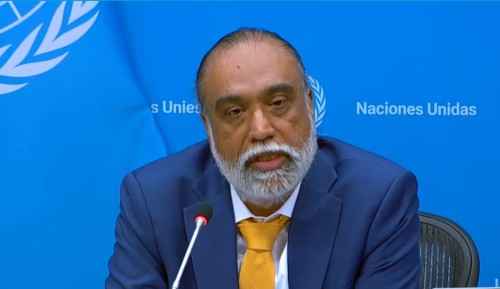 The United Nations Under-Secretary-General and Special Envoy for Digital and Emerging Technologies, Amandeep Singh Gill, briefing reporters on the Bridgetown Summit on AI to be held on Monday next week (CMC Photo)UN Secretary General Antonio Guterres will travel to Barbados where he will be joined by the country’s Prime Minister Mia Mottley for the Summit that will feature discussions on international cooperation for AI safety and governance.
The Secretary-General’s visit to Barbados coincides with the country’s 60th anniversary of Independence and of joining the United Nations. On this occasion, the Secretary-General is expected to participate in the signing of a new lease for UN House in Barbados.
He will also witness the signing of the new Multi-Country Sustainable Development Cooperation Framework for the Caribbean (2027–2031).
Monday’s hybrid event will bring together stakeholders from governments, tech, science, civil society, and the UN under the core themes that focus on global AI safety cooperation, risk management, equitable access, capacity building, and cultural/linguistic representation.
The UN said that the summit serves as a collaborative platform without establishing binding global rules, enforcing a single governance framework, superseding national policies, or dictating the scientific agenda of the Independent International Scientific Panel on AI.
Speaking at the daily UN media briefing, Gill told reporters that at the high-level week of the UN General Assembly at least 135 leaders made reference to AI, so up from just only three in 2017, adding “this was a subject that was on top of mind for everyone.
“There was a debate in the Security Council on this issue of AI safety and AI security, and we’ve had in the past six months several incidents which has kept this issue in the headlines,” Gill said, recalling that “there was at the start of the high-level week the launch of a call by Norway and Finland for the control of frontier AI models”.
He said it is now signed by 32 states and the European Commission, and two weeks ago, President Emmanuel Macron of France hosted a hybrid summit, and there was a call that was issued, and endorsed by 17 states and 10 AI developers.
Gill said that the United Kingdom, which is going to be hosting the G20 in 2027, has said that it will prioritise shared global principles and standards on AI during its G20 presidency.
“So there is a momentum, and Monday’s summit capitalises on that momentum. Very specifically, it will open up discussion on the Secretary-General’s suggestion made during his UNGA high-level speech for a multilateral AI risk management framework, which is backed by independent and credible oversight.
“So a number of leaders from governments, from private sector, from civil society, safety experts, would gather in Bridgetown on Monday to discuss how we can come to common understandings on AI safety, on trusted deployments, and how we can build AI safety infrastructure around the world,” Gill told reporters.
He said that the second part, which is the need to have solid, credible AI safety infrastructure around the world, is often underappreciated.
“There is discussion on the AI divide. Some countries do not have the compute infrastructure, the talent, the resources, financial resources to develop AI, but they also don’t have the capacity to test and evaluate models that have been developed elsewhere and get themselves ready for the kind of incidents that we are now seeing, say, cybersecurity-related incidents.
“So Barbados would also put an accent on this issue, building a minimum national capacity on AI safety assessments around the world,” Gill said, adding that at the end of the five-hour-long discussion spread out over two roundtables, there will be an opportunity for a press interaction with the Secretary-General and with Prime Minister Motley.
Gill said that the Barbados Summit will be attended y at least 150 participants who have already confirmed for “what is a hybrid meeting” and that both Norway and Finland would be represented by senior cabinet ministers in person, whereas President Macron will come in virtually.
“And we expect some leaders from industry, so at the level of CEOs, at the level of founders, to be there virtually as well. So it’s a multi-stakeholder summit from governments, from private sector, with heads of AI safety institutes and senior experts participating.”
He said a very interesting set of participants will come from the Independent International Scientific Panel on AI, which in the two days that follow the Bridgetown Summit would have its meeting, second in-person meeting in Bridgetown.
“So this panel, co-chaired by Yoshua Bengio and Maria Ressa, has, as you know, launched in September a brief on AI safety. So their presence would lend scientific heft to this particular gathering,” Gill said, adding that the United States would be represented by a senior diplomat.
He said he would not seek to “spoil the anticipation” in disclosing whether Chinese government would be represented in person, adding “yes, we do expect Chinese experts, including from the private sector, to be present in the meeting”.
Asked whether the summit would be discussing application of AI in military combat, or in the outer space as well, the senior UN official replied “this discussion is limited to the non-military domain, so AI safety, AI security in the sense of cybersecurity breaches, misuse by non-state actors for disruption terrorist acts.
“So there is a kind of separation there. The military domain is not going to be addressed. I should point out that in addition to the safety focus, there will be a focus on inclusion and access.
“Barbados is a small island developing state, and many, many developing countries are concerned about being left out of the benefits of AI, which are considerable, whether it is for disaster resilience, agriculture, health, or education,” Gill said adding “so one of the roundtables will focus on this theme of AI for humanity, access, inclusion, linguistic diversity, capacity building”.
Gill also responded to questions pertaining to the readiness of the UN to be involved in the regulatory framework of AI give that the global body “is a very deliberate body that often works on consensus with 193 bosses”.
“ I think this is why this meeting is important. I mean, it’s a timely initiative to build on the momentum that we’ve seen in the past few weeks, and with a look ahead to what is coming up in 2027, so that member states have opportunities to take action.
“For instance, we have the second global dialogue on AI governance on 3rd and 4th May here in New York. The co-chairs of that dialogue, the Republic of Korea and St Kitts and Nevis, held their first informal consultation yesterday ahead of the dialogue.
“So, that process is there. I mentioned the G20.There is also a summit on AI that Switzerland would host in June in Geneva. So, there are these processes, different multilateral processes, some mini-laterals, some universal, like at the United Nations, where the member states and other stakeholders have an opportunity to bring a focus on to practical actions that are needed.
“I think a fundamental point to be appreciated across these different calls, Norway, Finland, the Paris call, is that international action need not wait for national regulatory action. In fact, some action at the international level can act as a foundation for interoperable national safety measures.
So, if you look at the call for pre-deployment testing, for instance, of these powerful models, or sharing of information on incidents or near misses, transparency, reporting to each other, and then this aspect of building AI safety capacity around the world.”
Gill told reporters he believes that “those aspects are now resonating strongly.
“They are common across many of these calls, and I think they are already pointing us in the direction of multilateral action,” he added.

