


SANTO DOMINGO, Dominican Republic – St. Lucia has called for greater collaboration between Latin America and the Caribbean (LAC) in order to reduce poverty, create jobs and attract investments amidst a changing global and hostile environment.
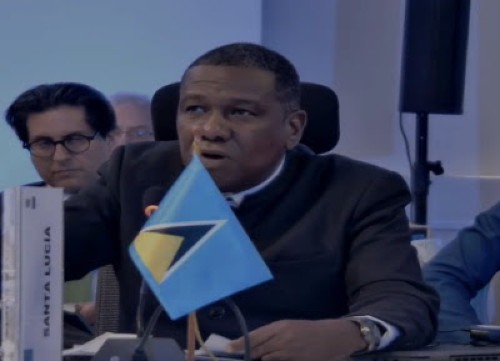 External Affairs and International Trade Minister, Alva Baptiste told the 41st session of the Economic Commission for Latin America and the Caribbean (ECLAC) (CMC Photo)External Affairs and International Trade Minister, Alva Baptiste told the 41st session of the Economic Commission for Latin America and the Caribbean (ECLAC) that “unless we come together and organise ourselves into that integrated whole, we are not going to achieve the type of benefits that we can derive from everything that has been given to us”.
He told the biennial meeting that ends later on Friday that in moments of crisis everyone wants to do the best and once the crisis is over, there is no zeal to go forward.
“Let us not behave like that in moments of crisis. Say we are going to do something about it, we are going to build resilience, we are going to get together. Let us …decide on the way forward, because one year of growth is not what we need.
“We need sustained growth so that we are able to reduce poverty, to create the jobs, to attract the investments, etc,” Baptiste told the conference recalling that in the post-Cold War period, “we found ourselves in a scenario, a very morbid scenario, that there was reduction in official development assistance”.
He said that this assistance that was vital in terms of expanding the social infrastructure of countries and as “if that was not enough, with the formation of the World Trade Organisation, we lost the preferential treatment we got on the United Kingdom market to export bananas”.
Baptiste said that the Windward Islands – Dominica, Grenada, St. Vincent and the Grenadines and St. Lucia – did not export one per cent of bananas to the UK.
“However, that banana cultivation on the island was responsible for the extensive socio-economic development of the country. So we lost the official development assistance and we lost the preferential access.
“Which means to provide the same level of service to our people, we had to do one of two things. Borrow or avoid the expenditure. You cannot avoid the expenditure because that would make the social situation even worse. And when you borrow, it increases your debt to GDP (gross domestic product) ratio and the outer limits you cannot go.”
Baptiste said that the World Bank and the International Monetary Fund (IMF) said to St. Lucia the island needed to invest in financial services.
“We embrace financial services, but we were blacklisted left, right and centre and therefore that fell through the cracks. Unlike most countries, we embrace tourism as an engine for economic growth.”
But Baptiste said St. Lucia knew the inherent vulnerabilities with tourism and saw it during COVID-19 pandemic “when the world virtually lost its appetite for tourism and travel.
“St. Lucia’s economy contracted during the year 2020 by 25 per cent, one of the highest contractions in the world and as we were living the whole situation, what happened to us, we found a Ukraine-Russia war that brought up interest rates and disrupted the supply chains.”
Baptiste said as a result “we are back to a period that time forgot” and as if that was not bad enough, the Caribbean region is confronted with a climate crisis.
“Normally I come to meetings like this and you’re here, you know, climate change is very stressful and it impacts all of us. But let us understand it in the context of a small island.
“For a big continental country, a hurricane or some disaster may come and affect a certain part of that country, but the economy continues to function. But in a small island like ours, when it hits, the entire economy is being affected.”
Baptiste recalled the statement made by Jamaica that the damage caused by Hurricane Melissa last October was in the vicinity of US$12 billion.
“But you know what the pledge was? The total pledge by countries, less than US$900 million. So you see the mismatch in terms of commitment to address it. So economies like ours always find ourselves taking care of yesterday’s investment and development instead of trying to build a particular fiscal framework that will help us to move forward.
“When a bridge destroyed by a hurricane is rebuilt, we are rebuilding yesterday’s investment. We are not expanding capacity in our country,” he said, noting that St. Lucia and some other Caribbean countries attempted to put in place a a Citizenship by Investment Programmes (CBI) offering foreign investors citizenship in return for making a substantial investment in the socio-economic development of these islands.
“But you know what? We are receiving pushback despite the best due diligence that we put in place so that we can raise monies to finance education in our country, to finance healthcare, to try to expand the housing stock for our people.”
He said St. Lucia has an economy with a GDP of less than three billion US dollars, a population of approximately 185,000 people “and we have to survive in a very hostile external environment.
“… we have to go to the market and borrow like everybody else. So we are considered to be upper income middle countries, and therefore we don’t qualify for concessionary financing. So in terms of the climate crisis that we did not contribute to mainly, we are on the front lines of trying to deal with it and building resilience so that we can continue to move forward.”
He said that countries like St. Lucia are asked to borrow to repair the damage of the climate crisis at their expense, recalling places in his homeland where he grew up now being overtaken by rising sea levels.
“… and who pays for it? We need to find the resources to actually pay for it. So when we go to COP (Conference of the Parties) and there are pledges, and you see that those determinations or the discussions take place in a very nice and cordial environment, and of course pledges are made, but those pledges are made outside the sphere of commitment.
“So the cross-fertilisation of ideas actually take place in the fallopian tube of pledges, which of course evades the womb of commitment. And so what happens? There’s a miscarriage of climate justice. So the world continues, we come to very important meetings like this one…but how do we translate the recommendations into practical action is the real challenge.”
Baptiste said he believes that the time has come for the people of Latin America and the Caribbean to determine what the national agenda for development is “and any political party that comes into office must be obedient to those development priorities.
“So we are going to measure the performance of government by its long-term policies to tackle the real problems that tantalise us in this region, or else changes of government will not produce better results if we do not have a coherent approach to development,” he said, adding that free and fair election is just a mere symptom of democracy.
“True and real democracy is to test positive for the wise and frugal use of power, or conversely, to test negative for the misuse and abuse of that mandate given to you via free and fair election,” he added.

