


NEW YORK, New York – Guyana and Trinidad and Tobago have agreed to impose a range of sanctions on the notorious Haitian gang, Viv Ansamn, and 23 other similar narco-terrorist groups operating in several countries of the Americas.
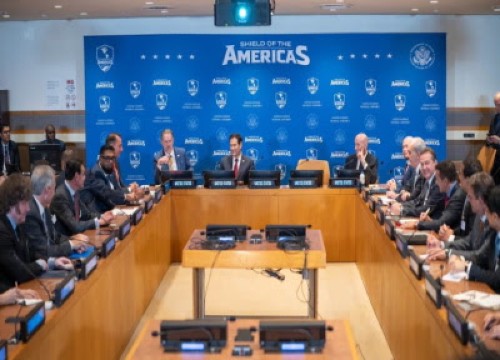 The two Caribbean Community (CARICOM) countries are members of the United States- led Shield of the Americas and announced their position following a meeting President Donald Trump on the sidelines of the ongoing United Nations General Assembly (UNGA) in New York.
“We declare our intention to impose, as applicable and in accordance with our respective international and domestic legal obligations, asset freezes; immigration and visa restrictions for members, associates, and supporters of the organizations; and criminal liability for individuals knowingly providing material support, including logistical support, to the organizations, among other measures,” the participating states said in a “Joint Statement on Defending Hemispheric Sovereignty” .
The Haitian criminal group Viv Ansamn is a coalition of gangs, led by former police officer Jimmy “Barbecue” Chérizier, and has been blamed for the widespread political instability in the French-speaking CARICOM country, ahead of the first presidential and legislative elections on December 13 this year.
The Shield of Americas member countries have also announced a collective action to confront the scourge of narco-terrorism targeting the Venezuelan gangs- Tren de Aragua and Cartel de Los Soles.
Guyana has in the past expressed concern that Tren de Aragua members had been crossing from Venezuela into Guyana’s Essequibo Region.
Trinidad and Tobago Prime Minister Kamla Persad-Bissessar in an address to the UNGA on Tuesday evening said transnational organised crime continues to pose a serious threat to the security and development of small island states.
“Small states face serious challenges from sophisticated criminal networks that move people, that move weapons, that move narcotics, and illicit finance across national borders.
“For Trinidad and Tobago, this is not an abstract threat. These networks directly endanger our citizens, they endanger our institutions, and they endanger our development,” she added.
Brazil’s largest criminal organisation, Primeiro Comando da Capital (PCC), regarded as that Brazil’s largest criminal organization, and the decades-old major drug group, Comando Vermelho (CV), are also on the list of 24 blacklisted groups.
In their statement, the Shield of the Americas members said they intend to defend their economies by enhancing economic cooperation; exploring investment screening mechanisms; safeguarding critical minerals supply chains through diversified and reliable sourcing; and promoting trusted supplier regulations for digital infrastructure, applied on a non-discriminatory basis.
“We recognize that durable security requires economic development, stable jobs, and tangible opportunities for the people, and that economic sovereignty is successfully defended when capital entering our nations is transparent and verifiable.”
They said they will also defend democratic governance against armed narco-terrorist networks including coordinating on sanctions, designations, and financial actions against terrorists and criminals; expansion of civilian law enforcement; and supplying humanitarian and messaging assistance to defend popular will.
In addition they said they will “defend and promote mutual respect for national sovereignty and each nation’s self-determination through multilateral fora to coordinate and advance shared objectives and proposals, such as catalyzing international enforcement actions against transnational organized criminal groups or pursuing needed reforms to multilateral organizations.
“In furtherance of these three pillars, participating states intend to strengthen cooperation through enhanced intelligence sharing; facilitate access, where appropriate, to security technologies and capabilities; promote training and professional development of human resources; and expand the exchange of best practices.
“Participating states also intend to deepen cooperation on investment and economic matters and to strengthen consultation on and coordination of common positions on issues of shared interest in regional and multilateral for a,” according to the joint statement.
They said to facilitate these aims, they intend to co-sign a formal request to the President of the Organization of American States (OAS) Permanent Council requesting a meeting of consultation to decide on the establishment of an Organ of Consultation under Articles 6 and 13 of the Inter-American Treaty on Reciprocal Assistance (Rio Treaty).
“Once the formal meeting of the Organ of Consultation is convoked, we intend to participate at the ministerial level to consider adopting a resolution promoting and facilitating collective action against narco-terrorist organizations under the Rio Treaty.
“States that participate in the Shield that are not currently parties to the Rio Treaty declare their support for this initiative and express their determination to contribute to it in accordance with and to the extent possible under their respective international and domestic legal obligations, including by participating in the Organ of Consultation to the extent permitted under its Rules of Procedure.”

