


BRIDGETOWN, Barbados – The Caribbean Development Bank (CDB), UN Women Caribbean and The University of the West Indies (UWI) Cave Hill Campus have joined forces to confront what they describe as one of the Caribbean’s most urgent challenges: the increasing prevalence of violence, including youth violence.
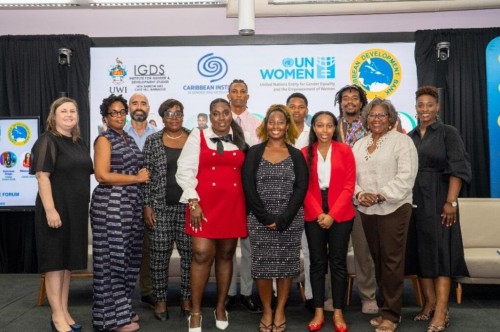 Maria Ziegler, Senior Gender Specialist, Caribbean Development Bank (left), Dr. Tonya Haynes, Head and Lecturer, Institute for Gender and Development Studies: Nita Barrow Unit, The University of the West Indies – Cave Hill (second from left) and Ms. Sharon Carter-Burke, Communications and Advocacy Analyst, UN Women Multi-Country Office – Caribbean (second from right) join youth advocates at Caribbean Futures High-Level Anti-Violence Forum. (Photo credit: University of the West Indies, Cave Hill)The organisations recently convened the Caribbean Futures High-Level Anti-Violence Forum, held during the 16th cycle of the Caribbean Institute in Gender and Development (CIGAD), bringing together youth leaders, policymakers, researchers and community practitioners from across the region.
CDB Senior Gender Specialist Dr Maria Ziegler said violence prevention requires changing the attitudes, beliefs and behaviours that normalise violence in homes, schools, communities and relationships.
“Violence prevention transforms the attitudes, beliefs, and behaviours that normalise violence in homes, schools, communities, and relationships. It promotes positive masculinities, empowers girls and young women, and engages boys and men as allies in creating safer, more equitable societies for everyone,” she said.
According to the organisers, the forum provided an intergenerational platform where youth advocates joined senior policymakers, criminologists and gender specialists to examine how gang violence, gender-based violence and climate-related displacement compound one another and to co-design solutions grounded in Caribbean realities.
UN Women Multi-Country Office – Caribbean Communications and Advocacy Analyst Sharon Carter-Burke said the organisation is working with partners to challenge gender norms that negatively affect both women and men.
“UN Women not only promotes the rights, empowerment, and safety of all women and girls, but we are working with partners to disrupt the gender norms that also harm men and boys,” she said.
She said the organisation’s Foundations Violence Prevention Programme is a participatory, youth-centred curriculum designed to transform the cultural and social norms, values, attitudes and beliefs that perpetuate gender-based discrimination, gender inequality and gender-based violence.
The forum also marked the completion of the in-person training phase for the 16th CIGAD cohort and featured activities including a theatre presentation on harmful masculinities and a youth roundtable with decision-makers, demonstrating how dialogue, evidence and shared ownership can strengthen violence prevention across generations.
Organisers said participants concluded that violence prevention requires contributions from all sectors of society and that gender justice and youth empowerment are complementary priorities.
They added that the partnerships forged during the forum are expected to continue supporting regional collaboration on violence prevention after participants return to their respective countries.
CIGAD is supported through financing from the CDB and UN Women to strengthen gender-responsive development across the Caribbean. The organisers said the investment aligns with the CDB’s 10-year Strategic Plan, which seeks to ensure gender equality is woven into decision-making across the public, private and civil society sectors in its borrowing member countries.

