


UNITED NATIONS - The Caribbean Community (CARICOM) Monday called on the United Nations Security Council to extend the mandate of the Gang Suppression Force (GSF) in Haiti as the country moves towards holding long overdue elections.
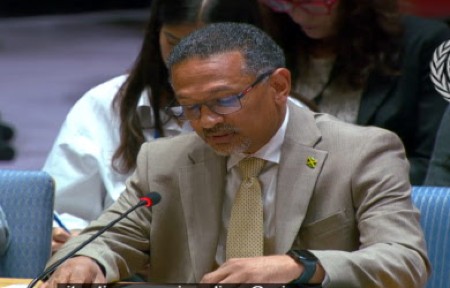 Jamaican diplomat reading out the CARICOM statement at the United Nations Security Council on Monday (CMC Photo)In a statement to the United Nations Security Council on one of its regular meetings about Haiti, the regional integration grouping of which Haiti is a member, said considering that the GSF has yet to be fully deployed, while its mandate is expected to expire at the end of September 2026, “CARICOM continues to strongly advocate for the renewal of this mandate.
“Renewing the mandate remains a critical safeguard against a further deterioration of the security situation, as well as the risk of widespread instability and anarchy,” CARICOM said in its statement.
The GSF is a 5,550-strong, UN-backed multinational security mission authorised under UN Security Council Resolution 2793 to neutralise armed groups controlling parts of Port-au-Prince. It operates in coordination with the Haitian National Police to secure critical infrastructure and protect civilians.
It was formed to replace the underfunded, smaller Kenyan-led Multinational Security Support (MSS) mission. It is empowered not only to support local police but to conduct intelligence-led arrest operations.
In its statement, CARICOM read by a Jamaican diplomat, CARICOM said it very much welcomes the hopeful indications of progress in Haiti and “ we remain deeply concerned by the multidimensional security crisis in Haiti.
“We reaffirm our unwavering solidarity with the Haitian people, our respect for Haiti’s sovereignty and our commitment to supporting a Haitian-led solution to the challenges the country faces.”
CARICOM said that while it recognise that some incremental improvements have been made, the overall situation remains dire.
“CARICOM commends the efforts undertaken by the government of the Republic of Haiti, with the support of important bilateral, regional and multilateral partners, including CARICOM, the UN and the Organization of American States (OS) to lay the foundations for free, fair and peaceful elections.
“However, given the expiration of the Transitional Presidential Council’s mandate in February this year, without elections having been held, CARICOM reiterates the importance of achieving this critical objective through Haitian-led democratic processes.”
CARICOM said that acknowledging that the elections originally planned for August 2026 can no longer be achieved, and that voter registration, initially scheduled to begin in April, only commenced in July, the Haitian Electoral Council and the government of Haiti are currently engaged in discussions to agree on a revised electoral timetable in light of the prevailing security situation.
“Despite these challenges, CARICOM considers that the holding of elections remains a priority, underscoring our continued commitment to Haiti’s long-term stability, democratic governance and constitutional order.”
CARICOM told the UN Security Council that Haiti featured prominently on the agenda of the recent CARICOM summit held in St. Lucia from 5-8 July this year. It said discussions included consideration of establishing a permanent CARICOM presence in Port-au-Prince
“It was also reaffirmed that the CARICOM Eminent Persons Group will continue to support the Haitian government in its engagement with national stakeholders and international partners.”
CARICOM said the regional leaders further committed to providing humanitarian support in response to the continuing needs of the Haitian people and the modest improvements observed on the ground.
It said of particular concern is the worsening humanitarian situation affecting Haiti’s most vulnerable populations, especially women, girls and youth.
CARICOM noted that sexual and gender-based violence has increased significantly amid escalating gang activity, placing women and girls at heightened risk.
“Gang violence has also had severe consequences for Haiti’s youth, contributing to rising unemployment and increasing the recruitment of children and young people into criminal gangs. At the same time, widespread food insecurity and Haiti’s deteriorating economic conditions have further intensified the humanitarian crisis.
“CARICOM encourages sustained international cooperation and support in addressing the ongoing crisis in Haiti and calls for accelerated stabilisation efforts, including increased humanitarian financing.
“We urge the financial community to deepen its engagement with the government of Haiti and other key stakeholders in pursuit of a stable, secure and democratic future for the Haitian people. Haiti deserves a future of peace, prosperity and democratic governance, a future deserving of every citizen in every country,” CARICOM added.

