


KINGSTON, Jamaica - The 20th edition of the Caribbean Week of Agriculture (CWA) has gotten underway here with Jamaica’s Prime Minister Andrew Holness urging the region to ensure that agriculture becomes increasingly export oriented and able to compete globally.
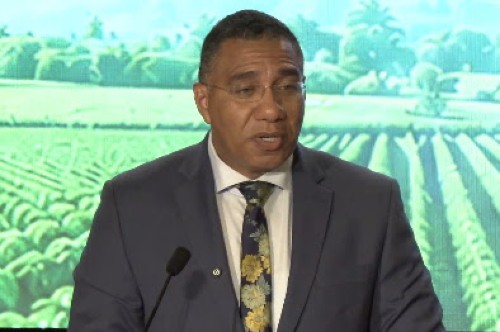 Jamaica’ Prime Minister Andrew Holness addressing the opening of Caribbean Week of Agriculture (CMC Photo)Holness told the opening ceremony that in time, agricultural modernisation must embrace digital technologies, precision farming, improved crop varieties, and more efficient production systems.
“These innovations must become accessible to small and medium-sized farmers, who constitute an important part of the Caribbean’s agricultural economy. Technology should not be viewed as something reserved for large commercial operations.”
Holness said that there is also the need to develop financing arrangements, shared services, and extension programmes that allow small producers to benefit from advances in agricultural science.
The CWA is being held under the theme “The New F.A.C.E of Caribbean Food Systems” with the organisers indicating that it highlights four key areas, namely Food Security, Agri-Business, Climate-Smart Technologies and Export Expansion.
The week long event has brought together more than 600 delegates representing agriculture and fisheries ministers, farmers, fisherfolk, policymakers, researchers, private-sector representatives, development partners and youth from across the Caribbean to advance discussions on the future of regional food systems.
Holness told the opening ceremony that technology is accessible and “we must find ways to get it into the hands of our artisanal farmers for whom the technology may not be native.
“We must get our young people, for whom technology is native, to apply it to agriculture,” he said noting that equally important is the development of agriculture as a commercially attractive sector for young people.
“Our region possesses a generation of talented young people with education, technological skills, and entrepreneurial ambition to transform agriculture. We must create the conditions in which they can see farming, agri-processing, and agricultural technology as viable and rewarding careers.
“This means improving access to land, financing, modern equipment, technical training, and reliable markets. It also means creating opportunities throughout the agricultural value chain, including logistics, processing, packaging, marketing, and distribution.”
Holness said that the Caribbean must move beyond the traditional perception of agriculture as simply an occupation and recognise it as an industry with considerable potential for innovation, enterprise, and wealth creation.
He said another important priority is expanding private sector investment.
“Governments have a responsibility to provide enabling infrastructure, establish an effective regulatory environment, and support research and development. However, the sustained transformation of Caribbean agriculture will require significant investments from the private sector.
“We need commercially viable agricultural projects capable of attracting patient capital, supporting economies of scale, and establishing lasting relationships between producers, processors, distributors, and retailers.”
Holness using Jamaica as an example, told the delegates that the agriculture system in the Caribbean needs to establish long-term supply contracts for farmers.
“We tend to see agriculture as a short-term endeavour that is not bankable. If we’re going to have any radical change in our agriculture, the government must be an instrumental partner alongside the private sector in the establishment of a system of long-term supply contracts where farmers can invest with the security of knowing there is a market for their products.
“I’m therefore pleased that this year’s programme provides opportunities for direct engagement between investors and agricultural enterprises, including the presentation of investment opportunities by the Jamaica Agro-Investment Corporation.
“We must translate these opportunities into bankable projects and productive investments,” Holness said, adding that there is also considerable scope to improve the integration of agriculture into the region’s tourism economies.
“Throughout the Caribbean, tourism generates substantial demand for agricultural produce, seafood, and processed products. Strengthening these commercial linkages can create reliable markets for local producers while encouraging improvements in quality, consistency, and efficiency.
“However, our ambitions cannot end at supplying domestic markets. Caribbean agriculture must become increasingly export-orientated. Our farmers and agricultural enterprises should be able to compete on the basis of quality, reliability, innovation, and price.”
Holness said that this requires more efficient shipping and logistics, appropriate cold storage, infrastructure, internationally recognised standards, and better coordination throughout agricultural value chains.
“Regional integration must facilitate the process. The Caribbean should be a market in which competitive agricultural producers can expand their operations, achieve economies of scale, and reach consumers across national boundaries.
“We must address the transportation bottleneck, unnecessary administrative requirements, and non-tariff barriers that restrict agricultural commerce within our region,” Holness said, noting that greater regional agricultural trade should be driven by productivity, competitiveness, supported by infrastructure, and efficient markets.
“Of course, our agricultural ambitions must also recognise the realities of climate change,” he said, noting that the experience of Hurricane Melissa, which slammed into Jamaica in October last year leaving an estimated US$9.9 billion in damages, “reminds us that climate resilience is an economic necessity. Investments in irrigation, drainage, protected agriculture, improved infrastructure, and disaster risk management are essential to protecting productivity and reducing the long-term costs of extreme weather events”.
He said the reconstruction efforts present an opportunity to incorporate these considerations into the future development of Jamaica’s agricultural sector, praising the “extraordinary achievements of our farmers in Jamaica” who have secured the CARICOM Farmer of the Year title for five consecutive staging of this event, including 2026.
“This record demonstrates the considerable talent and entrepreneurial capacity within our agricultural communities. It is a reminder of what our region can accomplish when the ingenuity of our farmers is supported by appropriate investment, technology, and public policy.”
Holnwss said that the Caribbean poses substantial agricultural potential and that realising that potential requires a sustained commitment to improving productivity, encouraging enterprise, and creating the conditions for our producers to compete successfully.
“The value of this gathering will ultimately be measured by the investments mobilised, commercial partnerships established, and practical reforms implemented after our discussions are concluded.
“Let us leave Jamaica with renewed determination to build an agricultural sector that generates greater prosperity for our farmers, creates rewarding opportunities for our young people, and contributes more significantly to the economic growth of our region,” Holness said.
Earlier, Jamaica’s Agriculture Minister Floyd Green said that it was necessary for the Caribbean to strengthen its capacity to produce more “of our agricultural inputs here in the region, including things like organic fertiliser, because our food security cannot just be measured by how much food we produce, especially if that production remains heavily dependent on input source outside of the region.
“We must leave CWA 2026 with a regional framework around inputs. We must confront the long-standing challenge of transportation and trade across the region. We will not deliver regional food security if we cannot move agricultural goods efficiently and affordably across the countries that produce them in this region.”
Green said that shipping, logistics, sanitary requirements should now be aligned “and I hope at the end of the CWA, we will move forward to say we have a seamless movement of goods across the region”.
He said that the Caribbean must also adopt the adoption of climate smart technologies, noting that “across our region, solutions already exist.
“How to use water more efficiently, how to increase productivity, how to make better use of data, how to strengthen our ability to withstand climatic shocks. We must share best practises and ensure that they’re implemented at scale.
“We are clear that this cannot be done by one government alone. It requires all our governments. But more importantly, it requires all our farmers. It requires all our fisher folks, our private sector, financial institutions, researchers, development partners, working towards common objectives.”
Green said that the weeklong event will have over 80 technical sessions, five high-level plenary discussions, alongside ministerial meetings, business engagements, exhibition, trade shows, the participation of youth and women.
“We will use CWA 2026 to lead the new face of Caribbean food.,” he added.
The Caribbean Week of Agriculture (CWA) is organized under the auspices of the “Alliance ” for Sustainable Development of Agriculture and the Rural Milieu, alongside host governments and international partners. The Guyana-based Caribbean Community (CARICOM Secretariat hosts and coordinates the flagship regional platform.

