


UNITED NATIONS – The head of the United Nations Integrated Office in Haiti (BINUH), Carlos Ruiz Massieu, Monday called on all stakeholders in the country “to make an unswerving commitment to exhibit political responsibility and to work in a constructive spirit” so as to ensure the future stability and security of the country.
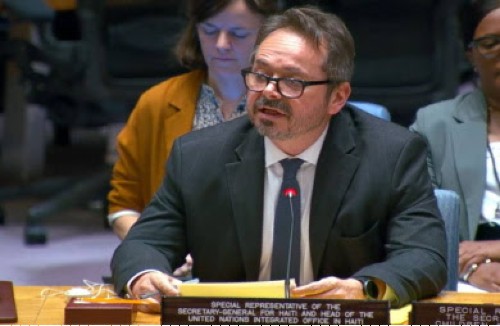 The head of the United Nations Integrated Office in Haiti (BINUH), Carlos Ruiz Massieu, addressing the UN Security Council on Monday (CMC Photo)Addressing the United Nations Security Council on one of its regular meetings about Haiti, Massieu said he was calling on the government as well as all stakeholders to work together “so as to safeguard the gains we have accomplished.
“I also encourage member states to provide the necessary resources so as to support national priorities and lock in security gains, as well as to help create conducive conditions to the holding of elections and the restoration of democratic governance.
“The United Nations remain resolutely committed to assisting Haiti’s efforts on this path. The Haitian people have been waiting for far too long. The Haitian people deserve for the progress that’s been accomplished to be transformed into concrete improvements to their daily lives, as well as into new prospects for the future.”
The UN Security Council is discussing how worsening violence is colliding with a humanitarian crisis, as well as plans to store security and Massieu, who is also the UN Secretary-General’s representative in Haiti, said Haiti continues to face persistent insecurity, acute humanitarian needs, and institutional challenges with devastating consequences for its population.
“Yet, recent developments demonstrate that there still remains an opportunity to move the political transition forward, begin reversing the threat posed by gangs, and restore democratic governance.
“The challenge now is to sustain that momentum and translate it into tangible improvements for the Haitian people,” Massieu said, adding that the transition stands at a critical moment.
He said the adoption of the revised electoral decree, and the consensus reached on an electoral budget earlier this month, are significant achievements that provide a basis for renewed momentum.
“The launch of voter registration today marks another important step forward. The next priority is clear, the adoption of a credible and realistic electoral calendar.”
Massieu said achieving this will require sustained cohesion among Haitian institutions, continued dialogue across the political spectrum, and a shared commitment to place the interests of the Haitian people above all else.
“I am convinced that Haitian stakeholders can work together to advance the transition, create the conditions for credible elections, and restore the functioning of their democratic institutions. ”
Massieu said that in his ongoing consultations with political parties, civil society, youth, and women’s organisations, one message has been consistent and that security is indispensable for credible elections.
“Yet, security challenges must not become a reason to delay the political process. Electoral preparations and security improvements must advance together to sustain them. In this context, the full deployment of the 5,500 Gang Suppression Force (GSF), in support of national authorities, remains critical to foster a security environment conducive to the electoral process.”
Massieu said that the United Nations is fully committed to accompanying these Haitian-led efforts, adding “they must now proceed with greater pace and coherence to ensure that institutional progress delivers tangible improvements for the Haitian people.
“Madame President, security remains Haiti’s most pressing challenge. Gang violence continues to exact a heavy toll on a beleaguered population. Millions of Haitians remain displaced or food insecure, while women and children continue to bear the brunt of the violence.”
He said recent attacks in Cité Soleil-Kenscouf, as well as in the Southeast and Archibonique departments, demonstrate the continued reach of gangs, and the imperative need to step up efforts to greater influence and strengthen the protection of populations.
“Against this backdrop, the launch of operations by the GSF represents an important milestone. Together with the continued strengthening of the Haitian National Police and the Armed Forces of Haiti, it marks a transition from planning to implementation.”
Massieu said that the progressive deployment and scaling up of the force, with the support of the United Nations Support Office in Haiti, and successful targeted anti-gang operations, will be critical to strengthening national efforts to address insecurity and restore public confidence.
He said ensuring that these efforts continue in the near future will be paramount, while at the same time, ensuring the full compliance of these operations with international human rights law and relevant international standards is also essential to sustaining legitimacy, strengthening public trust, and achieving lasting security gains.
He said he also wanted to comment the efforts of contributing member states, regional and international partners, in establishing the operational, legal, and logistical frameworks that have made this possible.
He said equally important is the close coordination now established among BINU, the GSF, Haitian institutions, and international partners.
“Success depends on security, political engagement, and humanitarian action reinforcing each other. Madam President, security operations alone will not produce lasting peace. Achieving it requires a broader strategy, one that reduces the appeal and the capacity of armed gangs while strengthening justice, state institutions, and providing opportunities for communities affected by violence, especially for women and children.
“Haiti’s children are at great risk. Alarmingly, as many as one in every two gang members today is a child. Children are being exploited, coerced into violence, and deprived of the opportunity to build a future. ”
Massieu sad that averting a lost generation must therefore be at the heart of Haiti’s stabilisation and recovery efforts, welcoming the sustained leadership of the National Commission on Disarmament, Dismantlement, and Reintegration to advance a Haitian-owned vision for reducing armed violence and creating viable alternatives to gang membership, particularly for children and young people at risk.
“This vision must now be translated into a comprehensive national programme supported by the international community,” he told the UN Security Council.

