


PORT OF SPAIN, Trinidad – The main opposition People’s National Movement (PNM) is threatening legal action if Prime Minister Kamla Persad-Bissessar is allowed to exercise a veto over who should be in charge when carrying out activities under the recently passed Special Operations Bill (SOB).
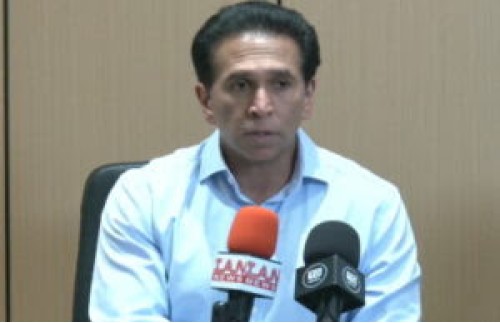 Former attorney general, Faris Al-Rawi speaking at news conference (CMC Photo)“We all saw the linguistic gymnastics of the Minister of Homeland Security (Roger Alexander) and the Commissioner of Police (Allister Guevarro) and then you saw the Honourable Prime Minister’s statements in relation to special operations,” former attorney general Faris Al- Rawi told a news conference.
“People have to be informed in due course as to impositions of curfew, cordon or other effects. I want to remind you that there is a suspension of warrants, a need for warrants and therefore with this law having been proclaimed special operations and with the secrecy, is it going to apply to all of Trinidad and Tobago?”
Attorney General John Jeremie, as he had done when the bill was first debated in the House of Representatives last month, said the constitutionality of the legislation is based on the balance that it strikes between the enhanced security powers granted to the services and the protection of fundamental rights and the rule of law.
Jeremie had told legislators that the legislation does not grant powers equivalent to a state of emergency (SoE) and that the Persad-Bissessar government accepts that the new legislation “might interfere with the right of the individual to liberty and to the enjoyment of property” under the Constitution, as well as the right of the individual to respect his private and family life and the freedom of movement.
“Our view is that any such infringement is reasonable and proportionate,” he added.
The new bill provides for the establishment of policing districts, the conduct of special operations to combat criminality in those policing districts including also for persons to be in possession of permits to enter or leave those districts
During the Senate proceedings last month, Independent legislator, Senior Counsel Anthony D. Vieira failed to secure support for an amendment preventing the Prime Minister from vetoing an appointment made by the Police Commissioner in deciding who should head a police operation.
He told legislators it is difficult to explain why the political executive should possess a veto over the Police Commissioner’s choice as to which officer should lead any operation into the districts.
But Jeremie contended that the Trinidad and Tobago Constitution provides that the Commissioner of Police shall act in accordance with the Police Service Act and the regulations made there under.
“I do not see why…I struggle to find a reason why the Prime Minister cannot exercise a veto. She’s not choosing, the Commissioner of Police has chosen, but essentially she’s exercising her veto,” Jeremie said.
Prime Minister Persad-Bissessar, who had been critical of both the PNM and independent legislators for not supporting the bill, has since said that the SOB will be implemented in areas controlled by the United National Congress (UNC) and its allied parties in the coalition government.
The prime minister referred to the independent legislators as “satanic,” “demons” and “scumbags.”
Persad-Bissessar said residents in PNM-represented constituencies would not be forced to accept the special operations and could continue to reject the assistance of law enforcement. She said violent criminal gangs and drug traffickers operating in government-controlled constituencies and electoral districts would be targeted through the special operations.
But Al-Rawi questioned her statement, asking “when and why is it going to happen?
“ I want to give notice right now that this law will be challenged in the courts. We are not talking about a challenge on an intrusion of your Section 4 and 5 rights alone,” Al-Rawi said in reference to the Bill of Rights, recognising fundamental human freedoms and shielding them from arbitrary state or legislative interference.
“We’re talking about the very unconstitutional provision that the Prime Minister shall have the power of veto over who the policeman in charge of a special zone will be and who the member of the Defence Force will be.
“That is fundamentally unconstitutional and I’m giving notice now the minute the first attempt at treating with citizens comes about under the hands of a commander appointed by the prime minister and under the hands of a member of the Defence Force appointed by the prime minister expect the legal action.”
Asked by reporters whether he had any trust in the Police Commissioner or the Police Service being truthful in indicating who really appointed the head of the SOB team, Al-Rawi responded by explaining “why we will take the action.
“This isn’t just to be difficult. Let me make it clear, the People’s National Movement supports the fight against crime and criminality. I certainly presented nearly 24 pages of amendments to the Zones of Special Operations Law. The party presented many other amendments as well and the Independent Bench presented many amendments as well.
“We proposed what we believed was constitutional,” Al-Rawi said, adding that the “courts need to guide the country and the population and the parliament on whether it is appropriate to have a political person have a hand in policing and have a hand in the Defence Force
“And that is the overriding safeguard that we must champion under the rule of law principles.”
Al-Rawi said that there are some aspects of the Special Operations Law that the PNM is concerned about.
“… for instance, originally the Defence Force had police powers. We made the amendment that that be removed. It’s not in that law but you see this unholy, unconstitutional association of a politician having the power to say yes or no to a policeman who carries police powers. That cannot be tolerated in our democracy. That’s the overriding reason why we will take action.
“That’s what our courts are there for and what we want is the sanctity of the court’s view so that the court will have a pronouncement on it. It will no doubt go all the way to the Privy Council and this obviously will be a test that will be paid attention to in the Commonwealth,” Al-Rawi added.
President Christine Kangaloo has officially proclaimed the Special Operations Act 2026, bringing the controversial crime-fighting legislation into effect on October 6, 2026

