


KINGSTON, Jamaica – Jamaica’s Prime Minister Andrew Holness says while technology is transforming how parliaments operate, it must never replace human judgement or compromise the dignity at the core of democracy.
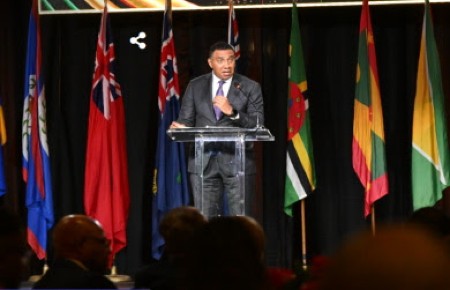 Prime Minister Andrew Holness addressing the 48th Regional Conference of the Commonwealth Parliamentary Association (CPA) Caribbean, Americas and Atlantic (CAA) Region.Addressing the 48th Regional Conference of the Commonwealth Parliamentary Association (CPA) Caribbean, Americas and Atlantic (CAA) Region in St Ann north west of here, Holness said parliamentarians across the Caribbean and the wider Commonwealth are operating in a digital age in which citizens expect instant access to information and real-time responses from their leaders.
But he said that even as parliaments modernise, they must remain grounded in the principles of representation, deliberation and public trust, stressing that “technology must remain the servant of democracy, not its master”.
Prime Minister Holness said parliament is the institution through which democracy finds expression, serving as the forum where competing ideas are debated, governments are held accountable, laws are enacted, and public resources are authorised on behalf of citizens.
He said as such, strong parliaments are the foundation of modern democracy and that this strength must not be sacrificed in the rush to digitise.
Holness, in illustrating how rapidly the landscape has evolved, said that commercial mobile phones were once so large they had to be carried in a suitcase, and parliamentary rules strictly limited their use within legislative chambers.
However, he noted that currently, legislatures such as the United Kingdom’s House of Commons have amended their Standing Orders to permit the use of mobile phones, while discussions are taking place around the world on live-streaming proceedings from parliamentary chambers and committee meetings
Prime Minister Holness acknowledged that Caribbean parliaments in Barbados, St. Lucia, Antigua and Barbuda, and other jurisdictions are facing similar pressures, as they are increasingly being called upon to integrate emerging technologies and digital platforms into their operations.
“The challenge before us is larger than simply digitising parliament. The challenge before us is how do we incorporate technology as a kind of renewal of the parliamentary process but, at the same time, preserve representative democracy,” Holness said.
He told delegates that technology can make parliamentary proceedings more accessible to citizens, enhance communication with constituents and strengthen legislative research and committee work.
While noting that artificial intelligence can significantly accelerate information gathering and document drafting, Prime Minister Holness emphasised that there must be a clear line between using such tools and outsourcing democracy to them.
“Efficiency is valuable, and I am the greatest proponent of efficiency. (However, democracy) must preserve the dignity of the people,” Holness said, cautioning Caribbean leaders that the rapid growth of artificial intelligence, social media and other digital technologies is creating new threats to democracy, particularly through the spread of misinformation, disinformation and manipulated content.
Holness said the region must strengthen its democratic institutions even as it embraces technology.
“Every day, in our Caribbean societies, our democracy is being threatened by false information, deliberate campaigns that assassinate character,” he said, citing a false report that was recently circulated online claiming that a government minister had died.
Prime Minister Holness said that such incidents underscore the real-world consequences of digital falsehoods, warning that advances in artificial intelligence are making it increasingly difficult for people to distinguish fact from fiction.
He warned of the growing challenge posed by emerging technologies, noting that “we are entering an era where seeing is no longer believing”.
The Prime Minister urged the CPA to consider how parliaments across the region should respond to these challenges, noting that Caribbean countries must confront the growing risks associated with unregulated information, including radicalisation, hate speech and deliberate disinformation.
Holness said that countries in Europe and North America have already begun developing legislation to address harmful digital content and called for greater attention to cybersecurity, emphasising that the protection of parliamentary systems, records, communications and data must be regarded as a critical component of the region’s democratic resilience rather than merely an information technology concern.
Holness said that successful digital transformation will ultimately depend on people not technology alone and called for sustained investment in parliamentarians, researchers, clerks and administrative staff.
“Digital transformation ultimately depends, not on the sophistication of the hardware and software but on the capability of the people and the institutions,” Prime Minister Holness said, urging leaders to prepare the next generation to inherit strong institutions that are capable of adapting to technological change while remaining firmly grounded in the principles of democracy.

