


PORT AU PRINCE, Haiti - The Secretary General of the Organization of American States (OAS), Albert Ramdin, Wednesday said that the electoral timetable set by the authorities in Haiti requires “urgent acceleration” and that there is need to intensify citizen registration and identification, as well as public information, outreach, and voter mobilization campaigns.
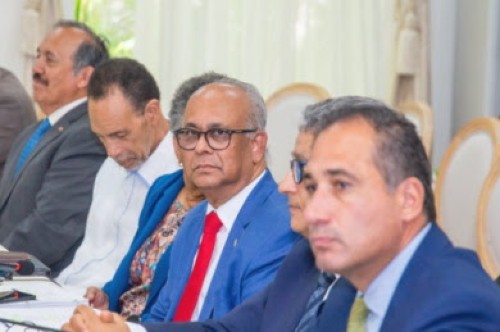 OAS Secretary General, Albert Ramdin (with glasses) who led a high-level delegation to Haiti.Ramdin, who led a High-Level Inter-American and International Mission to Haiti, told reporters that the delegation recognised the work being undertaken by the Provisional Electoral Council (CEP), the National Identification Office (ONI), the Haitian government and other relevant institutions in preparation for the upcoming elections scheduled for December 13.
“Our discussions with the CEP were open, wide ranging and constructive. At the same time, the electoral timetable requires urgent acceleration. There is a need to intensify citizen registration and identification, as well as public information, outreach, and voter mobilisation campaigns.
“The integrity of the process also requires confidence in the rules governing candidacies and their consistent application. Any concerns regarding candidate eligibility or potential links to illicit activities must be addressed transparently and in accordance with Haitian law and international electoral good practice,” Ramdin told the news conference, adding that the OAS will maintain a continuous assessment of both the security environment and electoral preparations.
“These two dimensions cannot be separated,” he added.
Last week, Prime Minister Alix Didier Fils-Aimé said “the elections will take place this year, no matter what” as the CEP announced the publication of the final list of approved political groups.
The CEP has scheduled the first round of long-awaited presidential and legislative elections, alongside a constitutional referendum, for December 13, this year, marking the first time Haitians will be casting ballots since 2016 when President Jovenel Moise was elected. Moise was later assassinated on July 7,2021.
Ramdin, whose delegation included the Secretary General of the Caribbean Community (CARICOM) grouping, Dr. Carla Barnett, told reporters that the presence of the mission reflects “a shared and collective commitment to support Haiti at this critical moment.
“We came here to listen, assess where things stand, and identify where greater urgency and stronger coordination are required. We are leaving with a better understanding of the priorities and needs of Haiti. We leave with a clear conclusion: we have to collectively speed up the work on security and elections as Haiti’s two most immediate and interconnected priorities.”
Ramdin said that the delegation also included representatives from the United Nations, the Pan American Health Organization (PAHO), the Inter-American Development Bank, the World Bank, The Development Bank of Latin America and the Caribbean (CAF), the Inter-American Defense Board, and the Inter-American Defense College.
He said the group had “a constructive meeting” with Prime Minister Fils-Aimé and “discussed frankly the progress achieved and the considerable challenges that remain.
“Haiti’s political and institutional actors must act in unity and remain focused on the fundamental objective: restoring constitutional and democratically elected government through a credible electoral process.”
Ramdin said that with regards to the security situation in the French-speaking CARICOM country, the members of this delegation expressed their full support for the renewal of the mandate of the Gang Suppression Force (GSF) at the United Nations.
“But renewal of the mandate alone will not be enough. I call on OAS member states and international partners that have pledged personnel, equipment, or financial resources to accelerate the fulfillment of those commitments.”
Ramdin said that the efforts of the GSF are essential to improving security and public safety; and to creating the conditions for a safe electoral process.
He said progress must be visible and measurable as soon as possible. Immediate objectives include reducing the territorial control of armed gangs, securing the main route to the international airport, ensuring sustained access to the airport and port, and restoring secure access toward the south of the country.
“Our discussions with the leadership of the GSF reinforced our conviction that the force must receive the personnel, financing, logistical support, and operational capabilities required to deliver results. We thank the GSF leadership for their efforts in this regard,” he added.
Media reports here, say Germany wants to contribute to the GSF and that the Germans are willing to make air transport capacity available in the short term to the GSF which will include military officials from Chad, Sri Lanka, Mongolia, Bangladesh, Guatemala, and Côte d’Ivoire.
The reports said that Germany is to transport equipment and supplies for troops operating in Haiti in the coming weeks.
According to the deployment schedule, during the month of August, the objective is to reach an intermediate threshold of 2,000 to 2,500 soldiers and police officers on the ground with the arrival of the second half of the Chadian contingent, complementing the promised target of 1,500 soldiers and the first specialized units from Sri Lanka.
During September, there is expected to be a massive deployment of forces from Latin America and Asia to extend the operational area beyond Port-au-Prince with contingents expected from Guatemala, El Salvador and Côte d’Ivoire.
The tactical priority will be to launch targeted intelligence-led operations in the Artibonite department and strengthening the protection of humanitarian corridors.
The authorities here are hoping to have a 100 per cent deployment of the 5,500 operational military and police personnel as well as 50 civilian advisors by October with the arrival of the main contingent from Bangladesh and police forces from the Bahamas and Jamaica.
Ramdin said that the delegation understands the multidimensional nature of security in Haiti and in this regard, PAHO has played a key role.
“From controlling cholera outbreaks and supporting displaced populations to sustaining trauma care in Port-au-Prince and protecting women and children, PAHO’s technical cooperation has remained a vital pillar of Haiti’s health security throughout one of the most complex humanitarian crises in the Americas.”
He said that the visit ends with a commitment to work with the Haitian National Police (HNP) in building trauma centers to care for wounded officers and that the OAS alongside PAHO and other partners will work towards this end.
He told reporters that the three-day visit also produced concrete results, adding “we welcome the formalisation of Haiti’s accession to the CAF in an operation facilitated by the OAS, expanding Haiti’s access to financing, technical cooperation, and development tools.
“We signed a new three million US dollar cooperation agreement with the Government of Japan to strengthen civil identification, including the acquisition of 350.000 biometric identification cards, expanded mobile registration services, and stronger coordination between the National Identification Office and the CEP.
“We also signed a new agreement with Brazilian NGO Viva Rio, building on Canadian-supported work to strengthen social cohesion and expand opportunities for youth and women affected by violence.”
Ramdin said that the OAS will soon, in collaboration with private sector organizations, among them the Latin American Business Council (Consejo Empresarial de America Latina, CEAL), mount a delegation of business leaders to discuss investment projects in Haiti resulting in more jobs, steady income and a future for youth at risk.
“These are tangible examples of what we mean when we say that the international community must move from solidarity and commitments to implementation and results,” Ramdin said, insisting that “this mission is not the end of the process”.
He said on August 26, he will report to the Permanent Council of the OAS on the findings of the mission and the areas where greater action is required. On September 4, he will convene the next meeting of the Group of Friends of Haiti to continue mobilizing political, technical, and financial support.
“Haiti is at a decisive point. The future of Haiti belongs first and foremost to the Haitian people. But the international community also has responsibilities. Our task is clear: accelerate security support, intensify electoral preparations, fulfill the commitments already made, and ensure that our cooperation produces results that Haitians can see and experience in their daily lives.
“The OAS will remain fully engaged in that effort,” Ramdin added.

