


GEORGETOWN, Guyana – The head of the Guyana Police Force’s Special Branch, Prem Narine, Monday told a magistrate court that Opposition Leader Azruddin Mohamed is a threat to national security even as the defence sought to establish that the United States extradition request is politically motivated.
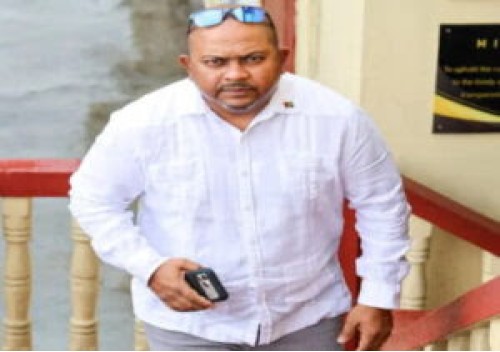 Prem NarineMohamed and his city businessmen father, Nazar “Shell” Mohamed are wanted in the United States for alleged wire fraud, mail fraud and money laundering associated with their once thriving gold trading business.
The Mohameds had been unsuccessful in getting the Trinidad-based Caribbean Court of Justice (CCJ), the country’s highest and final court to support their challenge of the validity of an Authority to Proceed (ATP) issued under Guyana’s Fugitive Offenders Act. The High Court and the Court of Appeal had also dismissed the challenge.
Appearing before Chief Magistrate Judy Latchman, the head of the GPF intelligence unit said that his assessment of the Opposition Leader was based on information available to him in his capacity as head of the Guyana Police Force’s Special Branch.
He told defence attorney Siand Dhurjon during cross-examination that Mohamed posed a threat to national security even though he said he was unaware of a similar statement made outside of the court by President Irfaan Ali.
“…. what I’m aware of is that Azruddin Mohamed, based on my information, is a threat to society,” Narine said, adding further that “standing here now, the information I have, I would consider him a threat to national security”.
The Head of the Special Branch denied that he was not being fully factual in his account to the court with the defence lawyer saying “I’m putting to you that your memory is rather selective today, and you’re not being honest with this court”.
Narine replied “that is not true”.
Last Friday, Narine during his testimony had described Mohamed as a dangerous person, adding that he was capable of anything.
Narine told the court that while he had collected two warrants from the Attorney General’s Chambers, he not say how the documents came to be there.
Dhurjon suggested that the Attorney General’s Chambers has no role in the extradition process and that such matters are handled by the Ministry of Foreign Affairs and the Ministry of Home Affairs, to which Narine replied that he did not know.
Asked whether he had encountered any other extradition matter involving the Attorney General’s Chambers during his career, Narine said he had never encountered another extradition process.
The defence lawyer sought to establish that the extradition process was politically motivated by the Guyana government, but Narine denied that he was instructed by President Ali to get involved in the matter.
“Definitely not, because an instruction from the president is a privilege and something that I would remember,” he said.
He specifically could not recall whether the police commissioner, crime chief or commander had instructed him to take action in the matter.

