


Guyana’s Nominee for UN Secretary General Receives Support From Former Opposition Legislator
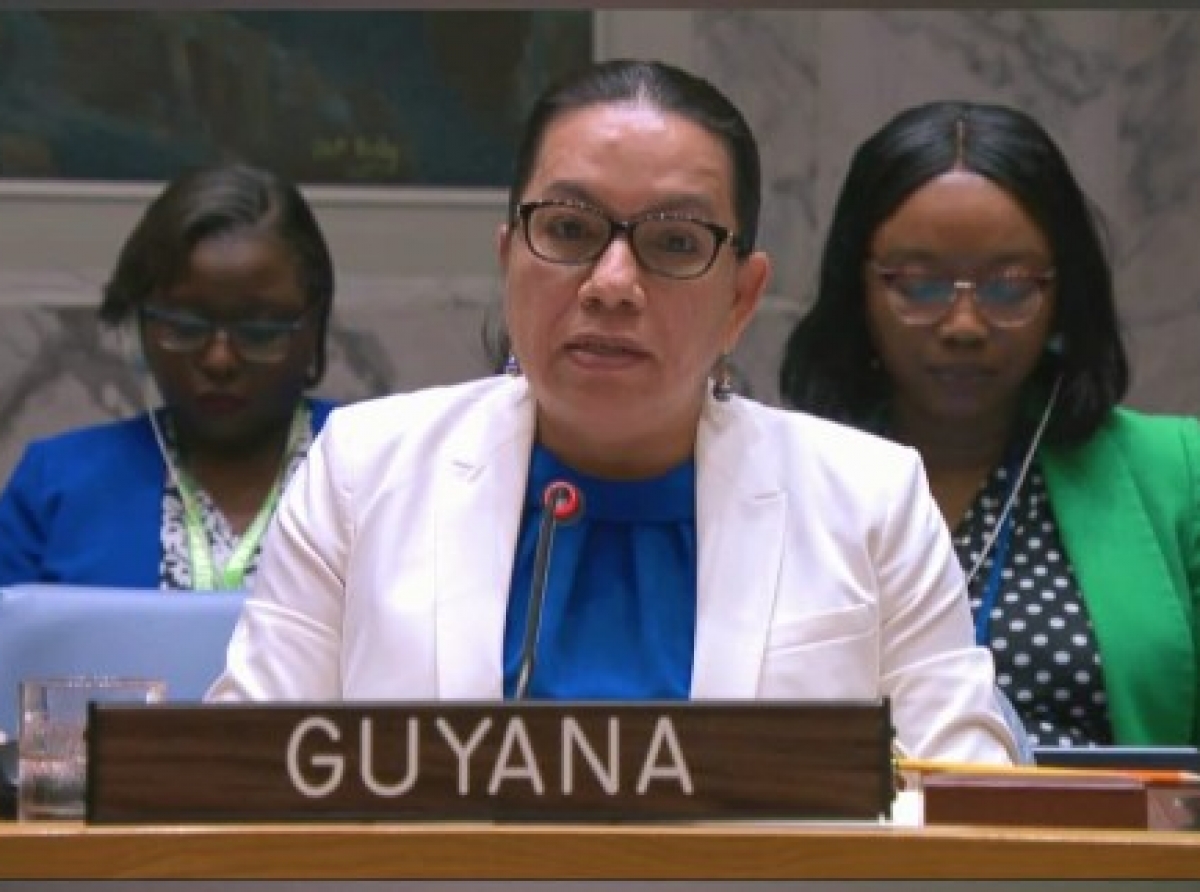
GEORGETOWN, Guyana – A former opposition legislator is throwing his support behind Guyana’s Ambassador Carolyn Rodrigues-Birkett, as the Caribbean’s candidate for the position of Secretary General of the United Nations.
 Guyana’s Ambassador to the United Nations, Carolyn Rodrigues-Birkett (File Photo)Jermaine Figueira, who served as an opposition legislator during the period 2020-25, says the diplomat is a “compelling voice for the Global South” and is the right person for guiding the global institution at this time.
“Most will agree and accept that there are moments when the achievement of one citizen becomes bigger than politics, party, ethnicity or government. Ambassador Carolyn Rodrigues-Birkett’s increasingly competitive candidacy for Secretary-General of the United Nations is such a moment.
“She is no longer simply participating in this historic contest; she is demonstrating that she belongs among its strongest contenders. Her performance in the selection process and her standing in the Security Council straw polls should give every Guyanese tremendous pride and should cause countries throughout the developing world to examine seriously what her leadership could mean for them.
“This is not an argument that she should be supported merely because she comes from Guyana, the Caribbean or the Global South. She should be supported because she is qualified,” Figueira said.
The formal recommendation and final vote to choose the next UN Secretary-General to replace Antonio Guterres are expected to take place in September or October this year, when the General Assembly appoints the successful candidate upon the recommendation of the Security Council.
The successful candidate will succeed Guterres and begin a five-year term on January 1, 2027.
In the race to succeed Guterres, Costa Rican diplomat Rebeca Grynspan won the first informal UN Security Council straw poll on July 30, 2026, while Ambassador Rodrigues- Birkett took first place in the second straw poll held on August 21.
Figueira said that Rodrigues-Birkett’s journey from the Indigenous Lokono community of Santa Rosa, through service as Minister of Amerindian Affairs and Minister of Foreign Affairs, to representing Guyana at the United Nations “is an extraordinary testament to ability, perseverance and public service.
“More importantly, that journey has given her an understanding of governance, diplomacy and an intimate understanding of development from the community level to the highest chambers of international decision-making,” he said, adding that “her candidacy therefore carries particular significance for South America, Central America, Latin America, the Caribbean, Africa and the wider developing world”.
Figueira said that for too long, developing countries have “correctly argued that international institutions must become more representative of the world they serve.
“Nations of the Global South confront enormous challenges, climate vulnerability, debt, food insecurity, unequal access to financing, poverty, conflict and persistent inequalities within the international economic system yet their influence over global decision-making has not always reflected their numbers or their importance.”
Figueira said that Rodrigues-Birkett understands these realities because she comes from them.
“Her vision of a stronger United Nations emphasizes effective multilateralism, institutional reform, preventive diplomacy, development financing and greater responsiveness to developing countries. These are not peripheral issues. They are central to whether the United Nations can remain relevant and effective in a rapidly changing world.
“Her candidacy should therefore provide a natural point of convergence for the Global South.
For CARICOM, the case is especially compelling. The Caribbean has contributed enormously to international diplomacy while never having produced a United Nations Secretary-General. “
Figueira said small states understand perhaps better than most that international law and multilateral institutions are not abstract concepts and that “they are essential safeguards in a world where economic and military power remain profoundly unequal.
“For Latin America and South America, supporting Rodrigues-Birkett would strengthen the hemisphere’s opportunity to provide consequential leadership at a moment when the international system requires bridge-builders rather than greater polarization.
“Africa, too, should see in her candidacy a partner who understands many of the developmental challenges shared across the Global South and who appreciates the legitimate demand for a more equitable international order and the need for a permanent seat on the security council.”
Figueira said that there is also profound symbolism in her candidacy.
“An Indigenous woman from a small Caribbean and South American developing country standing within reach of becoming Secretary-General represents something powerful about what the United Nations ought to embody: that geography, gender, ethnicity and the size or wealth of one’s country should never determine the limits of human possibility.”

