


Jamaica Files Reparations Petition to King Charles
LONDON, UK – Jamaica has officially filed an historic reparations petition to Britain’s King Charles with Kingston indicating that it anticipates that the petition will be referred to the Privy Council, Jamaica’s highest and final court.
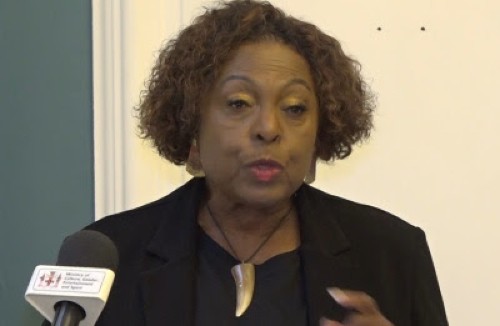 Jamaica’s Culture, Gender, Entertainment and Sport Minister, Olivia Grange, speaking to reporters after presenting petition to King Charles (CMC Photo)“…we will await the decision,” said Jamaica’s Culture, Gender, Entertainment and Sport Minister, Olivia Grange, after confirming that the petition had been filed with King Charles.
Grange said it was her “duty not only as a proud woman of African descent, but as a member of the human race to pursue reparations for the hundreds of years of chattel enslavement of African people on plantations in Jamaica.
“How can we not be moved to action about what is declared to be the gravest crime against humanity that went on for so long and affected so many millions of people?” asked the Minister as she called for support of Jamaica’s petition.
The petition asks the King, in his capacity of Head of State of Jamaica, to refer questions about the legality of chattel slavery to the Judicial Committee of the Privy Council.
“I wish to say here again that this petition of the government of Jamaica to His Majesty the King does not include a monetary claim,” said Grange, adding that “already there has been a lot of reaction to our petition and I welcome thoughtful, honest debate on the matter of reparations, but so far, we have seen and heard so much of what isn’t so.”
The Minister was reacting to incorrect media reports that the Jamaican government had made a monetary claim in its petition to the King.
“I wish to make it clear, and will do so at every single opportunity, that this petition is a legal petition. It contains three specific questions… (and) does not include a monetary claim.”
United Kingdom-based lawyer, Edward Fitzgerald, who helped to formulate the petition as part of a team of eminent Jamaican and UK lawyers, said “the petition simply asks the King to refer certain points of real importance to the Privy Council for their determination.
“There’s a special jurisdiction under section four of the Judicial Committee Act for the King to refer an issue of legal or constitutional importance to the Privy Council, for their determination…Any matter of legal or constitutional nature can be referred that cannot be determined through the ordinary judicial process. And this is obviously one of those issues,” Fitzgerald added.
The Jamaican petition asks three specific questions: Whether the seizure, transport and enslavement as chattel of Africans was ever lawful under English law? Was it a breach of international law to seize, transport and enslave Africans in Jamaica? And whether the UK has a legal obligation to provide a reparatory remedy to the people of Jamaica?
Fitzgerald said there’s a most powerful argument that it was never lawful.
“If you think of it, it’d be a pretty strange thing if a citizen could just go to Africa, see someone, against their will push them into a boat, and take them on a tortuous journey, and that that was lawful under English common law.
“There was no statute to authorise it. In fact, there was a statute which said it was unlawful to seize people from Africa and the National Council for Reparations highlighted that George II statute. So to those who say, oh, well, it was lawful at the time, we asked the Privy Council to find that it was never lawful at the time,” he added.
The petition also argues that chattel enslavement was, and is, a crime against humanity.
Regarding the third issue of a remedy, Fitzgerald said: “we’ve provided the legal principles to the King and to the Privy Council as to why there must be some remedy.
“The question of what the exact form the remedy would take would be a matter to be worked out in the litigation. But there must be some remedy for wrongs of this magnitude, which continue to have damaging effects on the descendants of those who were enslaved.”
The National Council for Reparations is a high-level advisory body to the Jamaica government on matters of reparatory justice. The Council, chaired by attorney at law, Laleta Davis Mattis, reports to Grange.

