


CASTRIES, St. Lucia – The Organisation of Eastern Caribbean States (OECS) Monday said it has signed an agreement with the Trinidad-based Caribbean Public Health Agency (CARPHA) that would renew their partnership to strengthen health security across the tourism sector, while reinforcing the sub region as a safer, more resilient and sustainable destination.
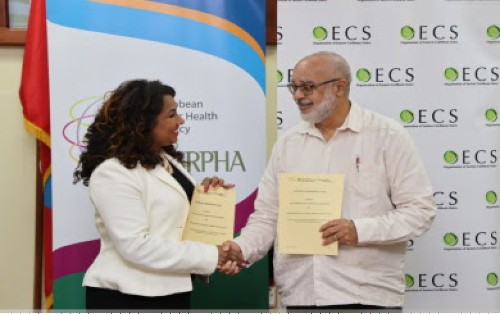 It said that the renewed Letter of Agreement (LoA) commits both organisations to the continued implementation of CARPHA’s Tourism and Health Programme (THP) across OECS member states through December 2030.
The OECS groups the islands of Antigua and Barbuda, Dominica, Grenada, St. Lucia, St. Vincent and the Grenadines, St. Kitts and Nevis, Montserrat, Anguilla and the British Virgin Islands.
The OECS said that the agreement represents the next phase of a partnership that has already delivered measurable results in strengthening public health systems, enhancing tourism resilience, and supporting sustainable economic development throughout the region.
It said tourism remains a key pillar of many OECS economies, contributing between 24 and 74 per cent of Gross Domestic Product (GDP) and accounting for almost half of total employment.
As one of the world’s most tourism-dependent regions, safeguarding the health of residents and visitors is fundamental not only to public health, but also to economic resilience, investor confidence and destination competitiveness.
“Our Sustainable Tourism Policy recognises that competitiveness, resilience and sustainability are inseparable. A destination is only as attractive as it is safe. Health security, then, is not an add-on to tourism. It is one of its foundational pillars,” said OECS Director General, Dr. Didacus Jules.
“When we strengthen surveillance, raise health and safety standards, and build capacity across our Member States, we are not choosing between protecting our people and protecting our economy.
“We are doing both with a single instrument. Several of our member states have already made real progress in implementing the Tourism and Health Programme, and I commend them. But our collective resilience is only as strong as the weakest system we tolerate among us. Through this renewed Agreement, our aim is to ensure that no Member State is left behind, that implementation is coordinated, even, and sustainable across the whole of the OECS,” he added.
CARPHA executive director, Dr Lisa Indar, said “through this agreement, CARPHA and the OECS Commission commit to a simple but powerful chain of real outcomes, strengthened travellers’ health delivers healthier, safer tourism; healthier, safer tourism builds a more resilient, competitive and marketable OECS destinations and a resilient tourism sector secures the economic sustainability of the OECS sub-region.
“A strong tourism and health programme in the OECS also translates into a healthier, safer Caribbean, further advancing regional health security.”
The renewed agreement also advances the objectives of the OECS Sustainable Tourism Policy, which recognises that resilience, competitiveness and sustainability are mutually reinforcing.
The OECS Commission said that by integrating public health more deeply into tourism systems, the partnership strengthens one of the essential pillars of sustainable tourism development: healthy communities, safe destinations and confident travellers.
The new agreement builds on the success of the first Letter of Agreement signed in 2021 with the OECS Commision noting that these achievements demonstrate the value of a coordinated regional approach that brings together Ministries of Health and Tourism and private sector stakeholders to strengthen preparedness and resilience.

