


SANTO DOMINGO, Dominican Republic – Jamaica says it supports the proposal by the United Nations Economic Commission for Latin America and the Caribbean (ECLAC) for a regional digital market noting that on digital transformation, Kingston is cognisant of the importance of equitable and meaningful connectivity for social and economic development.
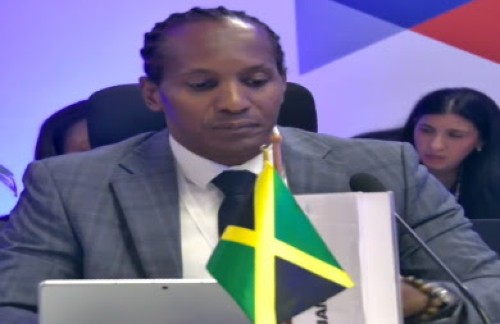 Jamaica’s junior Foreign Affairs and Foreign Trade Minister, Alando Terrelonge, addressing the ECLAC’s 41st biennial meeting.Addressing the ECLAC’s 41st biennial meeting, Jamaica junior Foreign Affairs and Foreign Trade Minister, Alando Terrelonge, said that the proposal for a regional digital market is welcomed, particularly in areas such as interoperable payments, digital identity, cybersecurity, and data governance where greater regional scale could reduce disadvantages faced by smaller economies.
Terrelonge said that Jamaica is actively pursuing a digital transformation agenda centred on wider Internet access, government digital services, payment modernisation, and enabling infrastructure.
“Our community Wi-Fi programme has established over 380 free Wi-Fi hotspots across our country, and our national identification system is being rolled out nationally,” Terrelonge said, noting that Jamaica therefore sees merit in strengthening the digital agenda for Latin America and the Caribbean”
He said ECLAC has a platform for greater coordination on artifical intelligence (AI) governance, digital skills, cybersecurity, and productive legislation and that Jamaica has taken concrete steps to prepare for responsible adoption.
The Jamaican minister said that unequal access to AI’s foundational resources threatens to widen global inequalities and create a new divide.
“Developing countries must be supported to strengthen domestic scientific institutions, cultivate local expertise, and build customised solutions. I therefore urge meaningful participation of developing countries, particularly SIDS, in international AI governance and standard setting processes.”
Terrelonge said that Jamaica has submitted its candidature to serve on the Council of the International Telecommunications Union (ITU) for 2027-2030, with the elections schedule for November.
“Our membership would enhance representation within the organisation, including that of SIDS, and help influence global telecommunications and ICT policies to strengthen connectivity, resilience, and inclusive digital transformation,” he said, adding also that Jamaica strongly supports ECLAC’s position that macroeconomic stability must create space for investment, productive transformation, and resilience.
He said that through sustained fiscal consolidation, Jamaica was able to reduce public debt from 135.6 per cent of gross domestic product (GDP) at the end of 2012-2013 financial year to 62.4 per cent at the end of 2024-2025 financial year.
But he said Hurricane Melissa, which slammed into the island in October last year, nevertheless, demonstrated the limits of domestic resilience.
“Jamaica’s prearranged disastrous financing provided important liquidity, but damage and loss estimated at US$12.3 billion, or 56.7 per cent of our GDP, far exceeded available fiscal buffers.
“Even advanced prearranged financing frameworks cannot match the scale of climate vulnerability facing small island developing states. Furthermore, with 82 per cent of our population living within five kilometers of the coast, we remain highly vulnerable to rising sea levels, impacting lives, livelihoods, and the very survival of our country.”
Terrelonge said SIDS remain on the frontlines of climate change, yet contribute less than one per cent of greenhouse gas emissions, adding “the lesson is clear. Sound domestic policy is indispensable, but it cannot eliminate the structural and environmental vulnerability confronting SIDS, nor can action be limited to the national level.
“The political will and support of the international community in taking meaningful action to combat climate change are essential. Jamaica therefore continues to call for developed countries and emerging economies to limit global warming to 1.5°C above pre-industrial levels in accordance with the Paris Agreement on Climate Change.”
Terrelonge said Jamaica was also calling for full delivery and implementation of climate finance commitments under the new collective quantified goal and increased allocation of grant-based and highly concessional financing for adaptation and resilience building.
He said reform of the international financial architecture is also critical, noting that “such reform must recognise the special circumstances of SIDS and facilitate complementary measures of progress beyond GDP, including a multidimensional vulnerability to secure equitable access to affordable and concessional financing”.

