


GEORGETOWN, Guyana - Aviation regulators, accident investigators and industry leaders from nearly 60 countries began a two-day meeting here on Tuesday with President Irfaan Ali urging then to seriously consider the impact artifical intelligence (AI) will have on the global aviation industry as well as safety.
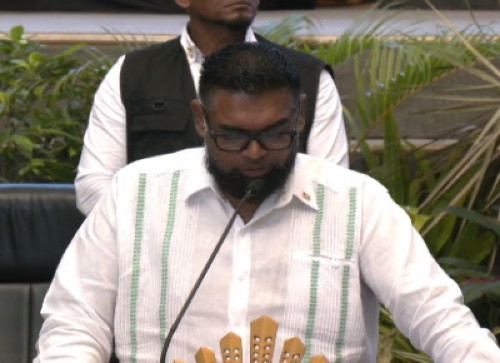 President Irfaan Ali addressing aviation conference on Tuesday (CMC Photo)The International Civil Aviation Organisation (ICAO) and the European Union Aviation Safety Agency (EASA) are jointly organising the event being hosted by the Guyana Civil Aviation Authority (GCAA) under the theme “Optimising Resources through Coordination and Cooperation”.
President Ali told delegates attending the Third Global Regional Safety Oversight Organisations (RSOO) and Regional Accident and Incident Investigation Organisations (RAIO) Forum for Aviation Safety that the aviation sector no doubt undergoing major shifts globally.
“We cannot sit here in a passive way and believe that we’re discussing aviation and safety in the same setting like three months ago. It is completely different and we need to I think readjust our approach to aviation safety and even the sector in keeping with the dynamic changes”.
Ali said that these changes encompass the demand, supply, equipment and technological sides of the industry insisting that “we need to look at the entire ecosystem and really reorganise our work to reflect this ecosystem”.
But he told the delegates that a pursual of the agenda shows an absence of AI , adding “we cannot meet today to discuss aviation safety and not have AI, the consequences of AI and importance of AI on the agenda.
“It would not be I think correct given the global realities. Your agenda I believe must be able to lead your discussions towards an AI strategy for aviation sector, especially as it relates to safety, issues of regulations, adaptability, equity and integration.
“Because if you don’t have equity in the build-out of AI in the aviation sector, especially for safety, then you will have disparity, you will have unevenness, you will have different rules and you will have countries being left behind.
“So it’s important that ICAO and all of the organisations from this moment adapt an AI strategy that is shared among all your membership, that identifies the opportunities, threats, the possibilities, but importantly to start the conversation on the regulations that will govern AI here in Guyana,” Ali said noting Guyana’s push towards fully utilising technology, AI, digitisation “to drive the future expansion and development of our country”.
He said that in the coming weeks, Guyana will be launching a new technology “in our security infrastructure and architecture that would look at our aerial asset” adding that “this by itself requires a set of safety rules that we must now implement.
“So, and this will be the approach across the region. This will be the approach across the region. So we have to be able to build an ecosystem that look at where we are going as a region, where we’re going in international community, and how we build structurally, institutionally, regulatory, legislatively to meet these requirements.
“Very important. So I believe that I would want to make that humble suggestion that we really bring AI as a key component for discussion early, and if I may further suggest that you set up a subcommittee or you set up an export group to look at this with urgency.”
Ali told the conference that “you need to set up an export group to look at this with urgency because the equity of the system, the safety of the system, the evenness of the system depend on this and your best place to offer this kind of assistance.”
The conference will look at how countries can pool their expertise and resources to strengthen safety oversight and accident investigation. It will also focus on the benefits of regional cooperation and how states can delegate specialised functions while still meeting their international obligations.
Delegates will also turn to workforce development, sustainable financing, partnerships with industry, and harmonised regulatory frameworks. Speakers include representatives of ICAO, EASA, and civil aviation authorities and regional bodies from Africa, Europe, the Caribbean, the Pacific, the Middle East and the Americas. Industry voices from Airbus, American Airlines and LIAT Air will also take part.
Ali told the conference that official data from the International Air Transport Association (IATA) showed that flying is the safest form of long-distance travel. He said according to IATA, in 2025, there were about 40 million flights worldwide and eight fatal accidents.
“This five-year average for 2021 to 2025 was one fatal accident for 5.6 million flights. The remarkable safety record of commercial aviation did not happen by accident. It was built over decades through rigorous standards, relentless oversight, and a culture in which safety is supposed to take precedence over convenience, costs, and commercial pressure.”
Ali said in the aviation sector, safety is paramount. Aircraft are subject to meticulous maintenance requirements. Pilots and crew undergo recurrent training and certification. Ali said that air traffic systems operate according to strict procedures and airports are regulated.
“ That is why aviation safety is not something that can be taken for granted. A country or an airline can have an impeccable record stretching back for years. However, that record is not a permanent guarantee. Aviation is an unforgiving industry. It takes years to build a reputation for safety, but only one serious lapse in standards to destroy it.”
Ali said that the intention of the government is to position Guyana as a human resource training and development hub for aviation globally.
“We are looking for a partner to help us to position Guyana as a global hub for training, aviation development, human resource development. Every aspect of aviation, safety, security, maintenance, pilot training, we want to build in our education development and aviation hub here that deals with training comprehensively.”
Ali said the government would be providing the infrastructure in “but we are looking for that international partner.
“We want to find a way in which we can build this ecosystem with an international partner. And I’m looking for ideas. We are looking for those who are ready to join with us,” Ali said, noting that as Guyana’s economy expands “so too will the movement of people, investment, goods, and businesses through our airports, placing greater demands on our aviation sector”.
He said also that central to Guyana’s development framework is positioning the country as a leader in food supply and production throughout the region.

