


NEW YORK, New York - Barbados Prime Minister Mia Mottley says Caribbean and African countries have a duty to create their own trade routes, to be able to ensure that they have the credit ratings that are credible, independent, and fair, as opposed to ones that are going to rate countries with similar circumstances but different geographies.
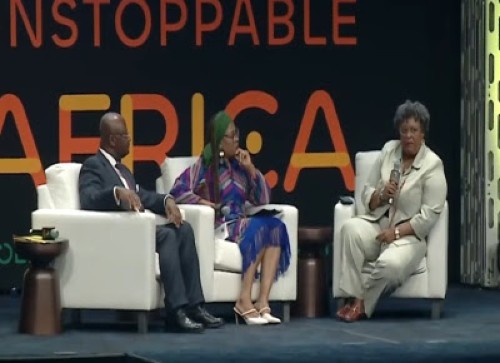 Barbados Prime Minister Mia Mottley participating in a fireside chat” with the President and Chairman of the Board of Directors of the Afreximbank, Dr. George Elombi, in New York (CMC Photo)“At the same time, we have to be able to believe in one another. Regrettably, we have been indoctrinated to look north before we look east or west. And that is fundamentally one of the first things to emancipate ourselves from that thought,” Mottley said during a “fireside chat” with the President and Chairman of the Board of Directors of the Afreximbank, Dr. George Elombi.
Mottley told the event held on the sidelines of the United Nations General Assembly (UNGA) that she wanted to give “full credit” to the Afreximbank that recognised it was important to create institutions that people can trust, so that if you want to move the diaspora into Africa “it will be much easier if there is a bridge, and that bridge usually is a financial institution that they trust”
She said that in the case of the Caribbean, the Trinidad-based Republic Bank, has almost 60 branches in Ghan and “It’s easier for a Caribbean person to move into Ghana because they know Republic Bank.
“Similarly, those in Africa who now see that Afreximbank has a regional office in Barbados and is working in the Caribbean, from the Bahamas in the north, to Belize in the west, to Ghana and Suriname in the south, to Barbados in the east, all of a sudden it becomes easier to think about how you’re going to make that path.”
Mottley said in addition, Africa and the Caribbean need to start looking at what can be common trade and other investment agreements.
“ Barbados has about 50, for example, agreements to avoid double taxation, but very few are in Africa. And why not? People use Barbados as a domicile to be able to help manage risk to go into Venezuela, to go into Brazil, to go into Cuba, to go to Mexico.
“Why are we doing it more in Africa? There’s just one or two countries with whom we have that relationship. And then the Africa Continental Free Trade Area and the Caribbean Single Market and Economy. We need to find a bridge that allows us to be able to get the benefit of both.”
She said that the Caribbean region through Afreximbank can have access to the Africa Medical Supplies platform in order to purchase the therapeutics, the vaccines, and the equipment at a time when nobody else was lending to the region.
“ We now face a world in which three primary trade routes are effectively compromised: the Straits of Hormuz. In recent weeks, the Houthis have taken action in the Red Sea, and in the last month, Panama has announced that the number of vessels that will come through the canal will be reduced because of the reduction in levels of water, making it almost impossible for them to carry the same volume of vessels.
“If that does not teach us that we don’t need to go through any other route other than to cross the Atlantic, that the flight between Barbados and Dakar is six hours, that the flight between Barbados and Accra is seven hours that the flight between Barbados and Lagos is seven and a half hours.
“The flight from Barbados to East Africa is probably about 10 or 11 hours. We can get to the Gulf States in 10 or 11 hours. What are we waiting on? I keep saying that, regrettably, there has to be a will, and I’m not sure that the will is as comprehensive across Africa and the Caribbean as we would like it,” Mottley told the audience.
She questioned also why more people were not coming to the Caribbean noting that people travel from the North Atlantic in the winter to get away from the cold, “so that our prices in the summer are down.
“But in truth and in fact, where should we be getting people from April to October, November? We should be getting people from Africa. We should be getting people from the Global South. And to that extent, why aren’t they coming? Because the air routes don’t exist.
“Why is it that we are still dependent on those corridors that I just talked about in terms of maritime trade routes? Because we have not taken the shortest route between two straight lines since we abolished slavery.”
Mottley was asked to provide an answer to Africa as the continent enters into this era of redefining its partnerships with the world, but also building the new world and the New Africa on Africa’s terms?
She replied that first and foremost the “engagements must not be perfunctory” and “ must not be in the shadow of the United Nations alone.
“That our engagements must be real and meaningful, and that we must be able to have the kind of assessment of our projects and all of the other things that will give a businessman or a household investor confidence. They can take some of their hard-earned money and invest. “When you look at the savings across our countries, there’s excess liquidity. But where do we? Our countries are buying treasuries here. Our countries are buying eurobonds. Our countries are doing everything else up north. But we’re not creating the platform to allow businessmen and householders to make justified investments.
“At the end of the day, where are the instruments that would allow both Africa and its diaspora to be able to make the investment on a matter (that) ought to be as sustainable an investment as a utility.”
Mottley said that a utility is one of the surest investments anywhere globally, asking “so why does Africa still remain without the level of access to electricity?
“Knowing full well that we have excess liquidity across our countries and the diaspora. Knowing full well that without that access to energy, you’re not going to have the kind of economic development that’s necessary to be able to remove the poverty.
“At the same time, let us be also very frank. Africa has been a victim of geopolitical chicanery. Africa has been a victim of the climate crisis. When you look at the map of Africa and you see the large brown swath across Africa.
“And you ask yourself, why is it that farmers can’t get the yields that they used to get? Well, if they’re not getting the yields that they used to get, what is it that they’re doing? Why is the level of insecurity as high as it is?
“Let’s come to the Caribbean and ask the same questions. At the end of the day, almost every windward coast, every easterly coast of every country in the Caribbean, and going into the Gulf of Mexico, has problems with sargassum seaweed. If you’ve never smelled it, it is almost noxious. It’s awful.”
Mottley said that while there are things that have been imposed on Africa and the Caribbean “but at the same time, there are things that we ought to do that we haven’t sufficiently prioritized, and that’s why the SDGs (Sustainable Development Goals) matter so much, and that’s why we have to keep fighting for being able to borrow to build schools, to build hospitals, to build and replace water mains with more than ten and fifteen-year money.
“The world changed when we allowed mortgages to transform home ownership for people. If you didn’t have the potential for a 20, 25, 30-year mortgage, a lot of people who own houses today would not own them. Similarly, if we crowd out the development opportunities for a country by making them have higher repayments because they built a school or they built a hospital, which is absolutely necessary, or they’re replacing mains that have been down for a hundred years, as we are water mains, then we are not being fair to ourselves.”
Mottley said the Caribbean and Africa are literally having to make choices saying “it’s like having six children and having to choose which two children you’re going to support, which two children you’re going to leave there, and which two won’t get anything at all.”
Ottley warned that unless the two regions are trading in digital services, the truth is we need to settle the maritime and air routes responding to a question on the need to further the progress of the Africa Caribbean Business Council with the support of Afreximbank.
“And we’ve really just got to stop talking about it. Airpeace has been flying into Barbados. There’ve been some teeth and pins, but we’ve stayed the course and we’re working them out. We need to be able to connect East Africa and South Africa, Southern Africa as well. And we also need to ensure that we do some.
“Some business books, and to literally say, these are the projects that we have. This is what we need for investment. When we, the government was re-elected in February this year in Barbados, and I made it clear: look, this term has to be about creating opportunity for our people, first in our country, then in our region, then in our diaspora. Because why? At the end of the day, we cannot be tenants in our own land, and ownership matters.
“And if a government can’t afford to run its debt up to be able to build out infrastructure and to build out services, then who next best to do it? But its population and its diaspora. So we’ve got to, rather than just simply opening up to foreign capital, we need to be able to find a way of ensuring that with the credit rating agencies. And I’m happy that the Africa credit rating agency will be launched on the 7th of October.”
But Mottley asked “that with those credit rating agencies, be able to launch and rate projects such that our institutional investors and our householders and our small businesses can all trade, whether the investments are in Africa or the investments in the Caribbean.”

