


CASTRIES, St. Lucia – A member of the United Nations Permanent Forum on People of African Descent, Dr. June Soomer, Monday dismissed calls for the Caribbean to put an end to demands for reparatory justice from the Atlantic slave trade, saying it is “very important for us to address the issue”.
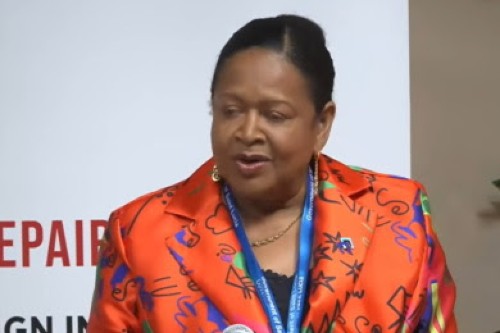 Dr. June SoomerSpeaking at a Reparations Forum on the sidelines of the 51st Caribbean Community (CARICOM) summit, Soomer, who is a member of the National Reparations Committee, as well as the CARICOM Reparations Committee, said “our reparatory justice movement is about humanity and ensuring dignity for our people
“Lots of people have come up to me and said, only in the last few minutes, do you think you will ever get that money? It’s not about the money. Yes, the money is important, but it is about the return of our dignity, of our personhood, of who we are as a people,” said Soomer, who is also a member of the African Union Committee of Experts on Reparations.
She told the forum that was also attended by former St. Vincent and the Grenadines prime minister Dr. Ralph Gonsalves, that some people are of the opinion that “we should just move on.
“Why don’t we just move on? Why don’t we just move on? And we cannot move on because one of our points speak to the issue of the trauma we have faced, and that is very important for us to address”.
She said that the new manifesto on reparations launched on Monday “demands a number of things from those people who enslaved us.
“But it also demands things from ourselves with regard to how we treat each other, how we regard each other, how we see pan-Caribbeanism, and how we see Pan-Africanism.”
She said that all these issues are embedded in the manifesto, which starts “with the full and formal apology, which all of us think is important and which we think has been disregarded, and we have been further disrespected because people do not think we deserve an apology.
“In fact, some of us think that we don’t deserve an apology,” she said, insisting that the reparatory justice movement will become the movement of the 21st century.
Soomer said that the manifesto was necessary “because of the fact that right now we are going through a period of erasure.
“People are trying to now whitewash our history, and we have to fight against that and this is what this reparatory justice manifesto is about. We are bringing to light what they are trying to keep out of the light.
“And so we will present to you a document that has evolved since 2013, 2014, and which is our gift to humanity today. Because it is a gift about humanity. Our reparatory justice movement is about humanity and ensuring dignity for our people.”
Soomer said reparation is very important within the 10-point manifesto.
“But more than that, resettlement is important. I want you to know that every time an African jumped from a ship that they were being trafficked across the Atlantic, every time they tried to swim, every time they bought themselves out of enslavement when they manumitted themselves, the aim was to return to Africa. That was always the aim and whether we do it now spiritually, physically, mentally, it is very important to this discussion.”
She said that a new part of the manifesto is the issue related to violence against women.
“It’s very close to my heart …women were equal under the whip. Women were equal within the preparations of the entire system and women reproduced the labour.
“The wombs of black women became the capital, the labour within the capitalist system and we have to recognise that,” she added.
Chair of the CARICOM Reparations Commission, Sir Hilary Beckles, told the Forum that the historical evidence shows that “we are in the fifth wave of the reparations movement.
“This is our time. We are standing on the shoulders of ancestors. This is our moment in time. The first wave we know was in the slavery period itself, when free black people would demand compensation and justice. They saw themselves as persons whose labour was stolen and they wanted compensation for this stolen labour, which was based on a standard philosophy that every human is entitled to benefit from the fruits of their labour.”
He said the second wave was the emancipation decade, the 1820s and 30s, when the European parliaments, the British parliament was debating, “should we free these black people or not?
“And eventually they settled on a model that said, we will, we will compensate the slave owners. We know that for the loss of their property, the government was taking their property away from them and therefore had to pay property compensation.
“It was the first time in the British parliament that they actually admitted that black people were not human beings, because the compensation they were going to pay was property compensation to take the taxpayers money and hand it over.”
Sir Hilary said the Europeans needed a framework and they said property compensation, and the British government and the British people together, they owned 700,000 black people in the Caribbean.
“And therefore the value was 45 million pounds. That was our replacement value or market value,” he said, adding that the third phase was the first generation of free black people in the Caribbean who “are now demanding reparations and compensation right across the Caribbean.
“They say we have not given up, we want reparatory justice. They were asking for land. They were asking for better wages. They wanted access to social services, schools, and so on. And organisations were springing up across the Caribbean, calling for economic and social justice. Sir Hilary said that the fourth phase, of course, was the 1930s when all of the Caribbean again rose up against colonisation.
“So we are now, once again, we are in the fifth phase. This is our time. So we have said, as Caribbean people, we are not going to let the struggle of our ancestors go to waste. We are going to take it up. This is our time, our duty, our responsibility to honour the legacy of all of our ancestors who demanded justice.
“This is our time. And so we rekindled the movement and we said to ourselves, hopefully this is going to be the last phase,” he said, adding “we could feel it.
“All of the people of the world today who have been colonised, who have been enslaved, whose resources were plundered, whose people were stolen, all over the world at this moment in history, everyone is saying we want justice for what has happened to us.
“So this might have started in the Caribbean, Africa, America, the black people of this hemisphere, …but now it is everywhere. It is now everywhere. And so at the United Nations, three or four weeks ago, when the resolution was passed, people from all over the world, Asia, Europe, Africa, the Middle East, the Far East, all those people came together and said, we are standing with the African black people on this matter.”
Sir Hilary said China, Russia, Iran, all of those countries stood with black people, noting that “for 300 years, did we have a legal case to reparatory justice? The answer now is yes. The case has been made. There’s nothing more to discuss whether it is a case or not.
“The question now is implementation, demand. That’s where we are now at this moment. That is why Africa and the CARICOM are now in league, providing global leadership for the next phase,” he told the Forum

