


SANTIAGO, Chile – The Director General of the Inter-American Institute for Cooperation on Agriculture (IICA), Dr. Muhammad Ibrahim, Tuesday said there is a need to address issues such as non-tariff barriers that affect trade in Latin America and the Caribbean (LAC).
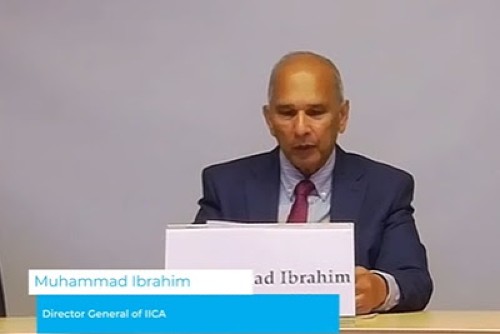 Addressing the launch of a report which provides a regional overview of productivity, sustainability, inclusion, innovation, financing, and public policies, the Guyanese-born IICA Director General, said he wanted to add on international trade as an engine for agricultural productivity.
“But here I would like to highlight not only international trade in terms of how do we move from the north to the south, but also more promotion of inter-regional trade,” Ibrahim said, adding that’s “an issue we need to address in terms of looking at the barriers, the non-tariff barriers that affect trade”.
He said as example in the Caribbean where the regional countries have an interest to reduce the food importation bill through the “the 25 by 30 initiative,” by promoting more inter-regional trade, there is need to “understand what are the regional barriers that we need to overcome to enhance this”.
The Caribbean Community (CARICOM) initiative, which targeted the reduction of the region’s more than six billion US dollar food import bill by 25 per cent by 2025, has now been extended to 2030.
The Food and Agriculture Organization of the United Nations (FAO), the Economic Commission for Latin America and the Caribbean (ECLAC), the Development Bank of Latin America and the Caribbean (CAF) and IICA shared their expertise in preparing the report titled “Outlook for Agriculture and Rural Development in the Americas 2025–2026: A Look at Latin America and the Caribbean”.
The report argues that Latin America and the Caribbean faces a challenging context and proposes increasing agricultural productivity as a strategic pillar to strengthen agrifood systems and rural territories.
The 2025–2026 edition identifies persistent rural gaps, productivity lags, financing and R&D investment limitations, and growing exposure to extreme climate events. It proposes an action agenda to increase agricultural productivity and strengthen food security, resilience, and regional cooperation.
In his address to the launch, Ibrahim thanked all the partners for contributing and all the authors for contributing into this book, adding that IICCA is looking forward to promoting the communication and getting the outreach of the information generated to the different stakeholders.
He said that the FAO in its outlook for agriculture noted that the global demands of food by 2050, which must increase by 70 per cent.
“… this book is providing the strategic actions to drive agriculture productivity to reach these global demands. It provides a concrete roadmap for transforming agriculture productivity in Latin America and the Caribbean.”
Ibrahim said that between 2011 and 2020, regional agriculture total productivity has only increased by about five per cent and productivity increase in production has been related towards the use of more inputs and resources, which is estimated to be about 80 per cent. “Therefore, the next growth cycle in the next decades is foreseen, where we need to increase total agriculture productivity to respond to the growing demands of food and to look at the nutritional demands from the growing population.”
He said that this chapter on strategic actions to drive agriculture productivity provide highlights of some of the important steps that is needed to achieve increase in total growth.
“One is looking at enabling policies. We still think that the countries, the developing countries, need to invest more in research and development, which is only about 1.6 per cent in some of the countries…”
“So, we need a stronger scientific capacities. We need to improve the laboratories, but also to look at the regulatory frameworks that will enable these policies, including agriculture health and biosecurity.”
Ibrahim said that currently, countries in Central America are having key problems including screwworm.
“We know there are challenges with TR4, there are many problems with diseases, bird flu and all these major challenges, which we need better science and informed to advance on these challenges that we have to boost productivity.
“Another area we need to work on is funding for sustained agriculture productivity,” he said, highlighting the importance of the CAF, in seeking to unlock financing for the agriculture sector.
“Financing must be understood as an ecosystem, not simply as a credit or innovative financial schemes. We need to look at de-risking the finance, but also looking at differentiated incentives and financial mechanisms that would also target the small farmers, the family farmers, which we need support to overcome the barriers to adoption of improved technologies and innovation that we are producing. ”
Ibrahim said there is a need for a more robust financing scheme to remove these barriers for adoption and scaling up of good practises, adding that the report also discusses the technical assistance and rural extension schemes.
“We think that the model of extension schemes need to be redirected understanding. Now there are digital tools, we need to look at the cascading model in which we move to impacts and having a wider transfer beyond the transfer of technology, but also understanding the whole ecosystems,
“.…all innovation and knowledge is flown and also integrating the youths, the women in the territories working towards the scaling up of good technologies. This is an area where IICA has been working on to promote new leaders in the region, new generation of external services to be combined in personal and digital models, connect with territorial innovation systems and incorporate sustainability, climate adaptation and risk management.
Ibrahim said that there is also need to look at the technology used to boost productivity, noting that technology is a catalyst for a new way of producing.
“Digitalisation, artificial intelligence, biotechnology, gene editing, all these tools, modern tools now have been used for improving productivity on the corn, on all of our soybean and all of these crops that we have.
“But understanding that the Americas have a rich agro-biodiversity, we should capitalise on these genetic resources also for boosting yields, but also adaptation, pest resistance, looking at nutritional needs and looking at more bio-fortified crops to look at the nutritional demands that we have based on the knowledge, precision and innovation that we have in these areas. “We also need to look at efficiency, efficient and intelligent use of inputs and resources,” the Guyanese-born official said, adding “so, there are sectors called to look at reducing its footprint, the ecological footprint, but also looking at resource efficiencies”.

