


PANAMA CITY, Panama - Jamaica’s Prime Minister, Andrew Holness, Wednesday urged Latin America and Caribbean countries to move from fragmented national initiatives to aligned regional priorities.
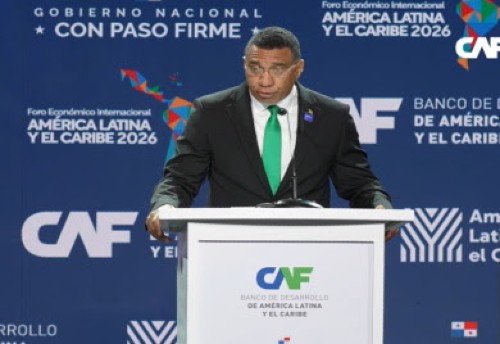 Jamaica Prime Minister Andrew Holness addressing the second International Economic Forum, Latin America and the Caribbean 2026 in Panama on Wedesday (CMC Photo)Addressing the second International Economic Forum, Latin America and the Caribbean 2026 here, Prime Minister Holness said that the region must also shift from reacting to global change to anticipating it and helping shape the standards and partnerships of the next decade.
The Development Bank of Latin America and the Caribbean (CAF), which is organising the three day event, said it is being held under the theme “Latin America and Caribbean International Economic Forum: How to return to the path of growth?”.
Holness told the event that has brought together global leaders and experts from the region to discuss strategies that strengthen sustainable economic development, with a special focus on impact investing, green energy transition, digitalization and infrastructure, that he is suggesting three imperatives to meet the aligned regional priorities.
“First, a regional competitiveness agenda anchored in connectivity, logistics, energy security, and digital transformation. Second, institutional readiness, credible frameworks that give global partners confidence that our ambitions can be executed with professionalism and continuity.”
Holness said that third would be a renewed diplomatic and economic posture, deepening engagement not only with traditional partners, but with emerging markets, global value-chain leaders, and the rapidly expanding green-technology ecosystem.
“If our region is to rise, we must deepen our economic connections. If our economies are to scale, we must scale our ambitions. If our voice is to carry globally, we must speak not as isolated markets, but as a coherent hemisphere.”
He acknowledged that the opportunity before countries is not modest, saying “it is broad, bold, and transformative” and that Jamaica stands ready to play its part.
”Through stronger institutions, more efficient government, and an increasingly competitive economic environment, we intend to contribute to a hemisphere that is not merely participating in global affairs but shaping them.
“Let us therefore commit to a shared regional vision: A hemisphere that acts with discipline, speaks with purpose, and competes with confidence. A hemisphere that is resilient, dynamic, and future-ready. A hemisphere that the world recognises not for its challenges, but for its capabilities.”
Holness warned that because the next decade will not belong to those who wait for opportunity to arrive, but to those who create it, the nations of Latin America and the Caribbean “standing together can shape a future worthy of our people and equal to our potential”.
Earlier, Holness told the conference that under three months ago, Jamaica faced one of the most severe natural disasters in its modern history. He said Hurricane Melissa, a Category Five storm, tested Jamaica’s institutions, infrastructure, and population.
“Yet today, I stand before you with a simple but powerful message: Jamaica has endured. Jamaica is recovering strongly. Jamaica is moving forward.”
Holness said that the moment is best understood in the context of how fundamentally Jamaica’s economic resilience has changed over time and how the country’s capacity to absorb shocks and rebound from them has been deliberately strengthened.
He said in 2008, the Global Financial Crisis struck a heavily indebted and structurally vulnerable Jamaican economy and that it took 11 years for the country to return to pre-crisis output.
“Eleven years of fiscal repair, institutional reform, and sustained effort to rebuild credibility. Jamaica’s public debt-to-GDP ratio underwent a significant transformation between 2008 and 2019, rising from roughly 120 per cent in 2008 following the global financial crisis to a peak of over 140 per cent in 2013, before decreasing to roughly 90 per cent by the end of 2019,” Holness said, adding “this marked the beginning of a major turnaround in fiscal stability”.
But he said that just as that recovery was consolidating, the world was struck by the COVID-19 pandemic, compounded by global supply-chain disruptions and escalating geopolitical tensions on a scale not seen in a century.
“ And yet Jamaica responded differently. Our recovery was V-shaped. We returned to pre-pandemic output in just three years. Same country, same people, different governance.
“Not governance of reaction, but governance of preparation. Not discipline in crisis, but sustained discipline over time,” he said, adding “that is why Jamaica now absorbs shocks differently and recovers faster”
He said that this is because the country’s economic management is more disciplined, institutions are stronger and the country has been able to build fiscal buffers.
“This foundation gives Jamaica the confidence not merely to respond to disruption, but to emerge from it with greater resilience, more durable stability, and a clearer pathway to long-term growth.
“Jamaica today is like a ship that has not only reinforced its hull, but redesigned its navigation systems. We are not merely seaworthy, we are voyage-ready. We can withstand shocks, but more importantly, we can chart a longer and more ambitious course. That journey has already begun,” Holness said, adding that “the world has taken notice”.
He said in the weeks following the hurricane, all three major international ratings agencies—Standard & Poor’s, Moody’s, and Fitch—reaffirmed Jamaica’s sovereign standing with stable outlooks.
“Moody’s even upgraded us. This is extraordinary in the immediate aftermath of a Category Five storm,” Holness said, telling the conference that the international credibility is now being translated into a platform for accelerated development.
He said through close engagement with development partners, including CAF, the International Monetary Fund (IMF), the World Bank, the Inter American Development Bank (IDB) and the Barbados-based Caribbean Development Bank, Jamaica secured a US$6.7 billion development-financing package.
“This is the largest and fastest mobilisation in Jamaica’s history,” he said, adding that the bulk of these inflows will be channelled through the National Reconstruction and Resilience Authority (NaRRA), which will serve as a centre of technical excellence for project development, a single point of national coordination and a platform for public–private partnership
“NaRRA will enable Jamaica to execute resilient infrastructure projects at scale and at speed,” Holness said, adding “we are further reinforcing this strong macroeconomic framework through productivity reforms to reduce delays, cut bureaucracy, and accelerate investment.
“We are reinforcing it through energy-sector reform to lower energy costs, expand renewable energy capacity and strengthen grid resilience. And importantly, we are reinforcing it through improved public safety. Jamaica recorded a 42 per cent reduction in homicides last year.”
Holness said that to date, Jamaica has reduced homicides by a further 54% compared to January last year.
Holness said he is extending an invitation to the region’s investors and partners, adding “Jamaica’s recovery has created not only resilience, but momentum, and with it, a trainline of bankable opportunities across infrastructure, logistics, energy, manufacturing, tourism, and the digital economy.”

