


GEORGETOWN, Guyana - The Barbados-based Caribbean Disaster Emergency Management Agency (CDEMA), Tuesday launched the 14th Caribbean Conference on Comprehensive Disaster Management (CDM 14) with Guyana’s Prime Minister, Mark Phillips, saying that the region is continuously contending with climate volatility and economic shocks.
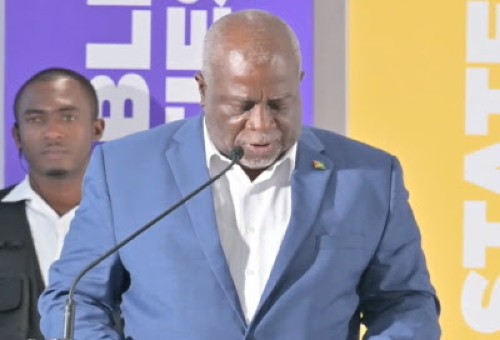 Guyana’s Prime Minister Mark Phillips addressing the launch of CDM-14 (CMC photo)He told the ceremonial launch that in addition, Caribbean states are also dealing with infrastructure vulnerabilities, public health threats, supply chain disruptions, and rapidly evolving technological and security risks.
“These pressures, most times, overlap and compound, testing governments’ capacity to respond within ever shorter windows of time,” Phillips said, adding this is why he has chosen to speak about resilience as statecraft.
“For much of our history, disaster management was treated as a function that only activated after an event occurred. That understanding is no longer adequate to the world we govern.
“Resilience now sits at the centre of how a country is run and touches various aspects of our economy, infrastructure, security, and long-term development,” he said.
CDEMA said that CDM 14, which is scheduled to take place here from December 7-12, will be held under the theme “CDM Road to Resilience – Checkpoint 2026: Resilient Sectors, Sustainable Communities, Safer States,” and that the launch event will formally introduce the strategic direction, partnership framework, and regional priorities shaping CDM 14.
Phillips told the audience that included senior government officials, international development agencies, donor partners, financial institutions, private sector stakeholders to govern well in the changing environment “is to govern at the speed of risk, anticipating threats before they mature, investing ahead of need, coordinating across borders, and acting with resolve when the moment demands it.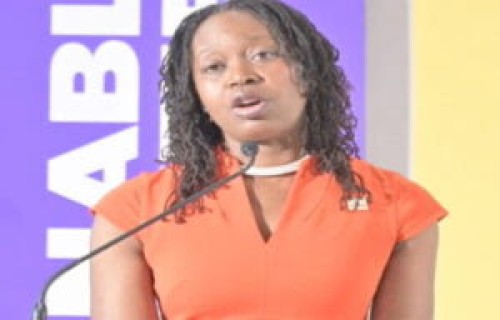 CDEMA executive director, Elizabeth Riley (CMC Photo)
“The windows in which decisions must be taken are narrowing, and the cost of acting late rises with every passing season,” he said, adding that resilience becomes a matter of competitiveness as much as protection.
“A country that can keep its ports and its power running through a shock, and its public services available to those who depend on them, is one that investors trust, and that its people can rely on.
“Equally, infrastructure built to withstand the hazards of a region retains its values over time. Early warning systems that reach every community lower the human and economic costs of an event.”
Phillips said that the steady adoption of new technology from satellite data to improve forecasting gives governments more time to act before a threat becomes a crisis.
He said Guyana understands the weight of this responsibility, noting “our economy is expanding, and our energy sector is growing.
“Our standing within the region has risen alongside that growth. Much of our population and economic life, however, is centred along the coast, where the effects of a serious hazard would be felt most acutely
“As we build new infrastructure and expand our energy capacity, the task of protecting those assets and the communities around them grows every year. For us, resilience and development are intertwined because neither can be secured without the other,” Phillips said.
He insisted that no country secures resilience on its own and no single budget can finance it.
“This is where partnership becomes essential, and it is why this morning’s programme places financing at its centre. Capital for resilience does its greatest work when it is well prepared in advance of disaster. Regional risk pooling and prearranged finance allow a country to respond and recover quickly, sparing its people the long delays that follow when resources have to be assembled from scratch.”
Phillips said that the presence of the Caribbean Development Bank (CDB) and Caribbean Catastrophe Risk Insurance Facility – Segregated Portfolio Company (CCRIF-SPC) speaks to that principle, ”and private investors must be drawn more fully into the work alongside them.
“Therefore, it is my firm belief that the dialogue this programme opens on risk, capital, and Caribbean resilience is among the most consequential we can pursue. Ladies and gentlemen, partnership of this kind extends well beyond finance. The strength of our regional response rests on shared standards and joint exercises, as well as a steady exchange of knowledge between agencies that face common hazards.”
He said the Caribbean has long understood ”that our security is shared” and that “when one of our states is weakened, the region is weakened with it.”
Phillips said that the coordinating role of CDEMA and its partnership with the Civil Defence Commission in hosting CDM14 gives that understanding practical form.
“Guyana assumes the duty of host, mindful of its responsibility to the wider Caribbean community. Guyana does not approach this role lightly. Our growing importance within the region carries with it an obligation to contribute to our own preparedness and to the strength of the wider Caribbean alike,” Phillips added.
Earlier, CEDMA’s executive director, Elizabeth Riley, said that investment decisions will be critical to safeguarding development gains.
She said these realities provide the context for CDM 14, and that the emphasis on resilient sectors is intentional.
“For 25 years, the Comprehensive Disaster Management Strategy has placed sector leadership and empowerment at the centre of resilience building. Since 2007, we’ve worked alongside education, agriculture, tourism, health, and civil society partners to strengthen sector resilience.
“The CDM Strategy to 2030 deepens that approach through expanded sector engagement with energy, water, the private sector, and a stronger focus on finance, economic development, and disaster risk financing.
“So CDM 14 will provide a wide-ranging examination of sector resilience. It is an opportunity to assess progress, identify remaining gaps, and align around practical actions that accelerate recovery outcomes. It will also explore how emerging technologies, including artificial intelligence, can strengthen decision-making, risk analysis, and preparedness while ensuring that planning remains grounded in strategic foresight and long-term thinking.”
Riley said more importantly, resilience must remain people-centred, adding “our objective is not more sophisticated systems.
“It is safer communities, protected livelihoods, continuity of essential services, and expanded opportunities for current and future generations.”

