


Caribbean Leaders End Summit on Optimistic Note
CASTRIES, St. Lucia – Caribbean Community (CARICOM) leaders ended their 51st annual summit here on Wednesday saying that the decisions taken during the four day event “reaffirm that CARICOM remain united in purpose and determined in action.
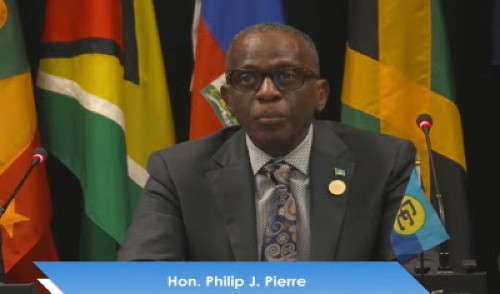 “Together we will continue building a Caribbean that is more resilient, more prosperous, more connected and better prepared for the future generations,” St. Lucia’s Prime Minister Phillip J Pierre told the closing news conference.
Pierre, who is also the chairman of the 15-member regional integration grouping, said the discussions over the past four days had been “guided by one central objective (and that is) ensuring that CARICOM delivers results that people can see and feel in their everyday lives.
“The true success of CARICOM will not be the number of decisions we make, but whether our people see and feel the difference those decision’s make in their everyday lives,” Pierre said.
Trinidad and Tobago Prime Minister Kamla Persad-Bissessar, who since her return to office in April last year, has enjoyed a stormy relationship with the rest of CARICOM, said she is now looking forward to a much more harmonious relationship with the grouping.
“ My position from the start remains to now and that position has been, whilst I would have levelled some concerns about the operations of the CARICOM, I have always said Trinidad and Tobago remains committed to the CARICOM.
“We have unwavering support to the CARICOM for us to work together to better the region and of course all our citizens. So I have not changed in that position. However, some matters discussed in the recent days, I think we’ve been able, through the chairmanship of Prime Minister Pierre and of course with the cooperation of the other heads that we’ve been able to iron out some of the concerns I had.
“So my position has not changed. I remain committed to the CARICOM. We will have issues from day to day, from time to time. In a family you have issues, you have issues of concern and I am, my position is that we must raise them.
“We must not put our heads down in the sand like ostriches. We raise them when they are and try to find resolutions,” she said, adding “we’ve been able in this 51st CARICOM Heads meeting to iron out some of those differences and I think we are better as we go forward”.
The leaders discussed a wde range of issues ranging from cost of living, food security and economic reliance, health, climate change and reparatory justice. But the issues that have been driving policies in the past few months remain without a clear position.
For instance on the issue of situation in Cuba, while regional leaders expressed support for dealing with the humanitarian crisis in that country, Barbados Prime Minister Mia Mottley acknowledged that “this is not an easy issue, and I think that we are agreed that the discussions and the debate must take place, but without prejudice to any discussions and debate for a peaceful resolution of what is transpiring with Cuba”.
She said that there is a humanitarian crisis and that you cannot continue to ignore that reality. Mottley said that while the United States has said itself that it will contribute to the relief of the humanitarian crisis, “the Caribbean has been resolute in saying that we want to do it” adding that “in Barbados’ own case, we had to spend about five months, and the money was returned twice, and this is the third time for us to buy baby milk.
“We recognise that this is always going to be a complicated and complex issue, as was reflected in the United Nations debate on Tuesday, but we want to remain focused on humanitarian efforts, and we want to remain focused on the dialogue that should continue to take place for the resolution of this matter, and CARICOM will always be ready and has told both the Americans and the Cubans that we are more than ready to be there to help facilitate this dialogue.
“Because when you live in a neighbourhood, what happens in the neighbourhood affects everyone, and the neighbourhood stretches from Florida to uyana and Suriname in the south”.
St. Kitts and Nevis Prime Minster Dr. Terrance Drew, who spent seven years studying medicine in Havana, told reporters that the region continues to be touched by the humanitarian crisis in Cuba,
“Different countries have delivered for different things, and we hope that that gets to the children of Cuba as soon and as quickly as possible,” he added.
The regional leaders said that they had also discussed the United States policy as it relates to third country refugees (TCR) where Washington is asking individual Caribbean countries to accept refugees or undocumented migrants who entered the US illegally.
Prime Minister Pierre said that the matter had been discussed, adding “as you know, it’s an issue that is of concern to all of us. We discussed it, and we took a position that we would share some more information among ourselves about what really is each island doing.
“Right now, we are not clear,” he said.
Pierre also said that the meeting had not discussed the Citizenship by Investment Programme (CBI), even though the European Union and the United States have linked their visa policies to the programme through which foreign investors are granted citizenship of some islands in the Caribbean in return for making a substantial investment in their socio-economic development.
“As an issue that we discuss among ourselves and at the larger curriculum level, it was not discussed. Yes, it was not discussed because …I’ll tell you what, we’ve been trying our best to follow best practise.
“We’ve been trying our best to ensure that all the requirements that we are asked for, we’ve met them. The latest requirement that we have a unified regulatory body, we’ve done that through the Eastern Caribbean Central Bank.
“All the due diligence procedures that we are asked to do, we take these steps. But each country has a right to impose its own domestic policy, and we are in no position to tell anybody what to do as far as their domestic policy is concerned,” Pierre said, adding that “so regardless of what we do, if Europe decides that it does not want us to have CBI programme, that’s what is going to happen
“Each country has its own domestic policies, and if for their own reasons that is decided by Europe, by countries in Europe, that they do not want to see a CBI programme, there’s literally nothing we can do under these circumstances.
“But we’re going to follow all what they’ve asked us to do. And we’ve gone, and in terms of history, we have been there before. We’ve done what we do, we took all the steps as far as our bananas were concerned, and we still lost treatment of our bananas as far as our sugarcane is concerned.
“So we’ve gone there before, we’ve been there before, and we’ve always survived, and I’m sure we’ll continue to survive,” Pierre added.
On the issue of climate change , the regional leaders reaffirmed their commitment to limiting global warming to 1.5 degrees Celsius and to advocating for the special circumstances of Smalll island Developing States.
“We also agreed to advance a regional insurance and reinsurance strategy to better protect our people, infrastructure and economies against hurricanes and other natural disasters,” Pierre said.
He said on the issue of health, the leaders “endorsed stronger regional cooperation, including enhanced preparedness for the emerging public health threats and expanded access to specialised healthcare services across member states.

