


PORT OF SPAIN, Trinidad – The executive secretary of the Economic Commission forLatin America and the Caribbean (ECLAC), Jose Manuel Salazar Xirinachs, Tuesday called on countries in the Caribbean region modernise their statistical legislation and governance systems to foster a culture of independence, access to administrative data, and improve data protection.
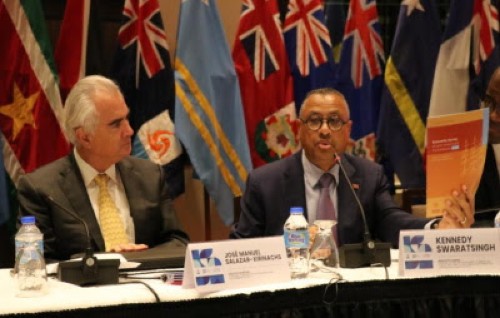 Executive secretary of the Economic Commission for Latin America and the Caribbean (ECLAC), Jose Manuel Salazar Xirinachs (left) and Trinidad and Tobago’s Minister of Planning, Economic Affairs and Development, Kennedy Swaratsingh.Addressing the 22nd Session of the Monitoring Committee of the Caribbean Development and Cooperation Committee (CDCC), Salazar Xirinachs, said the onde-day event will discuss among topics, the standout issue of how the subregion can improve its official data and statistics to strengthen resilience and development in the Caribbean as well as the role of the CDCC in supporting member states as it turns 50 and the implementation of ECLAC’s programme of work for the Caribbean.
He told the ministerial council that Monday’s seminar attended by officials, “provided rich food for thought on how the Caribbean could leverage South-South Cooperation to advance its development,” adding “we highlighted the many and varied challenges facing the subregion”.
He said among these are that sluggish growth is insufficient to provide adequate employment for citizens of the region, partly youth whose unemployment rate exceeds 20 per cent across the region, inadequate productive development policies and structural change to shift specialisation away from low-value-added commodities and services, to high-quality, innovation-based production in green energy, Greentechnologies, telemedicine and cross-cutting AI-enabled solutions across many sectors.
“Nevertheless…even as we recognised the challenges, we also focused on the opportunities that South-South and triangular cooperation present for the Caribbean in a world that is becoming more multipolar.
“We acknowledged the Second Resolution of Regional Conference on South-South Cooperation as a transformative vehicle for optimising cooperation between Latin America and the Caribbean in boosting productive development capacities, increasing trade and financial flows, while bolstering social inclusion and reducing inequalities. “
Salazar Xirinachs told the conference that Caribbean is now living in the knowledge and information age and like gold in the past, data and information are a major currency of development.
“Moreover, in small, vulnerable states such as ours, it is even more important to harness data, including real-time data, in decision-making. Given the multiple challenges to its development, the Caribbean must now invest in modernising the production and dissemination of high-quality official data and statistics to drive its development.”
The ECLAC official said good-quality, high-frequency, timely, trusted and tailored macroeconomic, social, and environmental data can provide a basis for deeper analysis of the development challenges and opportunities facing the subregion.
Salazar Xirinachs, said a number of practical measures are needed for the Caribbean to upgrade its data systems for development.
“First, the subregion needs to modernise its statistical legislation and governance systems to foster a culture of independence, access to administrative data, and improve data protection.”
He said indeed, the CARICOM Regional Strategy for the Development of Statistics (RSDS) 2019–2030 already address some of these issues.
He said secondly, the subregion must upgrade its data and information infrastructure by including digital and other tools, saying the goal should be to build a seamless, integrated statistical system that links various types of data, such as surveys, civil and administrative records, tax records, and social protection records.
“Crucially, the subregion needs to scale up investment in geospatial technologies to update hazard mapping, early warning systems, and monitoring of coastal, land-use, and risk factors to critical infrastructure such as major roads, airports, and ports.
“Furthermore, the Caribbean must close data gaps relating to disaster risk and resilience, indicators of digital inclusion, e-commerce and AI adoption and accelerate the harmonization data systems, including classifications and published metadata.”
He said ECLAC has been playing a role to facilitate data for development in the Caribbean and that the Port of Spain-based Subregional headquarters is currently implementing a Development Account project aimed at strengthening the capacity to design and implement policies to enhance resilience in Caribbean small island developing states (SIDS).
Under this project, ECLAC is carrying out national capacity-building workshops on statistical analysis in countries, including Antigua and Barbuda, Belize, and Suriname and Salazar Xirinachs, said ECLAC has also provided technical assistance and training on climate indicators for monitoring the UN Sustainable Development Goal Number 13.
“Crucially, ECLAC Port of Spain’s Caribbean Knowledge Management Centre (CKMC) serves as a vital information and knowledge hub for the subregion, driving digitalisation, data, and ICTs for development.”
Salazar Xirinachs said that as the CDCC turns 50 this year, “we must seriously consider the progress we have made and how we might reinvent the institution to meet the thorny challenges of the future.
“It is indisputable that the CDCC has been a boon for Caribbean development and for strengthening cooperation with Latin America. Since its inception, the CDCC has provided much-needed technical assistance, promoted regional cooperation and acted as a platform for a unified Caribbean voice in Latin America”.
He said concrete achievements of the CDCC include creating the first formal UN platform to address the peculiar needs of Caribbean SIDS with a focus on trade and regional cooperation, capability building in critical areas and vulnerability reduction and enhanced resilience.
In addition, the CDCC has been a forerunner in strengthening statistical capacity and development planning in the subregion.
In statistics, CDCC has supported the adoption of SNA for harmonised gross domestic product (GDP) statistics, tourism satellite accounts, population and gender statistics and environmental data.
Salazar Xirinachs said that ECLAC through the CDCC has been instrumental in institutionalising the Damage and Loss Assessment (DaLA) methodology across the subregion.
He said this has enabled the Caribbean to harness post-disaster recovery and reconstruction financing and technical assistance, thanks to the credibility the assessments bring.
Further, the CDCC has helped Caribbean countries coordinate their positions on the 2030 Agenda by providing timely technical assistance on SDG mainstreaming into national plans, advancing gender equality through its gender equality observatories, the design of social protection systems and population and demographic analysis.
“Nevertheless, delegates, as we know, the global environment has become more challenging for SIDS. The UN itself is going through a period of adjustment marked by staff cuts and retrenchment aimed at right-sizing the organization
“In this environment the CDCC must reform to remain relevant,” Salazar Xirinachs, said, proposing four important areas of reform.
He said the CDCC must strategically position itself as the main vehicle for advancing productive development policies and structural transformation in the Caribbean.
“It must produce cutting-edge research and technical assistance on value chain upgrading, especially in the green, blue, orange and digital economies. It must promote innovation and technological upgrading and productive integration of the Caribbean with Central and South America. These are crucial for driving competitiveness and growing high-value added exports to relieve the foreign exchange constraint in Caribbean economies.”
Salazar Xirinachs said that the CDCC must also position itself as a centre of excellence in facilitating integration and functional cooperation across Latin America and the Caribbean.
He said it should promote production and service-sharing agreements and joint institution-building in key areas such as education and skills exchanges, joint research and development and problem-solving research, the digitalisation of ports and customs agencies, and the joint procurement of pharmaceuticals, medical equipment, and the creation of digital health systems.
In addition, the CDCC must invest in becoming the Caribbean’s central hub for high-quality regional data and digital data-related public infrastructure. ECLAC’s knowledge management Centre could be upgraded to standardize and fully digitize various data sets
Salazar Xirinachs said the CDCC must raise its profile as convening body to raise the concerns of the Caribbean in regional and international fora.
He said this could include the presentation of a joint Caribbean Report on key issues to ECLAC’s annual session and continued advocacy for the full operationalisation of the MVI, better debt-swap mechanisms, and the reform of the global financial system to better meet the needs of SIDS.

