


PORT OF SPAIN, Trinidad – The Trinidad and Tobago government Friday night used its significant majority in the Parliament to pass legislation that in some instances provide for fines of up to three million dollars for persons engaged in illegal gambling which the authorities have said was deeply intertwined with “tax evasion, money laundering, prostitution and drug trafficking”.
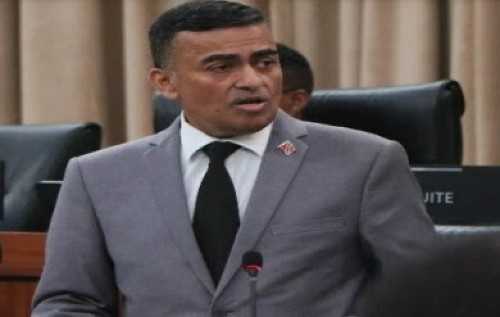 Finance Minister Davendranath Tancoo tabling the Finance Bill in Parliament on Friday (CMC Photo)Finance Minister Davendranath Tancoo tabled the Finance Bill 2025, containing a number of legislative reforms, including several new road traffic penalties, an amendment to the Board of Inland Revenue (BIR) and a Commercial Asset Levy that the Finance Minister said ensures large financial entities “make a fair and proportionate contribution to national revenue”.
Opposition Leader, Pennelope Beckles said the bill will have the opposite effect of what it is intended to do, which is, make legislative changes to give effect to proposed policies laid out in the national budget that was presented in October.
“Mr Speaker, a number of the measures are ill-conceived and are designed to inflict further pain to the people of Trinidad and Tobago. It is true to say that over the next couple of months we will see unfolding that these measures will actually bring more hardship to the people of Trinidad and Tobago.
“There are actually no measures in place for the people of Trinidad and Tobago to feel that this government is governing with any kind of equity. The Finance Bill is not a revenue plan, it reads more like a punishment plan. It is designed to squeeze water out of stone and place a heavy and extreme burden on the people of Trinidad and Tobago,” the Opposition Leader said.
She recalled, when in opposition, Prime Minister Kamla Persad-Bissessar had warned against placing heavy taxation on the citizenry, noting that the government has now introduced the commercial tax and landlord surcharge which requires every landlord to register the property and provide the description of properties and it purpose.
She also asked how the added five per cent surcharge interacted with the business levy that currently exists.
“It matters not if it is a surcharge or whatever they call it, it is a tax on homes. Who will pay that tax? It is simple to say that these people are in business and that tax is going to be passed on to every member of the public.”
She said the population had been hoodwinked when the current administration said it was abolishing the property tax that several home owners had already paid.
In his presentation, Tancoo said the legislation is a decisive step towards strengthening governance, modernising outdated laws, boosting public safety, and ensuring greater fairness in Trinidad and Tobago’s tax system.
He told legislators that the 23 clauses in the bill will amend 21 pieces of legislation, updating penalties, closing loopholes and introducing new revenue measures.
For instance, motorists who run afoul of the traffic laws could face fines up to TT$24,000 with Tancoo saying that the amendments reflected the government’s comprehensive strategy to improve public safety, reduce traffic violations, and ensure that penalties remain proportionate to current socio-economic realities.
The Finance Minister said that it was also sending a clear signal that road traffic offences are serious breaches of the law as they pose risks to the lives and property of all who use the nation’s roads.
Tancoo said that a new surcharge on rental income, coupled with mandatory property registration, will also take effect with the rates being 2.5 per cent on quarterly rental receipts of TT$20,000 or less and 3.5 per cent on amounts above that threshold
He said unregistered rentals and false declarations will attract penalties of TT$250,000 and three years’ imprisonment.
He said with regards to the electricity surcharge, there will be a five-cent charge per kilowatt hour on commercial and industrial electricity consumption and that certain public institutions, including schools and healthcare facilities, are exempt.
The legislation also provides for a five per cent tax on the CIF value of specified imported single-use plastics, including plastic bags, packaging, cutlery, and PET preforms, which the government said would align the country with global environmental standards.
The government has introduced amendments to the Gambling and Betting Act, significantly increasing fines and introducing tougher custodial penalties for illegal lottery operations.
The Finance Minister told legislators that the police have complained about illegal gambling being deeply intertwined with “tax evasion, money laundering, prostitution and drug trafficking”.
“For too long, illegal gambling has thrived due to low and outdated penalties. All illegal lottery activities will not be tolerated,” he said, the Finance Bill also provides changes to the National Lotteries Control Board (NLCB), including quarterly rather than annual deposits into the Consolidated Fund and a new offence targeting persons who illegally print, sell, or distribute tickets based on NLCB online draw results.
He said penalties will range from TT$250,000 and three years’ imprisonment on summary conviction to three million dollars and seven years’ imprisonment on indictment.

