


Prime Minister Pierre Promises Continuation of Policies of His First Administration
CASTRIES, St. Lucia – Phillip Joseph Pierre was sworn in Friday as St. Lucia’s 12th prime minister since the island attained political independence from Britain in 1979, promising to continue the polices of his previous administration that resonated with the vast majority of voters in Monday’s general election.
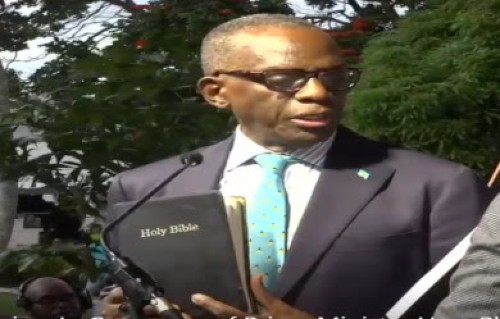 Prime Minister Phillip J Pierre, taking his oath of office on Friday (CMC PHoto)“I am excited and optimistic about the future of St. Lucia. I pledge to do my best for the development of my country. It is with humility and honour that I accept the mantle of Prime Minister for a second term,” Pierre said after he was sworn into office by Governor General, Sir Errol Charles at his official residence on the Morne, overlooking the capital.
Also present at the ceremonies were the prime ministers of Antigua and Barbuda, Barbados, Dominica, Grenada, St. Kitts-Nevis as well former St. Vincent and the Grenadines prime minister Dr. Ralph Gonsalves.
In his acceptance speech, the 71-year-old Pierre, who became the ninth person to be sworn in as a head of government since independence, said he was happy to be addressing the country “in the right mood” after he led his St. Lucia Labour Party (SLP) to a convincing victory, winning 14 of the 17 seats in the Parliament.
Two of the other seats were won by “independents” who were part of Pierre’s first administration, while the main opposition United Workers Party (UWP) will be represented by Allen Chastanet, who on Friday announced his resignations as party leader.
“I am overjoyed and grateful to the people of St. Lucia for electing the party that I have the honour to lead,” he said, adding that “today marks a historic achievement for the St. Lucia Labour Party being the only party in St. Lucia to have won a second consecutive term in the last 20 years”.
Pierre said what was even more remarkable is the fact that the party has done so increasing “both its share of popular votes and the majority of the parliamentary seats”.
Pierre said he was pleased that the electorate had backed the many policies of his first administration and that his government would continue to remember the vulnerable in society as well as implement policies that will prevent young people from joining gangs.
“WE cannot speak of preserving human dignity and a more equitable society if we are not prepared to address the basic needs of the vulnerable and the differently abled so that everyone can have a dignified existence.
“In our new term we will continue to target interventions to those most in need. We cannot develop a dual society where any demographic is allowed to go adrift. I speak to the disenchantment of our young male, who are disengaged from the developmental process,” Pierre said, promising to inject resources at addressing the need of this demographic.
“Gang membership and unlawful codes of behaviour should not be a desirable alternative for our young men. We call for zero tolerance towards all forms of deviant behaviour that is likely to destroy our society”.
Pierre said that the new cabinet will be announced and sworn into office next week, noting that among the new policies will be efforts to deal with what he termed the “weight” of negativity” pulling down St. Lucians.
“If we are not careful we will pay a heavy price. My government will therefore do all it can to help reverse this trend of negativity,” he said, calling on the society not to encourage division and hate “as normal behaviour”.
Pierre said that the new administration would have a “mandate to carry out the promises we have made to you” including embarking upon “an impactful public sector investment programme” that would include the upgrading of the Hewanorra International Airport, water supply infrastructure and investment in citizen’s security.
He said the foreign policy would result in Castries continuing its active participation in the sub-regional Organisation of Eastern Caribbean States (OECS) and the wider Caribbean Community (CARICOM) while subscribing to “the principle of sovereignty and peace in our region”.

