


BRIDGETOWN, Barbados – The newly formed coalition People’s Coalition for Progress (PCP) says it intends to cause an upset in the February 11 general election in Barbados and has accused Prime Minister Mia Mottley of calling a snap general election regardless as to whether or not voters are prepared for the event.
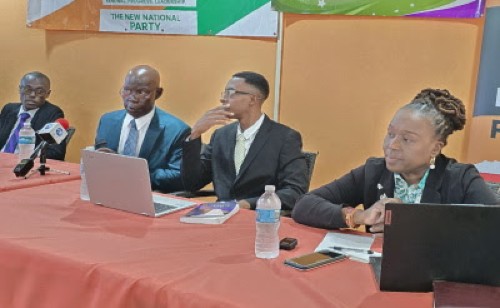 PCP leader, Lynette Eastmond, with other members of the coalition at the news conference.The PCP comprises The United Progressive Party (UPP), the New National Party (NNP) and the Conservative Barbados Leadership Party (CBLP) and it is the fourth political party to have indicated an intention to contest the general elections that Prime Minister Mottley called a year in advance for a second consecutive time.
The other parties are the ruling Barbados Labour Party, (BLP), the main opposition Democratic Labour Party (DLP) and the newly formed Reform Barbados headed by Steve Prescott, a British-born employment rights attorney with Barbadian roots.
Nomination Day is January 27. In the last two general elections, the BLP won all 30 seats in ther Parliament.
PCP leader, Lynette Eastmond, a former minister of commerce, consumer affairs and business development, told a news conference that Prime Minister Mottley’s decision to call the early poll was putting voters at a disadvantage voters rather than the political parties.
“You just call a snap election. Whoever ready, ready. We ready because we knew when it was going to be called. Let the others do whatever they please.
“That’s not fair. I’m not saying it isn’t fair to the parties, you know? I’m saying it’s not fair to the people of Barbados who should have a clear opportunity to determine who they would vote for, not vote for the loudest or stay home, because you realise that many Barbadians aren’t bothering to go out to vote,” Eastmond said, warning of voter apathy, especially in the constituency in the capital.
“We don’t treat the people as though they live in the capital of Barbados. So they don’t go to vote, and many Barbadians have stopped voting. I’m here to ask them to come back out to vote, which is markedly different; do not stay at home.”
Eastmond, who served as a research fellow for the Netherlands -based International Fiscal Association, spoke of the importance of moving away from a two-party system, noting that several countries with multi-party parliaments rank highly on the Human Development Index (HDI)..
“In Hong Kong, in some of these countries, they have over 12 parties represented in Parliament, and they also have coalitions in Parliament. When is Barbados going to move towards that, or are we suffering from arrested development?”
Eastmond also called for electoral reform, criticising the first-past-the-post system and advocating proportional representation.
“First past the post is an old-fashioned system of determining how people vote. It’s all ridiculous. So only 73 per cent of the population voted for the Barbados Labour Party but they took up all the seats. That’s not right. When we are given the opportunity to represent the people of Barbados, we will change that, because that needs to be changed.”
She told reporters that there should be fixed election dates and a broader political representation in Parliament, even as she questioned the size of Parliament, arguing that it is disproportionate to Barbados’s population.
“We don’t need 30 seats. No, it’s too big, not for a country with 300 000 people. It’s a joke. It’s too big and it’s too costly… It is totally unnecessary. It’s another burden on Barbadians.”
CBLP leader Corey Beckles said the coalition is offering renewed leadership and energy, arguing that Parliament needs new voices.
“We need fresh voices in Parliament… after many, many years of promises, after promises not being kept … sometimes our motivation starts to wane,” said Beckles.
“But you see us, we got the early tiger… the strong foundation, the strong motivation that will take this country into a new level of governance.”
Candidates will contest the election individually, as with other political parties, with elected members determining who would become prime minister, the PCP said, adding that its full list of candidates will be made public soon.

