


Grenada's Government Presents EC$1.9 Billion Budget to Parliament
ST. GEORGE’S, Grenada – Grenada's government has presented an EC$1.9 billion (One EC dollar=US$0.37 cents) budget to Parliament saying the fiscal package is more than a policy document and is a national call to action.
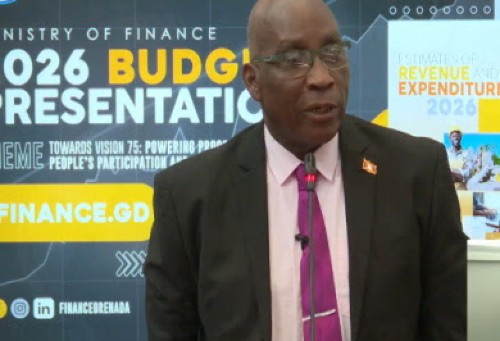 Finance Minister Dennis Cornwall presenting the 2026 national budget to Parliament (CMC Photo)Finance Minister Dennis Cornwall told legislators that the package, which is EC$47.1 million more than last year’s budget “signals our deepened commitment to citizen engagement and our determination to advance the bold reforms that continue to position Grenada among the most forward-moving small states in the region, if not the world”.
Cornwall said that the Dickon Mitchell government remains unwavering in its commitment to protecting Grenadian households from the cost of living and global economic shocks and in order to ease the burden, it is maintaining and strengthening a comprehensive package of cost-of-living relief measures.
He said that this include direct support to bus operators to offset rising fuel and maintenance costs, keeping fares affordable for all commuters, petrol and diesel taxes remain reduced at EC$3.50 per gallon, helping families manage transportation and household expenses as well as a monthly EC$10 subsidy for households consuming up to 99 kWh.
He said that the value added tax (VAT) reduced by 50 per cent for households consuming 99–150 kWh per month as well as a solar PV systems provided to low-income households to meet their energy needs sustainably.
In addition, the government is extended VAT exemptions on 20 basic food and essential items, including cooking oils, baby diapers, and female sanitary products, fixed price of a 20-pound gas cylinder being maintained at EC$40.
Under the Christmas Free Barrel Programme, there will be a 100 per cent exemption from duties and taxes, including Customs Service Charge, on up to two barrels per household on food and other basic necessities, from December 8 to January 5 next year.
“These measures represent an investment of over EC$47 million, directly supporting Grenadian households from global pressures,” he added.
The budget is being presented under the theme “Towards Vision 75: Powering Progress Through People’s Participation and Innovation,” and Cornwall said it captures the essence of “our transformative journey over the past three and a half years”.
The budget has a Recurrent Revenue of EC$1.3 billion with Recurrent Expenditure estimated at EC$1.1 billion with Capital Expenditure pegged at EC$370.4 million.
Cornwall said that to support growth in real wages for public servants, and in the interest of sustainable wage bill management, he was encouraging “all parties to the negotiations to work assiduously to complete this process in the shortest possible time.
He said he was pleased to announce that the 2026 budget is fully financed and that the projected overall deficit of EC$309.8 million will be financed primarily through a drawdown of EC$257.3 million of government’s deposits, complemented by limited domestic and external financing.
“This financing strategy reflects the government’s continued commitment to prudent fiscal management and sustainability,” Cornwall said, adding “it is also worth noting, that due to the stronger-than-expected fiscal performance in 2025…the financing needs were significantly lower than anticipated.
“ As a result, the drawdown on deposits in 2025 was EC$29.1 million less than projected, allowing for a larger buffer of resources to support the financing of the 2026 budget,” he added.
Cornwall said that while the rules and targets under the Fiscal Resilience Act (FRA) are further suspended in 2026 to allow continued support for post-Hurricane Beryl reconstruction and resilience-building initiatives, the government remains steadfast in its commitment to sound fiscal management and transparency.
“We will return to full compliance with the Fiscal Resilience Act, once conditions permit, ensuring that this transition does not compromise macroeconomic stability and growth or social progress.
“Importantly, the government will continue to adhere to the FRA’s wage bill ceiling of 13 per cent of GDP(gross domestic product) in 2026. Our ongoing good-faith negotiations with public sector unions will be guided by fiscal responsibility, fairness, and the overarching goal of maintaining a sustainable wage bill framework in the years ahead.”
In his presentation, Cornwall said that in 2025 the Investment Migration Agency (IMA) delivered another strong and credible performance, reaffirming the Citizenship by Investment (CBI) programe “as a major driver of foreign investment and fiscal stability.
“By the end of the third quarter, the Agency had already achieved its budgeted revenue with a surplus and is on track to exceed the annual target by as much as 10 per cent. Two new developments—the One True Blue Beach Hotel and Residence, and the La Sagesse Collections—were approved, bringing the number of active CBI projects to eight and further strengthening investor confidence,” he said.
Under the CBI , foreign investors are granted citizenship of Grenada in return for making a substantial investment in the socio-economic development of the island.
Cornwall said that the IMA has advanced the Enhanced Local Developer Policy, opening new pathways for Grenadian developers and ensuring more of the programme’s economic benefits to remain at home.
He said it also enhanced due diligence, improved operational efficiency, and aligned its processes with emerging global standards.
“In 2026, the IMA will accelerate digital transformation, deepen diaspora engagement, expand into new source markets and strengthen customer service. The CBI Committee will strengthen its governance and oversight role.
“This will include the repeal and replacement of the existing legislation. Additionally, the CBI committee will make the necessary internal changes in preparation for the advent regulatory functions of the Eastern Caribbean Citizenship By Investment Regulatory Authority (ECCIRA),” Cornwall said.

