


BRIDGETOWN, Barbados – Prime Minister Mia Mottley has defended her government’s decision to push ahead with legislation that is designed and will be implemented with a clear purpose, to protect and to grow jobs, to enhance foreign and domestic investment, and to grow the for all Barbadians, especially in a very uncertain global environment.
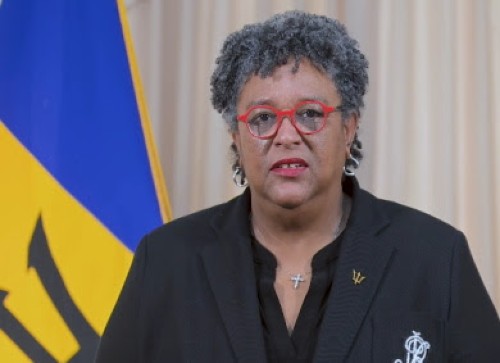 Prime Minister Mia Mottley addressing the nation on Sunday night (CMC Photo)In a national radio and television broadcast on Sunday night, Prime Minister Mottley said that while parliamentary proceedings are public and accessible, she fully accept that it is not reasonable to expect every citizen to watch Parliament, to read legislation, or to decipher financial language on their own.
She said with regards to the Economic Diversification and Growth Fund Bill much has been said publicly about the legislation.
“Some of it has been emotional, and yes, some of it has been political. But I do not dismiss emotion, and I do not dismiss concern. Once we slow the conversation down, and look carefully at the facts, a clearer and more balanced picture emerges.”
Mottley said that under the previous administration, in 2018 foreign international business companies were taxed at rates as low as 2.5 per cent and declining to 1.5 per cent, while local companies were taxed at 25 per cent.
“That is a fact. That system was judged by international regulators to be unacceptable given the ring fencing we provided in favour of foreign companies. In other words, there were two different regimes for foreign and local companies. More importantly, it therefore placed Barbadian businesses at a severe disadvantage in their own country. We corrected that and removed the disparity between the treatment of local and foreign companies with respect to taxation.”
Mottley told the nation that her administration was able to create a separate regime for small businesses, which is 5.5 per cent and other companies, whether local or foreign, are taxed at nine per cent.
“In addition, from the next financial year, 2026 to 2027, we expect that there will be a number of companies whose revenue exceeds Euro 750 million (One Euro=US$1.29 cents) will be taxed at 15 per cent which is the global minimum tax that the Organisation for Economic Co-operation and Development (OECD) prescribed.
If we do not do so, the country in which they operate businesses will have the right to tax any difference between what they pay here, below 15 per cent, and the actual 15 per cent. Accordingly, foreign companies now pay more, not less, than they did before we came to office.”
She predicted that some business will be paying more in the next financial year, saying “that is a fact, and that reform has brought in substantially more corporate tax revenue for Barbados, starting last year and continuing this year”.
She said revenue which the government has already begun to share with the population, and indeed to do the things to make this country stronger “helps protect our social services, our infrastructure, and indeed our stability and platform for prosperity.
“But my friends, that reform also created a new challenge. If we stop there, if we raise taxes but do nothing else, we risk losing existing investors, as has happened with the United States market in the last two years, and we have and will become unattractive to new ones without more.”
Mottley said that the country’s tax base becomes “very narrow and very tenuous”, even though the country is earning more revenue.
“In other words, a smaller number of taxpayers, even though you’re earning significantly more money because of the corporate tax reform of 18 months ago. This, my friends, is not sustainable for Barbados in the medium term. We need to encourage more companies with economic substance, local or foreign, to be operating here and to be creating jobs and to be earning foreign exchange and, yes, paying taxes.
“For you see, when substantive economic investment comes, we get jobs. And when those investors leave or shut down locally, those jobs go. Foreign exchange dries up and government revenue shrinks. These are all the facts of the lived Caribbean experience.”
She said Barbados experienced that situation with Intel when they closed in the early 1980s and so many others, adding “in fact, recently, in 2022, “we saw it with TT Electronics who left our shores and so went the jobs, the foreign exchange and the tax revenue from them.
“And in that case, it was approximately 350 jobs. Imagine the economic activity that they spawned locally from those 350 Bajans working. If we had been in a better position fiscally at the time, we would be in a position to see what support we could have put in place.
“But we were, as you know, in the middle of COVID, where we were having to do structural adjustment for the rest of the country to protect those who were not earning and to be able to expand significantly the amounts of money available to the Ministry of Health to keep people alive and to keep people well.”
Mottley said that the question before Barbados is simple but serious.
“How do we remain competitive for investment and jobs without violating international tax rules or without risk being blacklisted again? Please remember that blacklisting leads to companies wanting also to leave our jurisdiction, as companies are compromised in doing their business in the countries where Barbados is blacklisted.
“That is why we work so hard to remove the blacklisting, both as a result of the OECD and the financial action. We work so hard to remove the blacklisting, both as a result of the OECD and the financial action.
“We inherited the situation, but we accepted it was our responsibility to remove it, and we have been successful in removing it. My friends, the old tools are gone. The days of blanket tax holidays and deep tax concessions are over, and I will be real with you, they’re not going to be coming back.”
Mottley said that what remains is the need for “smart, lawful, transparent alternatives, and that is exactly what the Economic Diversification and Growth Fund is designed to augment, not replace, our economic toolkit”.
She said it allows Barbados to remain attractive for investment that earns foreign exchange, that creates jobs, and still pays taxes.
Prime Minister Mottley said that no investment or support will be given to any foreign company that does not significantly expand employment in Barbados.
“The bill speaks of at least 100 jobs being created to be eligible. And indeed, they must also earn foreign exchange above certain thresholds. These companies will still pay tax at nine per cent, not the old rates of 2.5 per cent declining to 1.5 per cent, so that they will be paying significantly more taxes”.
She said that those few companies subjected to the 15 per cent rate of tax will also pay that from next year.
“Equally important, this fund is not closed to Barbadians. Local companies with a foreign presence can also benefit. We want companies to also export capital so that when bad things happen here like a hurricane, they will be able to benefit by still having streams of revenue outside of Barbados.
“We’ve seen it with some of our larger companies that kept them afloat during the last decade. Our businesses benefit now and will continue to benefit through existing mechanisms, including, as I said, for small businesses, a lower tax rate of 5.5 per cent.”
Mottley said many of these companies who are local will have access and have had access to the Industrial Credit Fund, the Agricultural Development Fund, the Best Programme for Tourism that we designed in the heart of COVID, and the Small Hotels Investment Fund, which the government is bout to recapitalise.
She said that this is not an either-or proposition, it is both, as it was always when Barbados was liberally offering far more generous tax concessions to foreign companies.
“The difference is that you and the public never understood fully the quantums because that was done between the revenue authority and the particular companies anchored by legislation, that passed Parliament, but the amounts were never known to the public.
“That is what happens when it is a tax concession because you lose the right to earn that money. But with a subsidy, you earn money but you spend the subsidy and pay the company the money.”
Mottley said she also wanted to address issues about governance, oversight and accountability, because yes, your concerns are legitimate.
“Every cent that enters this fund and every red cent that is spent will be accounted for. The fund is administered by the accountant general. It will be audited by the auditor general. The applications are assessed by a broad-based advisory committee that includes public servants and private sector expertise.”
She said that the committee is chaired by the director of finance and economic affairs and also has on it the governor of the central bank and the chief executive officers of Export Barbados and Invest Barbados and two members of the private sector who must have experience in finance or business administration.

