


UN Security Council Renews Mandate of Gang Suppression Force in Haiti
UNITED NATIONS – CARICOM has welcomed the decision by the United Nations Security Council in adopting a resolution re-authorising the Gang Suppression Force (GSF) in Haiti for six months, until 31 March 2027.
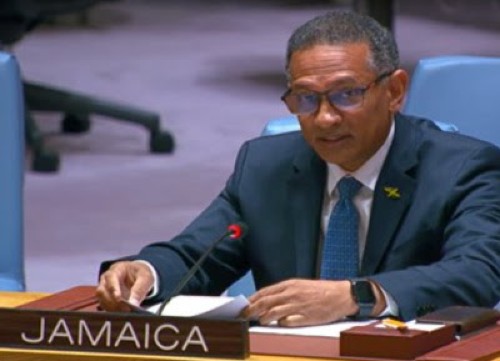 Jamaica’s ambassador, Brian Christopher Manley Wallace, who spoke on behalf of CARICCOM (CMC Photo)The GSF had replaced an earlier Kenyan-led security mission. About 1,500 to 1,600 personnel are currently deployed with its main function being to restore public safety, secure vital infrastructure and allow the government to function. The GSF is expected to reach its quota of 5,500 personnel in Haiti by October 2026
Speaking on behalf of the 15-member regional integration grouping, Jamaica’s Ambassador, Brian Christopher Manley Wallace welcomed the renewal, but said deployment has been slower than needed.
He called for sustained financial, logistical and operational support, including airlift, monitoring equipment, training and translation.
The Jamaican diplomat also urged greater attention to violence against women, girls and young people, as well as the recruitment of children by gangs.
“ Improved security must pave the way for elections and the restoration of democratic governance led by Haitians,” he said.
In welcoming the six-month renewal of the GSF, Haiti’s Ambassador Pierre Ericq Pierre called for the personnel, equipment and operational arrangements needed to deploy it fully.
He said the goal is to help Haitian authorities regain areas held by gangs, secure critical infrastructure and create conditions for elections.
“It is not enough to take territory from the gangs,” he said, adding that recovered areas must be held, public services restored and gangs prevented from returning.
The Haitian diplomat said that the GSF must work closely with the Haitian National Police and armed forces while strengthening Haiti’s own capacity and respecting its sovereign responsibilities.
The United Nations Secretary General, Antonio Guterres also welcomed the decision by the UN Security Council.
“I can tell you that the Secretary-General welcomes the adoption of resolution 2829 (2026) which renews the mandate of the Gang Suppression Force and extends the mandate of the UN Support Office in Haiti (UNSOH),” said Guterres spokesman, Stéphane Dujarric.
He told the daily UN news briefing that the Secretary-General has also called on member states to build on this momentum by working without respite to ensure the timely deployment of the remaining personnel so that the Force can fully undertake its important mandate.
“The Secretary-General takes this opportunity to recall that security support is imperative to creating the space for progress, including towards the restoration of democratic institutions through the holding of peaceful and inclusive elections, and must also be accompanied by sustained efforts to address the broader challenges facing Haiti, including the political, institutional, human rights, humanitarian and development dimensions of the crisis,” he added.
China, Pakistan and Russia abstained during the vote while 12 countries voted in favour and none against.
The text for the resolution had been put forward by the United States and Panama.
The US Ambassador Michael G. Waltz told the Council that after decades of international missions and spending in Haiti, gangs have grown stronger while the country’s institutions have weakened.
“We have to ask ourselves: ‘For what?’,” he said. The Gang Suppression Force, re-authorised today along with the UN Support Office in Haiti, “exists and, better yet, it is beginning to work,” he said.
The Force is “taking the fight to the gangs”, he said, clearing roads and neighbourhoods, reopening areas once inaccessible to the Haitian National Police and shutting down illegal tolls that fund gangs.
The US diplomat paid tribute to personnel from Chad, El Salvador, Guatemala, Jamaica, Mongolia and Sri Lanka serving in Haiti, noting that their work could help Haitians “win back their streets, their lives and their futures for their families”.
Panama’s Ambassador Eloy Alfaro de Alba expressed condolences for those killed in the Artibonite region on September 28, saying that the willingness of the Council members to bridge differences and show solidarity with the Haitian people had made the renewal possible.
He also highlighted a joint declaration by the Organization of American States.
“Behind each decision adopted in this Council are the lives of millions of people,” he said, adding that lasting peace and stability in Haiti will require complementary actions that address every dimension of the crisis.
Warning that drug trafficking and other illicit activity could provide new funding for gangs, Ambassador José Mauricio Gaona of Colombia said changing course on the Gang Suppression Force now would be a mistake.
He said extending its mandate will support deployment and allow the Council to assess its performance in March.
The Colombian diplomat said that as gangs expand into new areas and violence against civilians grows, Haiti needs a firm response.
“Restoring security is essential to peace and the restoration of its democratic institutions.”
The UN Security Council first authorised the GSF on 30 September 2025 for an initial 12 months. It is a non-UN multinational mission tasked with combating armed gangs.
The resolution had also requested that the Secretary-General establish a UN Support Office in Haiti to support the Force. The Office also supports the Haitian National Police and armed forces during joint operations with the Force, as well as the UN Integrated Office in Haiti.
Meanwhile, Dujarric told reporters that many communities in Haiti are at risk during this Atlantic hurricane season, which will continue through the end of November.
He said nearly 1.5 million people are displaced across Haiti and the majority of them live outside Port-au-Prince, staying in overcrowded collective shelters, with host families or in informal sites.
“All of this leave them exposed to flooding, landslides and severe weather. Our humanitarian partners are working with national and local authorities in early warning, contingency planning and prepositioning of essential supplies to be ready before the storm hits.
“However, insecurity and funding shortfalls continue to hamper our work. This year’s humanitarian appeal for Haiti seeks $880 million to support about four million people is less than half funded. We ask for more money and more flexible money to help fund these operations,” Dujarric said.

