


Trinidad and Tobago Government Defends Imposition of State of Emergency
PORT OF SPAIN, Trinidad – The Trinidad and Tobago government has defended the imposition of yet another state of emergency (SoE) less than two months after a more than year long similar measure had been lifted even as the opposition questioned the motive behind this new declaration.
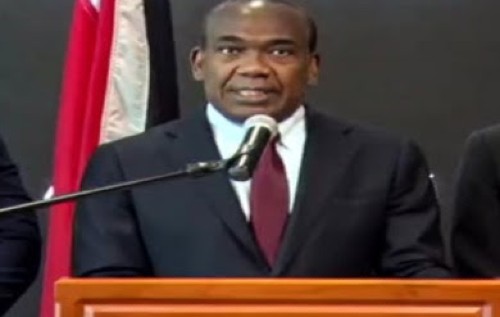 Attorney General John Jeremie defending the imposition of state of emergency (CMC Photo)Attorney General John Jeremie told a news conference that the government had no choice and was not willing to allow the country to return to the position it had been prior to the election victory of the United National Congress (UNC) coalition headed by Prime Minister Kamla Persad-Bissessar in April last year.
“This government is determined to never allow this country to deteriorate into the state of chaos and bloodshed, which we met in May of 2025 when we took office. We shall never accept the slow, dangerous surrender to the criminal gangs in our midst. There are examples in the region of territories that have allowed that. Trinidad and Tobago’s fate will be different,” Jeremie told reporters. Watch video
Just after 4.00 am (local time) on Tuesday, Prime Minister Persad-Bissessar issued a statement indicating she had asked the President Christine Kangaloo to place the country under a state of emergency following a meeting of the National Security Council (NSC) on Monday.
“This measure is consistent with your Government’s zero-tolerance approach to crime and criminal gangs, as demonstrated by numerous successful, strategic operations conducted by the Trinidad and Tobago Police Service and the Armed Forces over the last 10 months, legislation introduced in Parliament to empower and protect law-abiding citizens, and ongoing reforms to the criminal justice system,” she said in the statement.
Prime Minister Persad-Bissessar said that following the end of the previous state of emergency on January 31st, 2026, “there has been an increase in violent criminal activity across the country, most of which has been carried out by members of organized criminal gangs.
“The NSC further noted that several of these acts of criminality have resulted in multiple deaths due to mass shootings and that the continuance of reprisal shootings amongst criminal gangs, if left unchecked, would endanger public safety.”
Jeremie told reporters that the protective services will act in accordance with the law and that under the conditions of the SoE, the Trinidad and Tobago Police Service and the armed forces “will be able to do what they are entrusted by law to do in a manner that would match the escalating danger that is being posed to all of us as law abiding citizens and to the very rule of law in Trinidad and Tobago.
“From the very early hours of this morning, strategic operations have commenced by the protective services. These will continue in an intelligence led, targeted and deliberate manner until these threats to public safety are eliminated,” he added.
The Attorney General also said that the government cannot condone the violence.
But Opposition Leader Penelope Beckles, who questioned the whereabouts of Prime Minister Persad -Bissessar, said that as the chair of the NSC she should have been present at the news conference where the Attorney General spoke to reporters.
“Because I’m sure that you, the members of the media, would have had a lot of questions to ask. So we continue to have a missing Prime Minister from these press conferences. And I call on the Prime Minister again to make herself available to take questions from the media as it relates to this very important matter of the state of emergency.
“In this recently concluded state of emergency, we must ask ourselves how many of the hundreds of persons that were arrested and kept in custody, how many of those persons were charged?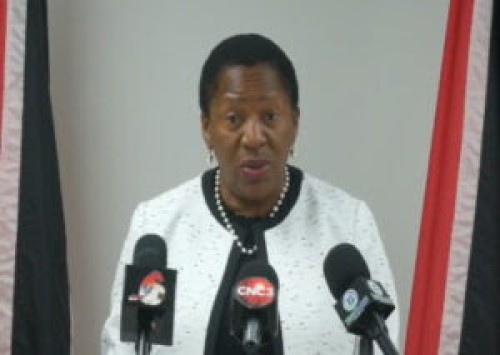 Opposition Leader Penelope Beckles speaking at news conference on Tuesday (CMCC Photo)
“How many of those persons were convicted? But here again, they are calling another state of emergency,” she told reporters.
Former junior minister of national security and criminal defence attorney, Keith Scotland said this latest SOE is proof that the UNC administration cannot solve the crime problem facing the country.
“While we were sleeping, the government declared yet another state of emergency. It’s critical because this is the implementation of a series of extraordinary powers by this administration, which we see demonstrates the lack of capacity of this government to govern Trinidad and Tobago and to deal with crime. Watch video
“Is the government’s crime plan merely a recycling of declarations of states of emergency and blaming the opposition?” he asked.
While there is no curfew announced as part of the SoE, the regulations grant sweeping powers that could affect social media use, protests, police searches and detention.
However, the Commissioner of Police is authorised to prohibit persons from being out of doors during specified hours.
If a curfew is imposed, persons would be allowed outside during those hours only with a written permit. The Commissioner can also require individuals to notify a specified authority of their movements at particular times.
The regulations do not specifically mention “social media”, but they contain broad language that can apply to online platforms. For example, it is an offence to endeavour—orally or otherwise—to influence public opinion in a manner likely to be prejudicial to public safety. That wording can extend to posts, videos or messages shared online.
It is also an offence to have any article in your possession with the intent of making or facilitating such an endeavour. An article could include a mobile phone, computer or other electronic device.
The Commissioner of Police may impose restrictions on any person regarding their association or communication with other persons. The President also may make Orders authorising the search of computers and electronic devices seized by police.
Protests, gatherings and movement
Although the word “protest” does not appear in the regulations, the powers granted can affect public demonstrations and gatherings.
The Commissioner of Police may restrict a person’s association with others and can require a person to leave a specific place or prohibit them from entering certain areas.
Any location can be designated a “protected place”. Entering such a place without authorisation is an offence, and police may search or remove anyone found there.
The same public safety offence relating to influencing public opinion could apply to speeches or organised efforts during a protest.
Police have expanded powers to act without a warrant. An officer may enter and search any premises if they suspect that evidence of an offence under the regulations is likely to be found. Officers may use force, if necessary, to gain entry.
Police also may stop and search individuals, vehicles or vessels, whether in a public place or not. A police officer may arrest a person without a warrant if the officer suspects the person has acted, is acting, or is about to act in a manner prejudicial to public safety. Anyone driving a vehicle must stop when required to do so by a uniformed officer.
Members of the Defence Force may be called out to assist the police and, when doing so, have the same powers as a police officer.
The Minister may order preventive detention to prevent a person from acting in a manner prejudicial to public safety. A detained person can be held in a place and under conditions directed by the Minister.
Persons detained under the regulations or charged with an offence where there is an apprehension they might incite breaches of the peace, can be denied bail. In such cases, the writ of habeas corpus does not lie, and judges cannot exercise jurisdiction to grant bail.
Offences under the regulations carry a fine of TT$100,000 and imprisonment for five years.
The regulations remain in force for the duration of the State of Emergency unless amended or revoked.

