


HAVANA, Cuba – Cuba says it will withdraw all its medical professionals from Jamaica less than 48 hours after Kingston said it was discontinuing the current arrangement with Havana regarding the deployment of Cuban medical professionals in the public health sector.
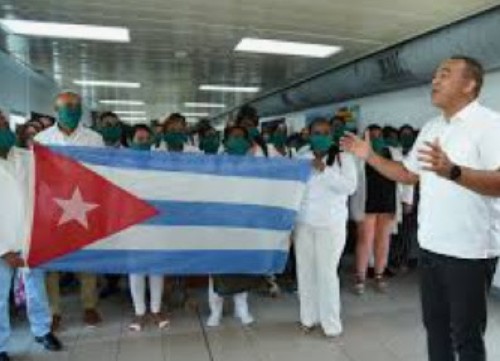 Cuban health workers in Jamaica (File Photo)“Cuba regrets the decision of the government of Jamaica to cease medical cooperation, yielding to pressure from the U.S,” according to a statement issued by the Ministry of Foreign Affairs.
It said that on March 4, the Foreign Ministry of Jamaica communicated to its embassy in Kingston “the unilateral decision of its government to terminate the health cooperation agreement that has linked both nations for decades.
“With this action, the government of Jamaica yields to the pressures of the government of the United States, which is not concerned about the health needs of the Caribbean brothers.
“Cuba deeply regrets that in this way a history of fruitful and sustained collaboration is disregarded, one that has brought countless benefits to the Jamaican people, who are now deprived of receiving the basic and specialized health services that Cuban collaborators provided.
“In response to the step taken by the government of Jamaica, the government of Cuba has made the sovereign decision to proceed with the return of the Cuban Medical Brigade. These health professionals leave behind an indelible mark and return to Cuba with the satisfaction of a duty fulfilled and the permanent willingness to assist wherever their spirit of solidarity is required,” the Ministry of Foreign Affairs said.
On Thursday, Kingston announced that it was discontinuing the current arrangement saying that the decision comes as both governments were unable to agree on the terms and conditions of a new technical cooperation arrangement, following the expiration of the previous agreement in February 2023.
“In the interest of continuity of the valuable service provided by the Cuban medical professionals present in the country, and for their personal certainty and well-being, the Government of Jamaica has indicated its willingness for the Ministry of Health and Wellness to engage these medical professionals on an individual basis, in keeping with local labour laws. This arrangement would last for the remainder of their scheduled tenure in Jamaica under the programme,” the Jamaica government said.
Foreign Affairs Minister, Kamina Johnson Smith, told the Jamaica Parliament on Thursday that the government’s decision to discontinue the 50-year-old medical cooperation programme with Cuba was not influenced by the United States. She said the move stemmed from unresolved issues in renegotiating the agreement.
“We are in an environment where it is clear that there have been concerns expressed by the United States government about the operation of Cuban medical programmes across the world. So, clearly, they had expressed concerns about all programmes and accordingly would have expressed concerns about Jamaica.
“You would have heard us defending the programme in various contexts because when they come here we do our very best to be respectful and ensure that our treatment of them accords with the laws of Jamaica and best international labour law practice. Where the programme came into conflict with those things, unfortunately we were unable to reach agreement on correcting them, and that is why the programme has ended,” she explained.
Last month, the United States Embassy in Barbados said the Cuban regime’s “medical missions” programme, which has benefitted several Caribbean countries “relies on coercion and abuse.
“Cuban medical workers face withheld wages, confiscated passports, forced family separation and exile, restriction of movement through curfews and surveillance, intimidation and threats, and even pressure to falsify medical records and fabricate procedures. Many also endure excessive work hours and unsafe conditions,” the Embassy said.
Washington has also stepped up its attack on the Cuban health brigade programme, saying that the regime in Havana is profiting off the forced labour of medical personnel and that “renting out Cuban medical professionals at exorbitant prices and keeping the profit for regime elites is not a humanitarian gift.
The move by Kingston was welcomed by United States legislator, Carlos Gimenez, who last month had accused Jamaica of covering up for the Cuban dictatorship after Prime Minister Andrew Holness had highlighted the economic hardship, energy shortages, and growing humanitarian challenges being experienced in Cuba in his speech at the opening Caribbean Community (CARICOM) summit in St. Kitts and Nevis.
Gimenez, who is a member of the House Committees on Armed Services and Homeland Security, in welcoming the Jamaica government position, said “In the US Congress, we thank the people of Jamaica for ending this pathetic, criminal human trafficking operation with the dictatorship in Cuba.
“Doctors were human trafficked, their wages garnished and subjected to inhumane conditions amounting to modern day slavery,” said Gimenez, the Congressman serving Florida’s 28th Congressional District.
In its statement, the Ministry of Foreign Affairs said Cuba’s work in Jamaica is “an eloquent example of genuine cooperation” and that in the last 30 years alone, more than 4,700 Cuban collaborators have provided medical assistance on the Caribbean island.
“Currently, the Brigade was composed of 277 professionals whose work has had a tangible and profound impact on strengthening the Jamaican health system. The historic results of this collaboration speak for themselves: More than 8,176,000 patients treated. 74,302 surgical procedures performed. 7,170 births attended. More than 90,000 lives saved.”
Havana said through the Operation Miracle programme, present in Jamaica since 2010, the sight of nearly 25,000 Jamaicans has been restored or improved, adding that Cuban cooperation has also been decisive in projects for the control and prevention of diseases such as malaria and in the fight against the COVID-19 pandemic.
“The most recent example of this dedication was seen after the passage of Hurricane Melissa, which severely affected the island. In those difficult circumstances, the Cuban Medical Brigade remained firmly at their posts, many of its members working for more than 72 consecutive hours and actively joining the tasks of recovering hospitals and communities.
“Faithful to the historic relations of brotherhood and solidarity that unite us with Jamaica, Cuba reaffirms its unwavering commitment to the Jamaican people, who will always be able to count on the selfless cooperation of Cuba,” the Ministry of Foreign Affairs said.
Jamaica’s Health Minister Dr. Christopher Tufton said at least 300 Cuban healthcare workers will be impacted and that the issue will create a gap in the healthcare system.
He said that provisions will be made for the Cubans to sign individual contracts with Jamaica.
“It is a loss in terms of the gaps and in terms of the relationship. Nevertheless, just to make it clear that the nature of the proposed new approach is to offer individual contracts to the Cuban healthcare workers. So they do have the opportunity to stay and to sign individual contracts. And we are just seeking not to renew the expired MOU, which had a different set of rules of engagement,” he told Radio Jamaica News.
Tufton said a determination will be made within the next few days on the way forward.

