


GEORGETOWWN, Guyana – The 70th annual meeting of the Trinidad-based Caribbean Public Health Agency (CARPHA) began here on Wednesday with Guyana indicating that it is prepared to assist regional countries in the area of telemedicine as well as the implementation of artificial intelligence in healthcare delivery.
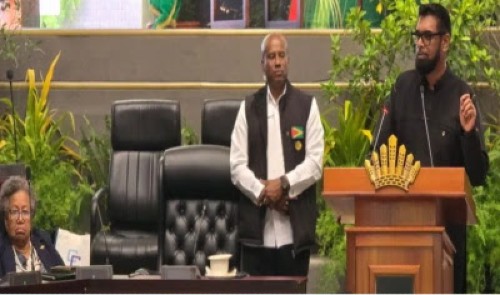 CARICOM Secretary General, Dr. Carla Barnett, listens attentively as President Irfaan Ali addresses opening of CARPHA’s 70th annual meeting in Guyana.“Today, in Guyana, we’ve embraced telemedicine because of our geographic layout and we’ve already seen great success, we’ve seen lives saved, we’ve seen need for medical evacuation reduced and we’ve seen greater support by specialist staff to others in hinterland and remote areas,” President Dr. Irfaan Ali told the ceremony.
“I think, per capita, we may have the highest telemedicine reach maybe globally but definitely in this region and we’re ready to deploy this investment for the rest of the region,” he added.
Guyana’s telemedicine programme launched in 2022, connects remote hinterland and riverine communities with specialists, rapidly expanding to roughly 130 sites by early 2026. The initiative uses real-time video, audio, and diagnostic tools to improve healthcare access, supported by a digital health records system and training for local health workers.
The government plans to develop 50 more sites this year and President Ali said Guyana is ready to work with the rest of the region in rolling out this initiative, with Georgetown as a hub.
“We’re ready to partner with the rest of the region in creating a telemedicine hub here in Guyana to support the rest of the region whether it’s for clinical care, research or educational purposes,” he said.
The Guyana head of state also spoke of his administration’s investment in utilising artificial intelligence in healthcare, specifically in diagnostics, and that Georgetown is also willing to share that initiative with the wider Caribbean.
“Historically, it may have taken us a day to organise a scan and then another day to read it. Today, you can get a scan done and evaluated in three minutes with AI,” he said.
“We have brought in the technology that allows us to do that here in Guyana. We have already implemented it in four of our facilities, and we would love to share that experience with you,” he added.
The CARPHA conference has brought together regional and international health professionals to discuss innovations and collaborative approaches to improving public health across the Caribbean.
In her address to the opening ceremony, Caribbean Community (CARICOM) Secretary General, Dr. Carla Barnett said she regarded the focus on “Innovations in Health”, as a deliberate strategy to safeguard the region’s future, building on the 2011 vision of regional governments when they established CARPHA as an effective declaration that CARICOM would move as one in matters related to health.
She said that this collective approach, grounded in surveillance, laboratory strengthening, and research, remains one of our most critical defences against health threats.
She said CARPHA, as the region’s premier public health agency, works in collaboration with member states and other institutions, allowing for an inclusive approach in managing complex issues.
“This is bolstered by scientific research undertaken over many decades by The University of the West Indies, alongside other regional and international universities, independent researchers and scholars around the world. It is this broad, collaborative effort that transforms raw data into today’s life-saving policies and interventions.”
Barnett said that during the COVID-19 pandemic, countries rapidly deployed digital platforms integrating travel management with public health surveillance.
She said increased investments in laboratory networks and genomic surveillance have strengthened the region’s capacity to detect and respond to emerging threats.
“At the same time, mobile health outreach models continue to extend essential services to underserved communities. These are just some of the initiatives that demonstrate how innovation is being applied in practical ways to advance equity, resilience, and system performance across CARICOM.
”As we look to the future, the nature of innovation is already shifting beneath our feet. We are entering an era where Artificial Intelligence (AI), genomics, and digital health platforms are no longer futuristic, but offer an immediate path to leapfrog historical barriers.
“Imagine a Caribbean Community where genomic research enables us to tailor non-communicable disease treatments to our uniquely complex genetic heritage, or AI-driven surveillance that predicts a pandemic outbreak weeks before it hits our shores. These are the game-changing possibilities to safeguard the health and resilience of the people of the region.”
But Barnett warned that these possibilities come with a heavy responsibility and that innovation must be anchored by regional sovereignty which responds to the hard questions, some of which are being addressed by this conference.
She said these questions include “who owns the data generated in our clinics? how do we ensure our citizens are not just “data points” for external extraction, but are the primary beneficiaries of breakthroughs? how do we build a “Biobank” that protects our biological assets while advancing global science?
“Our goal must be a model of health innovation that is sovereign, fair, and rooted in trust,” she added.

