


Special Envoy Recommends Jamaica’s Programme For SIDS
KINGSTON, Jamaica – Jamaica’s Special Envoy for Climate Change, Professor Dale Webber, has lauded the country’s Adaptation Fund Programme (GOJ/AFP), saying that the initiative could become a “model for resilience building in Small Island Developing States (SIDS)”.
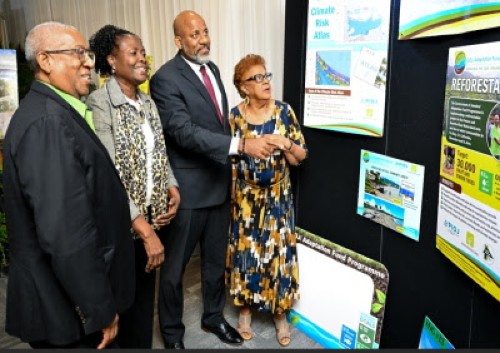 Special envoy for climate change, Professor Professor Dale Webber (left) joins other members of the Jamaica Government Adaptation Fund Programme (GOJ/AFP) in looking at the exhibition mounted at the end of the programme (JIS Photo)Addressing the closing ceremony of the GOJ/AFP, Webber said that while the project was driven by science, its success lay in its visible practical outcomes.
“What has been achieved here is not just theoretical…; what happened here was practical. It was visible, and it continues to be impactful. You have strengthened and stabilised coastlines, protecting critical infrastructure, including health facilities as well as community assets.
“You have supported fisheries and coastal livelihoods, helping communities adapt to changing marine ecosystems, especially with fishermen and the pelagics. You have advanced reforestation and improved land management practices, reducing soil erosion and improving watershed stability,” Webber said.
Webber, who was representing the Minister of Water, Environment and Climate Change, Matthew Samuda, at the ceremony, praised the programme’s achievements, which included capacity-building efforts such as training shelter managers and deploying the Climate Risk Atlas to enable evidence-based, risk-informed planning at the local level.
He also used the occasion to highlight the project’s focus on gender, which ensured that the resilience-building strategies were inclusive and equitable.
“The Adaptation Fund has been a critical partner in Jamaica and its climate journey. It has enabled us to pilot integrated community-based adaptation solutions, strengthening national institutions, building technical capacity, and developing a pipeline of scalable, bankable adaptation investments,” he said, urging international partners to ensure faster processing and greater access to climate finance.
“Jamaica has demonstrated that we can deliver on results. We have institutions, we have the capacity, we have the vision, and now we have the experience. We’re not short on ambition, but we’re often limited by funding,” Webber said.
He said that Jamaica must leverage available resources from funds like the Climate Investment Funds (CIF), Global Environment Facility (GEF), the Adaptation Fund or the Fund for responding to Loss and Damage (FRLD), to ensure climate programmes run uninterrupted and small-scale pilots transition into large-scale initiatives.
Delivered through the Planning Institute of Jamaica (PIOJ) the programme was implemented in 2013, in collaboration with the Office of Disaster Preparedness and Emergency Management (ODPEM), and National Environment and Planning Agency (NEPA).
It consisted of three interrelated projects that had the objective of building climate resilience in Jamaica.
Component one of the programme focused on increasing climate resilience of the coastline along the northeastern end of Jamaica, while component two dealt with improving water and land management in select rural farming communities.
The third component supported the first two projects through building local and national capacity at the community and institutional levels.
The authorities said each project met or exceeded its targets, delivering significant benefits to local farmers, fishers, small businesses, and institutions and that these efforts bolstered the nation’s climate resilience in direct alignment with the Vision 2030 Development Plan.

