


Guyana Welcomes United Nations Joining the Global Biodiversity Alliance
GEORGETOWN, Guyana - President Irfaan Ali has welcomed the decision by the United Nations to become a member of the Global Biodiversity Alliance (GBA) saying that it sends a “clear and unmistakable message”, that the protection of biodiversity is now central to the international agenda.
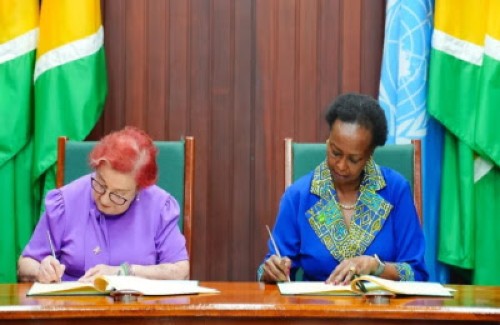 Minister of Parliamentary Affairs and Governance, Gail Teixeira and United Nations (UN) Resident Coordinator, Jean Kamau signing the agreement (DPI Photo)Ali speaking at a ceremony at the Office of the President, where United Nations Resident Coordinator Jean Njeri Kamau signed the Letter of Intent to join the organisation, described the UN’s participation as both a natural fit and a powerful endorsement of the GBA’s vision.
“It is natural because biodiversity protection has become central to the global agenda of the United Nations system, and it is powerful because the presence of the world’s foremost multilateral institution elevates the credibility, reach, and impact of this initiative.”
Kamu has since been presented with a certificate of membership of the Alliance that was launched in June 2025 with the Georgetown Declaration, beginning with 17 founding members.
“From the adoption of the Convention on Biological Diversity to the Sustainable Development Goals, the UN has consistently advanced the principle that humanity’s future depends upon living in harmony with nature,” said President Ali, noting that the UN has long stood at the forefront of global efforts to protect the environment and promote sustainable development.
He said that biodiversity protection must be integrated into agriculture, infrastructure, energy, tourism, urban planning and national economic policy. Ali said that this approach aligns directly with the GBA’s philosophy of moving biodiversity from the margins of policy into the mainstream of global development decision making.
“When the United Nations joins this effort, it sends a clear and unmistakable message: the protection of biodiversity is now central to the international agenda,” President Ali said, adding that the partnership lends greater standing and legitimacy to the Alliance, consolidating efforts, avoiding duplication and ensuring that global biodiversity action is more coordinated and impactful.
He said that through the GBA, there is now the opportunity to scale international collaboration to a broader global platform — sharing lessons, mobilising finance, strengthening institutions, advancing scientific cooperation and empowering communities that are the true custodians of biodiversity.
Ali said that while the Alliance continues to gain traction and international endorsement, much more remains to be done.
“We therefore use this moment to extend a strong invitation to other international organisations, development partners, multilateral institutions and sovereign states to join the Global Biodiversity Alliance.”
He said the crisis facing biodiversity is too large, too complex and too interconnected for any single country or institution to address alone.
“What is required is collective action at a scale never seen before — bringing together governments, international organisations, civil society, Indigenous Peoples, the private sector and scientific communities in a unified effort.”
The Alliance, he added, offers precisely such a platform: inclusive, action oriented and grounded in the principle that protecting nature is not only an environmental duty but also an economic and moral imperative.
The UN Resident Coordinator praised Guyana as a global leader in biodiversity and conservation, noting that the country’s dedication is both admirable and essential. She said this marks the beginning of even stronger and more coordinated efforts to protect one of the world’s most important assets.
Minister of Parliamentary Affairs and Governance, Gail Teixeira, signed the agreement with Kamau, who said the United Nations is pleased to have join the initiative, and that it is closely aligned with the world’s shared objectives of sustainable development goals (SDGs) while championing South-South cooperation.
The agreement also emphasises the importance of Indigenous Peoples and local communities in biodiversity conservation, recognising their knowledge and stewardship as essential to sustainable environmental management.
The partnership is expected to strengthen coordination, data-sharing and biodiversity action under the United Nations Multi-Country Sustainable Development Cooperation Framework and the Kunming-Montreal Global Biodiversity Framework, while supporting Guyana’s continued role in global climate and biodiversity diplomacy.

