


Caribbean and EU Form Joint Environmental Police Network
PORT OF SPAIN, Trinidad – Security officials from across the Caribbean, Latin America and Europe Friday initiated plans to establish a specialised police network to track and dismantle transnational environmental crime organisations operating in the region.
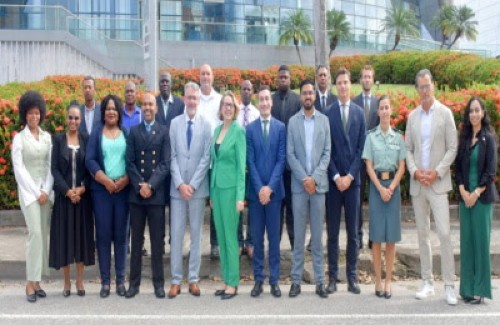 Participants at the inaugural meeting of the Caribbean Police Network to Combat Environmental Crime (CARICOM IMPACS Photo)The delegates gave the green light at the inaugural meeting of the grouping following an intensive two-day Waste Trafficking Workshop geared towards confronting the rapidly escalating global threats of waste trafficking and pollution crime
The newly proposed network will establish a structured regional mechanism to improve real-time intelligence sharing, coordinate joint investigations and dismantle criminal networks exploiting the Region’s unique geography and maritime routes.
The international and regional security experts attending the meeting held at the Trinidad-based headquarters of the Caribbean Community (CARICOM) Implementation Agency for Crime and Security (IMPACS), warned that environmental crimes, such as wildlife poaching, illegal logging and illicit mining, have evolved far beyond ecological threats, becoming major challenges to national security and regional governance.
Deputy Head of Mission, Delegation of the European Union to Trinidad and Tobago, Evelina Melbarzde, said that these activities directly undermine the rule of law and the stability of local communities.
She said whether dealing with timber, wildlife or waste, these offences rely on the exact same networks, maritime routes and illicit financial flows that sustain other criminal markets
Melbarzde said that EU views the creation of this network as part of a genuine, reciprocal partnership between the two regions, rather than a one-sided initiative.
“Our aim is not only to support individual activities, but also to build stronger bridges between Caribbean institutions, national law enforcement authorities and their European counterparts. In this way, cooperation with regional partners delivers value in both directions”, she said.
The Environmental Crime Lead at the CARICOM IMPACS, Virun Lutchman, spoke of the vulnerability of the Caribbean region’s geography to exploitation.
He said that transnational syndicates take advantage of vast maritime spaces and porous borders to move illegal goods, frequently combining environmental offences with document fraud, tax evasion and money laundering.
Lutchman stated that because these criminal networks operate across borders, a siloed national response was no longer viable, urging regional law enforcement to move towards a highly integrated model of policing, stressing that the proposed network was essential for closing the operational gaps that criminals currently exploit.
“No Caribbean country should have to face environmental crime alone. The regional geography, maritime space, biodiversity and strategic trafficking routes create vulnerabilities that call for a coordinated regional response”, he said.
Key expert for Environmental Crime, EL PACCTO 2.0 Alain Lemangnen, reinforced the call for structural unity, noting the defence of the environment is a matter of regional sovereignty. He warned that illegal exploitation directly threatens food security and exposes local populations to heightened risks from natural disasters
Lemangnen asserted that international agencies stand ready to provide specialised operational training but underscored the importance of local execution and long-term commitment to the network’s success.
“Beyond tools and structures, the long-term success of this initiative will depend on trust, continuity and shared commitment. It is about clearly stating that the Caribbean will not be a lawless zone when it comes to environmental protection”, he added.
He also urged participating States to designate national points of contact, enhance financial investigations and intelligence sharing as well as actively support the formation of permanent, specialised environmental law enforcement units
The network is supported by EL PACCTO 2.0 and CARICOM IMPACS, alongside international partners such as Interpol and the Spanish Civil Guard (SEPRONA). It aims to replicate the operational success of Latin American initiatives, like the Jaguar Network, while tailoring the framework to Caribbean realities.

