


Bahamas PM Says Climate Change is Not a Distant Risk to Be Modeled For Future Generations
NASSAU, Bahamas - Prime Minister Philip Davis has told an international climate change conference that for the Bahamas, climate change is not an abstract concept, nor is it distant risk to be modeled for a future generation.
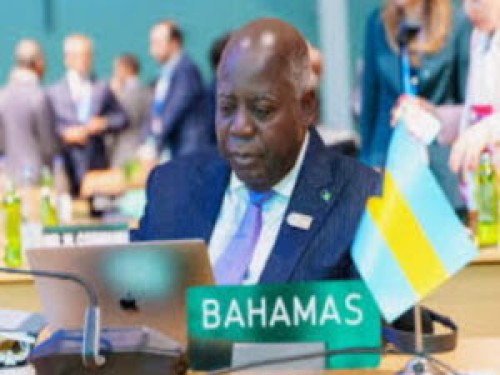 Prime Minister Philip DavisAddressing the weeklong conference that has brought together more than 200 of the world’s leading climate scientists to draft the Intergovernmental Panel on Climate Change (IPCC) Seventh Assessment Report, Davis said that the Bahamas regards it as both an honour and a profound responsibility to host this “Lead Author Meeting for Working Group 2.
“We are pleased to welcome so many of the world’s leading experts on climate impacts, adaptation, and vulnerability, bringing with you not only your expertise, but your commitment to evidence, to rigour, and to human progress.”
Prime Minister Davis said that for Bahamians climate change is “personal” given that the country is a low-lying archipelago of more than 700 islands and cays. ” Phillips said, recalling that Hurricane Dorian in 2019 showed the world, in the starkest terms, what climate-fueled extreme weather can do to a small island nation.
“The recovery continues even now. And yet, we have not allowed vulnerability to define us. Instead, it has strengthened our resolve. Our approach to climate change is grounded in resilience, innovation, and partnership.
“We are advancing a national strategy that prioritizes climate-resilient infrastructure, ensuring that our homes, schools, hospitals, and critical systems can withstand stronger storms and rising seas.
“We are investing in nature-based solutions, protecting our mangroves and seagrass beds, which serve as both natural buffers and powerful carbon sinks. We are also moving decisively toward cleaner energy. Through targeted policy reforms and investment frameworks, we are reducing our reliance on imported fossil fuels and expanding renewable energy across our islands. ”
Davis said that this is not only an environmental imperative, it is an economic one and that the Bahamas has taken a leadership role in innovative financing mechanisms.
“From debt-for-nature swaps to climate resilience funds, we are working to unlock the capital needed for adaptation at scale. Because for small island states, adaptation is not optional. It is essential.
“But let me be clear: while we are proud of what we are doing, we know that no country, especially no small island nation, can meet this challenge alone. And this is why your work matters so deeply.”
Prime Minister Dais, whose Progressive Liberal Party (PLP) administration was returned with an even larger majority in last week’s general election, said that the IPCC represents the gold standard of scientific collaboration.
“Your assessments inform global policy, guide national decisions, and shape international negotiations. You translate complexity into clarity, and uncertainty into actionable insight.
Working Group II, in particular, plays a critical role. You examine how climate change affects ecosystems, economies, and societies. And importantly, you provide insights into how we adapt and how we respond to loss and damage.”
He said also that the work of the group gives voice to vulnerability, but also to solutions.
“For countries like The Bahamas, your findings are not just academic, they are foundational. They influence how we plan our cities, manage our coastlines, protect our people, and invest for the future.
“Hundreds of scientists, from diverse disciplines and regions, working together in pursuit of shared truth. We commend you for that. And we thank you,” he said, noting that this is the first time that Nassau and the Caribbean region at large, has hosted an IPCC author meeting.
“By convening in a Small Island Developing State, you are grounding your work in lived experience. You are seeing firsthand the landscapes, communities, and ecosystems that are most directly affected by the issues you study,” he said, adding “you are engaging with a country that sits at the frontlines of climate impact and increasingly, at the forefront of climate solutions.
“History will judge our generation not by what we knew, but by what we did with what we knew. The science is clear. The impacts are accelerating. The window for effective action is narrowing, but it has not yet closed.
“Your work ensures that the world cannot claim ignorance. It equips leaders with the evidence needed to make informed, courageous decisions. It empowers communities with knowledge. And it reminds us all that while the challenge is global, the solutions must be local, inclusive, and grounded in reality.”
The week-long conference focuses on socio-economic and natural system vulnerabilities to climate change with the report expected to be published in 2028.

