


BRIDGETOWN, Barbados – Prime Minister Mia Amor Mottley is urging producers and industry stakeholders to work with her administration in a renewed national effort to rebuild production, expand exports and strengthen Barbados’ economic resilience.
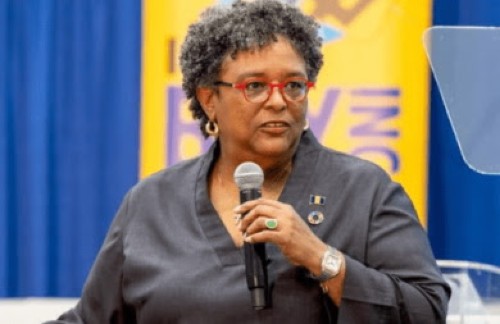 Prime Minister Mia Mottley addressing Barbadian producers and industry stakeholders (Prime Minister’s Office)“Barbadians have been satisfied to be consumers and not producers. That is not going to get us anywhere,” she said in an address that focused on reindustrialisation, export strategy, standards, financing and energy resilience.
Mottley said that Barbados could no longer be satisfied with being primarily a nation of consumers and that the country’s next phase of development must be built on a clearer commitment to producing more, exporting more and creating higher-value goods and services for regional and international markets.
She said the challenge was especially urgent in Barbados’ 60th year of Independence and fifth year as a Republic, noting that reindustrialisation would only be achieved if producers, policymakers and supporting institutions worked together in common purpose.
Mottley said that in 1960, Barbados exported approximately US$24 million in merchandise and imported US$49 million in goods. By 2024, however, exports stood at approximately US$461 million, while imports had risen to US$2.2 billion, noting that imports were now almost five times the level of exports.
Prime Minister Mottley identified six key areas that she said must guide the country’s industrial and productive agenda: developing an export mentality; using standards and regulation as a competitive advantage; changing the approach to financing and ownership; building energy resilience; committing to continuous retraining; and greening and digitalising industrial processes.
On the export agenda, she explained that Barbados’ small population could not provide the scale required for producers to grow sufficiently. Producers, therefore, had to see the Caribbean Community (CARICOM) Single Market and Economy (CSME), wider trade agreements, and international niche markets as part of the space in which Barbadian goods and services must compete.
She said small size could either become a limitation or an advantage. In her view, Barbados had to choose agility, nimbleness and higher value, rather than allowing small size to become what she described as a “mental noose”.
Prime Minister Mottley said standards were essential for market access and Barbados had to understand and apply standards in a practical way and also ensure that it was present at the table when standards and rules were being set internationally.
“Without standards, you are not going to have access to a lot of markets,” she said, adding that standards allowed producers to speak “the language of the market” arguing further that regulation should be treated not simply as a compliance issue, but as a potential competitive advantage for Barbadian companies.
On the issue of finance, Prime Minister Mottley said too many companies continued to depend almost exclusively on debt as their source of expansion capital, encouraging producers to examine other options, including equity and mezzanine capital, and added that the broader development of ownership was critical to protecting Barbadians’ relative economic position.
She said approximately BDS$15 billion are in domestic savings, earning very low returns, and that financial literacy, new investment structures and greater trust were necessary if local companies were to scale into stronger regional and global players.
A major part of the address focused on energy, which Prime Minister Mottley described as being to producers what oxygen is to human beings. She said affordable energy was central to production, competitiveness and industrial expansion, and that Barbados had a complex energy challenge due to its small population, high unit costs and vulnerability to the climate crisis.
She said that government had been meeting over recent weeks with stakeholders across the energy sector, including Barbados Light & Power, independent power producers, the Barbados Renewable Energy Association, the Fair Trading Commission, and objectors and interveners, to address the implications of global volatility and domestic energy costs.
Mottley said that the government had made a deliberate decision to cushion Barbadians where possible from the pace and intensity of rising energy costs, referring to measures outlined in the national budget including capping the value added tax (VAT) and the excise tax, as part of government’s effort to reduce the immediate pressure on consumers and producers.
Mottley said that when the current conflict began in the Middle East, oil was being sold at approximately US$64 per barrel, but is now being sold at US$109 per barrel, and that gasoline prices had increased by at least 40 US cents per litre in the United States, while in the United Kingdom gasoline had risen by about 34 US cents per litre and diesel by about 60 US cents per litre.
By comparison, she said Barbados’ latest increase was 28 Barbados cents, equivalent to 14 US cents, per litre.
Mottley said this reflected government’s policy decision to carry a greater share of the pressure in the short to medium term, with the country carrying about one-third of the weight and Government carrying about two-thirds.
She cautioned, however, that if global pressures continued for a longer period, the balance would have to be reconsidered, and consumers and producers would likely have to carry more of the cost over time.

