


BRIDGETOWN, Barbados – Prime Minister Mia Mottley has called on Barbados’ business community to help lead the country into a new phase of resilient and inclusive growth, adding that their investment decisions, leadership and treatment of workers will help determine whether the country can move beyond traditional levels of economic expansion.
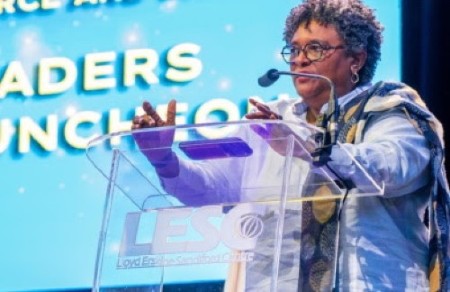 Prime Minister Mia Amor Mottley speaking at the Barbados Chamber of Commerce and Industry’s (BCCI) Legacy of Leaders Celebration (Office of the Prime Minister Photo)Addressing the Barbados Chamber of Commerce and Industry’s (BCCI) “Legacy of Leaders Celebration” Mottley linked the private sector organisation’s 200-year history to the choices now facing Barbados.
She recalled that the Chamber began in 1825 as the Commercial Hall, where the merchants of the day gathered, and said the modern private sector now had to use its reach for the wider national good.
“In this room lies the capacity for this country to determine where it wants to go. I have the honour of helping to pilot the ship, but you determine ultimately through your leadership and investment, through your skills, whether we are capable of moving to the next stage,” Mottley said, adding that Barbados had stabilised after the fiscal crisis and the global pandemic and was now recording “20 straight quarters of economic growth”.
She said that progress should not lead to comfort or complacency and that the task now is to raise the national ambition from the familiar two to three per cent growth range towards three to five per cent growth, while recognising the risks posed by natural disasters, geopolitical instability and external economic shocks.
She said resilience, innovation, productivity and competitiveness should be the hallmark of the next stage of development and that those ideas could not remain slogans or annual talking points.
“I want us to focus on those four because it’s not just a conversation. It has to translate to action, not individually either, but collectively.”
Mottley said on resilience, Barbados had to prepare more deliberately for climate risk, stronger storms and vulnerable housing patterns. She warned that a severe hurricane could create major losses within hours and said the national building code and new construction practices were essential to protecting lives, homes and economic stability.
“If you don’t know resilience in an island, you don’t know who you are because you can’t survive,” she said, connecting resilience to energy security and the cost of living, while also making reference to the ongoing international instability, including tensions affecting shipping and oil prices, could quickly place additional pressure on households and businesses.
Mottley said government’s role is to avoid sudden shocks where possible, while keeping the country’s finances responsible.
“We can withstand heavy showers, but we cannot withstand a deluge,” she noted, adding that there would be no return to unlimited subsidies, although “so long as we can carry it, we will help.”
The Prime Minister said the country’s renewable energy transition had to move faster, with the aim of reaching at least 50 per cent renewable energy by December 2027. She said a national task force had been working to remove regulatory obstacles, unlock investment and address the battery storage and generation issues needed to make the transition credible. She told the audience that this was not only an environmental agenda, but a national security, competitiveness and cost-of-living imperative.
Mottley also placed strong emphasis on ownership and enfranchisement, noting that Barbados had brought its debt-to-GDP ratio down from 177.5 per cent to 93 per cent, but still had to finance major public priorities, including health infrastructure, national security and roads.
She said that this required new investment vehicles and opportunities for Barbadians to earn better returns on domestic savings, rather than leaving billions of dollars in the banking system earning very little.
The Prime Minister made reference to the recently announced Trident Arrow Investment Fund as one example of the kind of vehicle that could allow ordinary Barbadians, Guyanese, institutional investors and private sector players to participate in large development opportunities.
She cited possible investments in port infrastructure, desalination, battery storage, renewable energy, cruise facilities, a new government headquarters and convention centre and other projects.
A major part of the address focused on productivity, competitiveness and the value of workers and Mottley said Barbados’ history required the country to find “a new way of seeing, hearing and engaging workers,” arguing that service, morale and national competitiveness were connected.
She told businesses that they could not build sustainable profits by treating labour costs as the enemy.
“Any business that tells me that they can’t make money because of their labour costs, I say to them, ‘You’re in the wrong business,’” she said, calling specifically for “a new deal for hotel workers”, while also stressing that service standards had to become world class.
She said hospitality workers remained central to the country’s tourism product and had to be treated as part of the engine of national growth.
Mottley challenged businesses to digitise, green their operations and invest continuously in training, while urging them to think beyond Barbados’ 166 square miles, noting that Barbados had already earned significant confidence internationally.
“We have the confidence in us from outside. I need the confidence in us from within,” she told the BCCI event.

