


KINGSTON, Jamaica – Nearly a year after the Category 5 hurricane Melissa slammed into Jamaica resulting in 45 deaths and an estimated US$12.2 billion in total losses, the government is saying that the country’s economy is improving significantly.
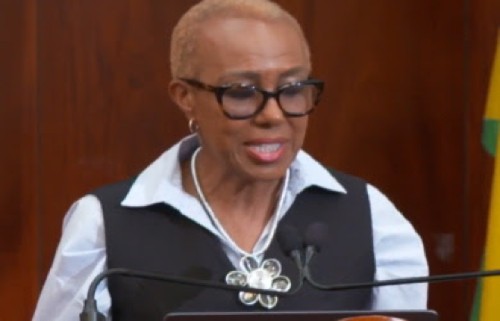 Finance and the Public Service Minister, Fayval Williams, speaking at the news conference on Wednesday (CMC Photo)Finance and the Public Service Minister, Fayval Williams, Wednesday told a news conference that based on what was projected right after the aftermath of Melissa relative to what’s happening now, “the recovery is on the way.
She told reporters 22 years ago, a storm like Melissa meant Jamaica would have had to enter into a programme with the International Monetary Fund (IMF), there would have been a run on the local currency and “a decade of austerity paid for by the people who had just lost their roofs.
“This year, it means a deficit that’s J$2.5 billion wider than planned. That is what the discipline of the last decade or more brought, is the ability to weather a storm. Yes, I’m going to say not everyone is back to where they were just yet, in terms of where they were before Melissa”
But she acknowledged that the numbers made public by the Planning Institute of Jamaica (PIOJ), the Statistical Institute of Jamaica (STATIN) and the Independent Fiscal Commission (IFC) point to an economy improving at a steady rate.
“We in government at the Ministry of Finance and the Public Service, we continue to ensure that we exercise that discipline that has worked so many times for us. And we will continue to manage the resources of the Jamaican people and to ensure that in their households, (18:12) that they begin to feel a recovery as well,” Williams told the news conference.
She said following the passage of the storm per cent, Jamaica was recording quarterly periods that were becoming less negative, adding “that is a good sign.
“And no, this is not a picture of a recession. The Planning Institute of Jamaica already debunked that motion. The shrinking year-on-year numbers are themselves proof that the economy is recovering.
“An economy in decline produces deepening figures, not improving ones. So let me just hasten to add that the negative 2.9 per cent is not yet settled by STATIN, whose final number will be in around by the end of September 2026.
“But the number I want you to take away is this one. In November of last year, right after the Category 5 Hurricane Melissa, the Planning Institute of Jamaica expected that Jamaica would not get back to its pre-Melissa level of output until the last quarter of 2028, three years down the road”.
But Williams told reporters that the PIOJ now expects “that we will begin to see growth in the second quarter of 2027, six quarters earlier, a year and a half earlier”.
She said that the PIOJ has been able to revise their forecast because the outturn keeps getting better and that for this financial year 2025-26, which ended March 31, 2026, the three headline measures, all came in better than projected.
“The fiscal deficit we projected right after Melissa, we projected that it would be a negative 3.8 per cent of GDP. It came in at negative 2.5 per cent, better by 1.3 percentage point. The primary surplus, which was projected to be 1.3 per cent, it came in at 2.3 per cent, a full percentage point better for fiscal year 2025-26, and the public debt, we had projected in the aftermath of Melissa that our debt to GDP would rise to 68.9 per cent, it came in at 65.6 per cent, 3.3 percentage points lower.”
Williams said that the numbers are not a one-off because they are based on improved numbers.
“The economy itself is bigger than we assumed, and that is a kind of improvement that will persist. Just so you know, these figures were scrutinised by the Independent Fiscal Commission, an entity with the legislative right to scrutinise the figures and put out their own assessment to the Jamaican people”
Williams said that the three major international rating agencies, -Fitch, Moody’s and Standard & Poor’s – have all looked through the Category 5 Hurricane Melissa, and have held positive ratings for Jamaica.
Williams acknowledge that while the national figures are encouraging, residents in the west of the cuntry who bore the brunt of the hurricane are not fully experiencing them.
“I want to assure them that this government continues to work night and day to restore the West, to restore roads, water, housing, all the services, employment, schools, and so on,” she said.
The Finance and Public Service Minister was also thankful to the Jamaican diaspora fr their financial contribution last year, emittances totalling US$296 million, the largest single month of remittances had been received according to the Bank of Jamaica (BoJ) records.
“In the three months after the storm, Jamaicans abroad sent home US$93 million more than they sent in the same three months a year earlier.
“So, I want to tie this back to the parishes, the five parishes that got hardest hit by Melissa. Remittances held or grew in every single one,” she said, adding that “Jamaicans abroad saw what happened at home, and they sent more.
“And so…I want to say to the diaspora who sent something home, and to the families who received it and made it stretch, thank you. You are part of this recovery, and the numbers prove it,” Williams said

