


Hurricane-Hit Communities in Jamaica Explore Recycling Debris During Cash-For-Work Clean-Up
KINGSTON, Jamaica – The trash from Hurricane Melissa, which slammed into Jamaica last October, is becoming valuable resources for homes and schools in two western communities as the circular economy emerges as a force for change during citizen-led cleanup efforts.
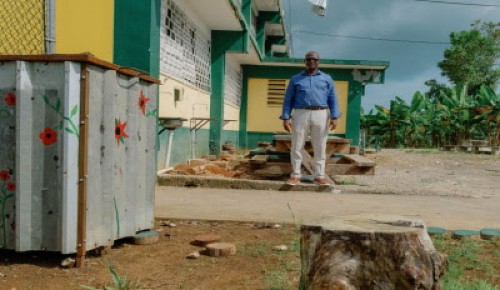 Rohan Green, Principal of the Petersfield High School poses on the school compound with a trash bin created from hurricane Melissa debrisThe United Nations Development Programme (UNDP) launched the Jamaica Resilient Recovery Initiative (JRRI) in November 2025 with an initial investment of US$2.4million of grants from the European Union, Australia AID, CARICOM Development Fund and UNDP’s core resources.
JARRI supports debris management collaborations; livelihoods recovery for SMEs led by women and persons with disabilities; community solar solutions and new roofing systems; Capacity development and establishment of Technical Assistance Centres (TACs) offering guidance and support on climate resilient build back better methods.
Now, residents of Petersfield in Westmoreland have converted damaged chairs, fallen trees and discarded zinc into garbage bins for the community and picnic tables for the Petersfield High School, partnering with 360 Recycling Manufacturing.
In Sawyers, Trelawny, residents created picnic tables from fallen trees, for a newly created community spot and recreational spaces, while lumber and zinc are being repurposed for home reconstruction in both communities.
Nearly 2000 tonnes of debris combined has been cleared in Petersfield and Savanna La Mar in Westmoreland; Sawyers in Trelawny and Salt Spring in St James, benefitting more than 19 000 residents across four communities.
“This programme was about much more than removing debris. It was about restoring access, reducing risks, creating opportunities, and helping communities regain a sense of hope and control over their future,” said UNDP Assistant Resident Representative, Lesley Ann Ennevor.
Speaking at the closing ceremony to publicly thank the residents, she said the communities’ achievements stand as evidence of what can be accomplished when communities, local organizations, donors, and development partners work together on a shared vision.
Ennevor also expressed appreciation to the CARICOM Development Fund (CDF) for its financial support noting that the support had enabled communities like Petersfield and Sawyers to take important steps toward restoring safety, dignity, and normalcy after the Hurricane.
Principal of the Petersfield High School, Rohan Green, said he was overjoyed when the team collected hurricane debris on the school compound in exchange for completed benches and garbage bins.
“Ever since those benches have been there, students have been using them daily” he said, adding that the recycled assets have helped facilitate group work while providing alternative learning spaces outside the classroom.
“The Cash for Work programme was very beneficial to the community. We were able to bring it back to what we know it was before. As a result, persons are now able to go to the shops; access their places of worship and collect water once again from the community catchment,” reported Christina Sinclair, Administrator with the Sawyers Forest Management Benevolent Society.
Residents also hailed the cash for work component of the programme that paid participants in the clean-up programme a living wage under an emergency employment modality.
“The Cash for Work income put me back on my feet reasonably with enough to purchase my own tools painting and carpentry,” said Gregory Anthony of Sawyers.
President of the Petersfield Galloway Benevolent Society, Norma Fenton, said residents were once afraid to walk in their community after Hurricane Melissa.
“But now it’s a new community because when you walk through, all the old zinc, the wires and all the debris, most of them, thank God, they are out,” she said.

