


Barbados' Government Outlines New Initiatives to Further Develop Energy Sector
BRIDGETOWN, Barbados – Barbados' government says it is advancing a major programme of battery energy storage, grid modernisation and regulatory reform as the country works towards achieving 50 per cent renewable energy penetration by the end of 2027.
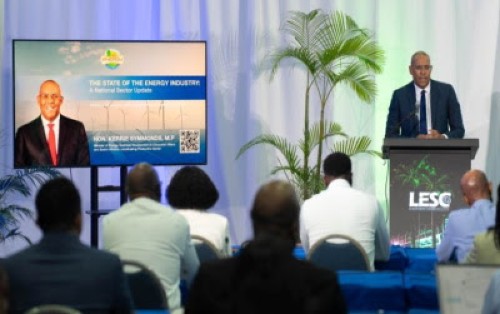 Minister of Energy, Business Development and Commerce, and Senior Minister with responsibility for the Productive Sector, Kerrie Symmonds, said Government was shifting its focus decisively from policy development to implementation following six National Energy Consultations. (Photo courtesy Ministry of Energy, Business Development and Commerce)In addition, Bridgetown has introduced an expedited licensing and grid-connection pathway aimed at bringing an estimated 33.1 megawatts (MW) of existing solar photovoltaic capacity fully onto Barbados’ electricity grid.
The new process gives priority to solar generation licensees whose systems are currently curtailed or have already been installed but remain unconnected, where those licensees are seeking to add battery energy storage.
Energy, Business Development and Commerce Minister, Kerrie Symmonds, providing an update on the national energy sector, said the Mia Mottley government was shifting its focus decisively from policy development to implementation following six national energy consultations.
“The consultations made one issue abundantly clear: Barbados does not suffer from a shortage of ideas or policy ambition. The principal challenge is implementation,” he said.
Technical assessments indicate that approximately 125 megawatts (MW) of battery energy storage capacity will be required to support the 2027 renewable energy target. With 60 MW already being advanced through a competitive procurement process, Government is moving to procure an additional 65 MW of battery storage capacity.
That programme will include 15 MW at the transmission level through a single project and 50 MW at the distribution level through multiple projects of approximately one to five MW along identified critical feeder lines.
Government is also proposing the establishment of Barbados Energy Special Purpose Vehicle Inc., which is intended to facilitate wider Barbadian participation in the ownership and investment opportunities associated with the storage programme.
Under the proposed structure, the principal project sponsor would retain 51 per cent, while up to 49 per cent of the economic interest could be made available to Barbadian investors, including credit unions, pension funds, insurance companies, the Barbados National Energy Company Limited and individual Barbadians.
Preparatory work on the additional 65 MW procurement has already begun with the procurement targeted for launch during the fourth quarter of 2026. The initiative forms part of a wider programme aimed at strengthening the electricity grid so that it can safely accommodate increased renewable generation.
The government said it is also supporting and facilitating the advancement and deployment of critical technologies and systems, including synchronous condensers, Distributed Energy Resource Management Systems (DERMS), Automatic Governor Control (AGC), modernised interconnection arrangements, and grid-forming battery energy storage. These investments will strengthen grid stability, resilience and flexibility, while enabling Barbados to safely accommodate increasing levels of renewable energy.
The Barbados Light & Power Company has also been formally instructed to commence the process of updating the Integrated Resource and Resilience Plan, which will help guide future decisions on Barbados’ energy generation mix, grid requirements and resilience. The updated plan is expected to consider solar and wind alongside battery storage, biomass, hydrogen, waste-to-energy, pumped storage and marine renewable technologies.
To oversee the legal and commercial arrangements, technical requirements, tariffs and regulation, and coordination between the Ministry and the Fair Trading Commission, the Government has also established four committees.
Symmonds noted that these interventions are necessary to ensure Barbados’ renewable energy ambitions are delivered in a manner that is technically sound, financially sustainable and affordable to consumers.
“We therefore have to balance three imperatives: energy security, investment and affordability. None can be ignored,” he said, adding that efforts to improve the speed and predictability of regulatory decision-making are intended to support faster implementation of national energy priorities, while preserving the role of the Fair Trading Commission.
“Put simply, we are seeking to remove unnecessary procedural uncertainty, not to remove regulatory oversight,” he said, noting that the need to accelerate implementation has taken on greater urgency amid continued volatility in global energy markets.
Symmonds said that as a country that imports virtually all of its fossil fuels, Barbados remains exposed to international price shocks and their wider impact on electricity costs, transportation and the cost of living.
“We cannot control geopolitical events, but we can strengthen our resilience to their consequences,” he said, noting that against this backdrop, government is maintaining its target of 50 per cent renewable energy penetration by 2027, while considering a further target of approximately 70 per cent by 2029.
Symmonds said the combination of expanded battery storage, grid modernisation, regulatory reform and stronger implementation structures is intended to ensure those targets translate into greater energy security for Barbados.
“We will continue to move from consultation to implementation, from policy to delivery, and from energy vulnerability to greater energy security and resilience.”
Meanwhile, Symmonds has acknowledged the financial impact on individuals and businesses that had invested in renewable energy projects but were unable to realise the full benefit of those investments.
“I want these licensees to know, in the clearest possible terms, that they have not been forgotten, and that a structured, prioritised, and time-bound process now exists to bring their investments fully online,” he said.
Under the new priority system, licensed and installed generation systems that are currently being curtailed and propose to add storage will be considered first. They will be followed by licensed and installed systems in areas of high renewable energy penetration that are not yet connected and propose to add storage, and then other licensed and installed systems awaiting connection.
According to Symmonds, this approach is intended to protect investments already made before additional capacity is brought onto the public grid.
“This is a deliberate policy choice by this Government to protect and unlock existing investment before further capacity is added to the public grid,” he said.
Applications will be processed through the Ministry’s online portal and will undergo administrative, technical, grid and – where required – financial review, before consideration by the Electricity Advisory Committee and a ministerial decision.
Successful applicants will retain their priority position through both the licensing and grid-connection stages.
The Ministry has also established milestones covering an eight-month period between licensing and interconnection, including the signing of a Power Purchase Agreement, procurement and delivery of the battery system, installation and commissioning.
Licensees will be required to provide status reports to allow the Ministry to identify projects that may be falling behind and provide appropriate support.
“This is not a vague assurance of goodwill. It is a published, auditable, milestone-driven process, with named institutional actors, a fixed timeframe, and a clear point of entry for every existing solar licensee who is curtailed or unconnected today,” Symmonds said.
He noted that the expedited pathway is intended not only to restore the value of existing solar investments, but also to strengthen the stability of the national grid and create the conditions for further renewable energy development.
He also reaffirmed the government’s commitment to ensuring that the country’s transition to renewable energy is safe, orderly and fair.
“This government remains firmly committed to Barbados’ transition to a renewable energy future under the Barbados National Energy Policy. That transition must, however, be a safe, orderly, and just one, in which no investor is left permanently stranded and no ratepayer bears an unfair burden.”

