


NASSAU, Bahamas – The main opposition Free National Movement (FNM) is calling on the Bahamas government to make public the agreement signed with Ghana allowing for the African country to send 300 teachers this year to the Caribbean Community (CARICOM) country.
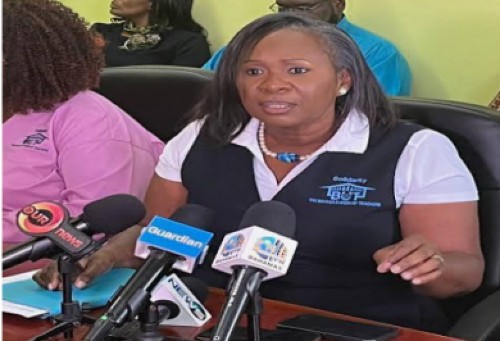 BUT president Belinda Wilson (File Photo)In addition, the president of the Bahamas Union of Teachers(BUT), Belinda Wilson, is questioning how the government was able to negotiate the recruitment of the African teachers in “minutes” while it is unable to reach an agreement for salary increases for its members despite ongoing negotiations for nearly a year.
Ghana’s Foreign Affairs Minister, Samuel Okudzeto Ablakwa, in a statement posted on Facebook said that the deployment of the teachers had been negotiated during his visit to The Bahamas for the country’s 53rd Independence Anniversary celebrations last week.
“This will be the first phase of a new cooperation in education,” he said.
Deputy Prime Minister and Minister of Education Chester Cooper in a statement, described the proposal as a “generous offer of cooperation” from Ghana as the Ministry of Education grapples with a shortage of roughly the same number.
He confirmed that officials held direct discussions with Ablakwa during the Independence celebrations to advance the initiative, but stressed that Bahamians would receive first priority for all vacancies.
However, the FNM’s Shadow minister of education Shanendon Cartwright has since called on the government to fully disclose the terms of the agreement including salaries.
“The Bahamian people deserve answers,” Cartwright said in a statemen, adding “the government must fully explain terms of the agreement: What is the scope? For which subjects and islands? What is the duration?
“What are the qualification requirements? Who is doing the vetting? Are they meeting Ministry of Education and Bahamas Union of Teachers standards?
“What are the costs for travel, housing, work permits, and salaries? Is this cheaper or better than training and hiring Bahamian teachers? What consultation was done with the Bahamas Union of Teachers? What housing, orientation, and support will be provided for incoming teachers?”
Cartwright said that Bahamians have a right to know how decisions affecting the classrooms and their children are made.
“Vague statements and social media posted are not enough. The Minister of Education must come to the public with a full disclosure. We call for respect for Bahamian teachers. It starts with transparency.”
But Cooper said in his statement that the ministry currently faces a shortfall of approximately 300 teachers and that “this is compounded by retirements, contract expirations, and the expansion of specialized areas such as special education, technology, financial literacy, digital literacy, and entrepreneurship studies.
“To address this urgent need, we established a multi-agency Task Force comprising the Ministry of Foreign Affairs, the Ministry of Public Service, the Department of Labor, the Royal Bahamas Police Force, and the National Accreditation and Equivalency Council of the Bahamas (NAECOB).
“The taskforce is actively implementing strategies to attract Bahamian educators, including recently retired teachers, recent graduates, and those who previously left the profession and now desire to return. In keeping with government policy, Bahamians will be given first priority to fill all vacancies.”
Wilson is questioning why the BUT learnt of the proposed recruitment through a Ghanaian official, saying “this is egregious and highly offensive to the hard-working, dedicated teachers of The Bahamas”.
She accused the Philip Davis government of moving much more swiftly in talks over foreign teachers than in negotiations over salaries and outstanding payments for Bahamian educators.
She said hundreds of teachers were awaiting money owed to them, including rent allowances, while some who have graduated from the University of The Bahamas in 2025 are still waiting to be hired by the ministry.
“All we get are excuses,” she said.

