


SANTIAGO, Chile - The Economic Commission for Latin America and the Caribbean (ECLAC) says tax revenues rose in more than half of the countries in Latin America and the Caribbean (LAC) in 2024, with the largest gains occurring in those that implemented major tax reforms.
 “Revenue Statistics in Latin America and the Caribbean 2026,” is a joint publication by the Inter-American Center of Tax Administrations (CIAT), the Inter-American Development Bank (IDB), ECLAC, and the Organisation for Economic Co-operation and Development (OECD) Centre for Tax Policy and Administration and Development Centre.
In a report, ECLAC said tax revenues rose as a share of gross domestic product (GDP) in 15 of the 28 countries in the LAC region included in the report and declined in 13.
The largest increases were observed in Antigua and Barbuda 1.9 percentage points(pp), Brazil (two percentage points), Barbados (2.1pp) and Cuba (five percentage points).
“Each of these countries recently introduced major tax reforms, which increased revenues from taxes on goods and services – Brazil, Cuba, and Antigua and Barbuda – and from corporate income tax – Barbados and Brazil.
The two largest declines in the tax-to-GDP ratio were mainly due to economic factors. In Trinidad and Tobago, lower energy prices and declining natural gas production contributed to a fall of three percentage points, while in Guyana strong economic growth outpaced increases in tax revenues, resulting in a fall of 2.4 pp
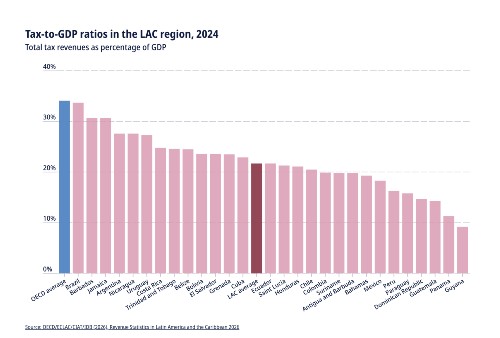
The report shows that tax-to-GDP ratios in the LAC region ranged from 9.2 per cent in Guyana to 33.7 per cent in Brazil in 2024, with a regional average of 21.7per cent, an increase of 0.2 pp from the previous year. Excluding Cuba, the average was unchanged from the previous year as slow economic growth and volatile commodity prices weighed on revenues.
Taxes on goods and services continue to represent the largest part of the tax mix in many LAC countries, with a lower contribution from income taxes and social security contributions than in OECD countries.
In 2024, taxes on goods and services accounted for 49.2 per cent of total tax revenues on average across the LAC region, driven largely by value-added tax (VAT) estimated at 28.9 per cent of revenues).
Taxes on income and profits generated 29.1 per cent of total revenues – 17.4 per cent from corporate income tax and 9.6 per cent from personal income taxes – and social security contributions accounted for 15.9 per cent.
Looking further back, the average tax-to-GDP ratio for the LAC region rose by 1.pp between 2014 and 2024, largely due to increases in revenues from VAT and from taxes on income and profits.
Over this period, tax revenues rose as a share of GDP in 21 LAC countries and declined in seven. Tax revenues per capita increased in all countries, more than doubling in the Dominican Republic, Nicaragua and Guyana in pp terms.
The difference between the LAC average tax-to-GDP ratio and the average for OECD countries has narrowed only slightly over the past decade. The OECD average tax-to-GDP ratio rose by 1.2 pp between 2014 and 2024, reducing the gap with the LAC average to 12.3 pp in 2024.
The report shows how fiscal revenues in some of the largest economies in the LAC region are significantly affected by fluctuations in commodity prices.
Amid strong volatility in oil and gas markets, average hydrocarbon revenues among major producers fell to 3.1 per cent of GDP in 2024 from 4.1 per cent of GDP in 2023. Decreases in Colombia and Trinidad and Tobago drove the overall decline, which was partly offset by higher oil revenues in Guyana.
Meanwhile, revenues from mining fell from 0.55 per cent of GDP in 2023 to 0.47 per cent of GDP in 2024, largely due to a sharp drop in tax revenues in Colombia.
In 2025, oil and gas revenues are projected to have fallen to three per cent of GDP due to a sharp decline in hydrocarbon prices, while mining revenues are estimated to have risen to 0.63 per cent of GDP, supported by exceptional increases in the price of gold, silver and, to a lesser extent, copper.

