


KINGSTOWN, St. Vincent – Prime Minister Godwin Friday says his New Democratic Party (NDP) government is exploring ways to ease the pressure the EC$3.1 billion national debt placed on government finances.
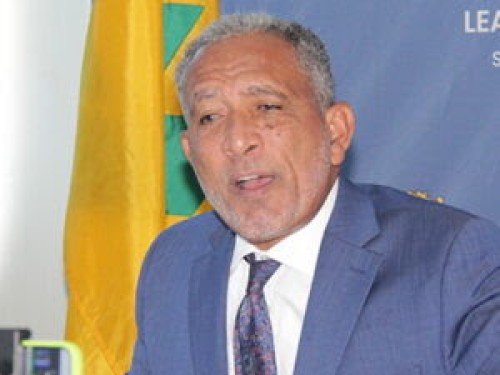 Prime Minister Godwin FridayFriday, who is also the minister of finance, disclosed the size of the national debt in radio interviews this week, adding that he was still reviewing information on the nation’s fiscal situation, three weeks after the NDP was voted into office.
Friday spoke about the national debt in an interview on Hot 97 on Tuesday and also addressed the topic during a similar appearance on Boom FM on Wednesday — Christmas Eve.
He said despite the fiscal situation, his government will honour the promises it made to citizens during the campaign for the Nov. 27 general election, reiterating that a salary bonus will be paid in January.
“I’m not going to use that as an excuse because you will not get an excuse, because I will honour those pledges,” the prime minister said.
He said the budget that he will bring to Parliament in January will increase public assistance to EC$500, as the NDP had also promised in the campaign.
Social welfare recipients will begin receiving that amount from February.
Asked where the money will come from, the prime minister said, “You let me worry about that.”
He noted that the Ministry of Finance has not had to prepare a transition document on the state of the economy for a new government in 25 years.
“So, they prepared that, to me, it’s a fairly thick document, and I’m working my way through it,” the prime minister said on Hot 97.
Friday became prime minister on Nov. 28, one day after the NDP won 14 of the 15 parliamentary seats, with the remaining one going to the Unity Labour Party (ULP), which had been governing the country since March 2001.
Friday said there are some things that his party knew about government finances.
“.. we knew that the government finances are tight. You have a debt now that is over $3 billion … $3.1 billion in public debt.”
The prime minister said a lot of the debt is to countries, some is owed to the Caribbean Development Bank CDB and other parts are financial instruments that had been floated to be able to pay for certain things.
He said there are payables that the government had not been honouring to local businesses.
“And it’s quite a lot …” he said, adding that while he had the figure, he did not want to disclose it as yet.
“… I have to remember that I’m not in opposition,” said Friday, who served as opposition leader from November 2016 to November 2025.
“I’m not here to expose and depose. … I want the people in my office — they are very capable people — to do their job without feeling that they’re in a fishbowl and that they can’t trust the prime minister with certain information,” Friday said.
“… the point of the matter is we are looking very carefully at what the financial status of the country is. We knew before going into government that things were difficult.
“What we didn’t know is how difficult they were. But as I say, that is something that was not outside my expectations.”
Asked how bad, on a scale of one to 10, the economy was, the prime minister said, “eleven.”
He said the government has not appointed auditors to look into government financing, as they are trying to get a sense of the situation.
The prime minister said his cabinet is going through the process of assessing wastage in government.
“There are individual things we could see from when we were outside,” he said.
The prime minister said the NDP had cutting wastage in mind when it announced during the election campaign that an NDP government would pay EC$500 to fmailies on the birth of a child.
“And people said, ‘Oh, where you go get the money from?’ Well, what it costs to do the baby bonus for one year is what they spent on the Emancipation cricket tournament,” he said, referring to the cricket festival that the ULP administration held in August.
“But the point was that if you put those money where they’re supposed to go, then people benefit, and it doesn’t cost anything more,” Friday said.
Meanwhile, in his interview on Boom FM, the prime minister said the size of the national debt means that one-third of the money that the government collects goes to debt servicing.
To illustrate, he said that if someone borrows EC$50,000 to buy a minivan, they don’t want to pay it back by borrowing from friends.
“’Cause if you’re borrowing to pay back your loan, then you’re digging a deeper hole for yourself…
“It applies the same way that you have to pay from what you earn. We have not been able to do that. And so, what’s been happening is that a big chunk of the money that we earn, more than a third of it, goes just to service debt , and very often we don’t have that because you have to meet other obligations. You have to pay health care, to pay for education and fix the potholes in the road …”
The prime minister said the government has to find ways to tighten up the financing of development projects.
“… to find ways in which to make savings and to also be more efficient and also to stabilise the situation going forward as we invest in growing the economy.”
He, however, said this does not mean “banding yo’ belly” as the host of the show suggested.
“Well, I wouldn’t use that language. The point of the matter is, I’m bringing hope to people. What I’m saying, what I want to do is that we are going to be focused on essentially running government, the finances of government, in the way that it was designed to be done.”
He said the ULP administration did things that seemed expedient or convenient and justified it by saying it was being done in the interest of the poor.
“The point of the matter is that if you are serving poor people, you don’t get yourself in a situation where, instead of paying debt at 3 and 4% interest, you’re borrowing, or you’re doing overdrafts and so forth that you’re borrowing, or you’re paying back at 8% interest. That takes money away from what you can do to help people.”
Friday said the NDP has complained for years about the government ignoring the guardrails that govern how government finances should be managed.
He said it might take the NDP government some time to correct the situation but it is committed to doing so.
“… because it is part of good governance. People look at us from the outside and say, ‘These guys are serious about running the country properly.’
“And then, also for the ordinary folk here, the ordinary people in the country, it benefits them more because it means that government revenue, the fiscal position of government, is basically sounder.
“And you don’t have this situation where you always have to be borrowing and borrowing and borrowing and borrowing at expensive rates that create hardship for people,” the prime minister said.

