


PORT OF SPAIN, Trinidad - The US oil and energy giant, ExxonMobil has been granted an environmental clearance from the Environmental Management Authority (EMA) for a major seismic survey off the east coast.
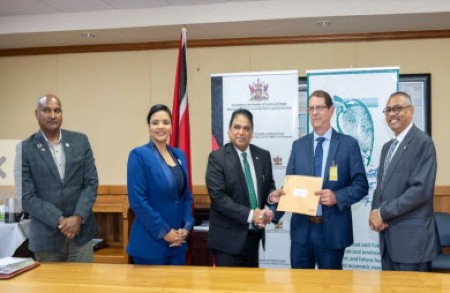 Energy Minister Dr Roodal Moonilal, third from left, hands over the Certificate of Environmental Clearance (CEC) to local advisor Alex Almandoz, the in-country representative for ExxonMobil on Monday.The EMA issued the Certificate of Environmental Clearance (CEC) to ExxonMobil Trinidad and Tobago Deepwater Ltd (ExxonMobil) for the conduct of a three-dimensional seismic survey with a total area of 8,825 square kilometres within Block TTUD-1, located off Trinidad’s east coast.
“This approval marks a significant milestone, as it is the first CEC issued for activities related to the exploration for hydrocarbon resources within the ultra-deepwater marine area, and is the second CEC issued for the offshore exploration for oil and gas under the newly appointed board of directors,” the Ministry of Planning said in a statement.
“This approval was granted well within the EMA’s statutory timeframe, underscoring the Authority’s commitment to efficient, transparent, and timely decision-making processes,” it added.
TTUD-1, a combination of seven blocks east of TT, spans beyond TT’s 5,128km surface area at 7,165 square km and is set to cost Exxon US$42.5 million in the first phase.
Per the block’s product-sharing contract, development cost is estimated at between US$16.4 billion and US$21.7 billion, with the potential to bring over US$21.7 billion in investment.
This was attributed to advancements in technology, which have expanded the depths of drilling capabilities with the design of drill ships, semi-submersibles and other high-pressure temperature technologies, addressing many of the issues in deep-water exploration.
ExxonMobil’s agreement covers the drilling of two exploration wells, with one well in each of the optional second and third phases of the exploration period. The company also agreed to administrative charges, minimum payment, training contributions, research and development contributions, technical assistance, equipment bonus as well as scholarships.
The CEC was handed to local advisor Alex Almandoz, the in-country representative for ExxonMobil, and Planning Minister, Kennedy Swaratsingh, told the ceremony on Monday that the ministry was focused on balancing development opportunities with environmental sustainability.
EMA’s deputy chairman Neeala Mongroo said the CEC marked an important milestone for Trinidad and Tobago as it is the first CEC granted for exploration activity in the country’s ultra-deepwater marine environment.
“The EMA undertook a thorough, science-based and transparent assessment process, supported by inter-agency collaboration and detailed technical review. This decision reflects careful consideration of environmental protection, regulatory compliance, and national development priorities.
“The EMA remains committed to strong oversight and ongoing monitoring to ensure that all approved activities are conducted in strict accordance with the conditions of the certificate and the laws of Trinidad and Tobago,” she said, adding “advancing sustainable development while safeguarding the nation’s environment remains a central priority of the new board of directors, which is focused on improving the efficiency of regulatory processes”.
Energy Minister Dr Roodal Moonilal, said while ExxonMobil’s return to Trinidad and Tobago could be part of reshaping the country’s economic future, the slow pace of project processes is costing it billions of dollars in revenue.
He told reporters that since ExxonMobil’s return, the Trinidad and Tobago government has worked with other major oil companies, paying particular attention to fast-tracking TTUD-1 development.
“Data that came to me very early suggested that if we just take decisions faster, we can actually earn, as a country, US$120 million per year…Our ministry works across the board with 16 other state agencies and ministries for licenses for approvals, amendments, legal orders and so on, so there is an enormous amount of co-ordination that we do,” he said.
“One of the problems over the years that we have heard of is related to the EMA and the length of time some of these processes take. So, this morning, we are particularly pleased that we can sign a production-sharing contract in August and before the end of December, we can be here to collect our CEC…We have enormous other matters before us that will require fast pace.”
Moonilal said to encourage this, the ministry is developing an energy hub to ease logistical processes in the secto and that with Cabinet approval, the hub will include entities within and outside of the ministry.
“This will co-ordinate the problems and complaints in real time to sort out some of the problems that we face. The energy sector has a myriad of challenges: it could be a lease operator on land waiting too long for a particular bureaucratic process to take place; it can be an international oil and gas company waiting a long time for legal matters to be sought out…for example, work permits.
“It will shock you to know that whether you are cooking at a restaurant or you are the president of BP or Shell, you still need to line up and get your permit,” Moonilal said, adding “those things take time, and that creates a problem along the way”.

